Why Night Capability Matters on the Modern Battlefield
A large share of military operations takes place at night. That is why night capability — for surveillance, search, target recognition and navigation — is a core requirement in armoured vehicle and mobile platform design. Military searchlight (projector) systems are one of the building blocks of this capability.
A modern military searchlight is not merely "a device that produces light at night". It is a subsystem in which the light source, optics, movement mechanism, control and diagnostics, and environmental durability are designed together. In this guide we first cover the mounting classes of searchlights, then the difference between visible and infrared (IR) illumination, the 940 nm and 850 nm wavelengths, and NVG compatibility in general terms. In the final section we explain where the TEDEG T-Light TWR — a visible-light LED searchlight — fits into this picture, using the product's actual technical data.
Searchlight Mounting Classes — Fixed, Pan-Tilt, Turret-Integrated and Stabilised
Military searchlights fall into four main classes by mounting and movement:
- Fixed mount — Locked in one direction, with no horizontal or vertical adjustment. Used at static points such as border outposts and observation towers.
- Motorised pan-tilt — A standalone unit with its own horizontal and vertical movement mechanism, steered remotely by the operator.
- Weapon turret-integrated — The searchlight takes its horizontal movement from the weapon turret it is attached to and drives its vertical axis with its own mechanism. The beam stays aligned with the direction the turret is facing.
- Stabilised mount — Systems that compensate for platform motion. Preferred particularly on naval platforms to keep the beam on target.
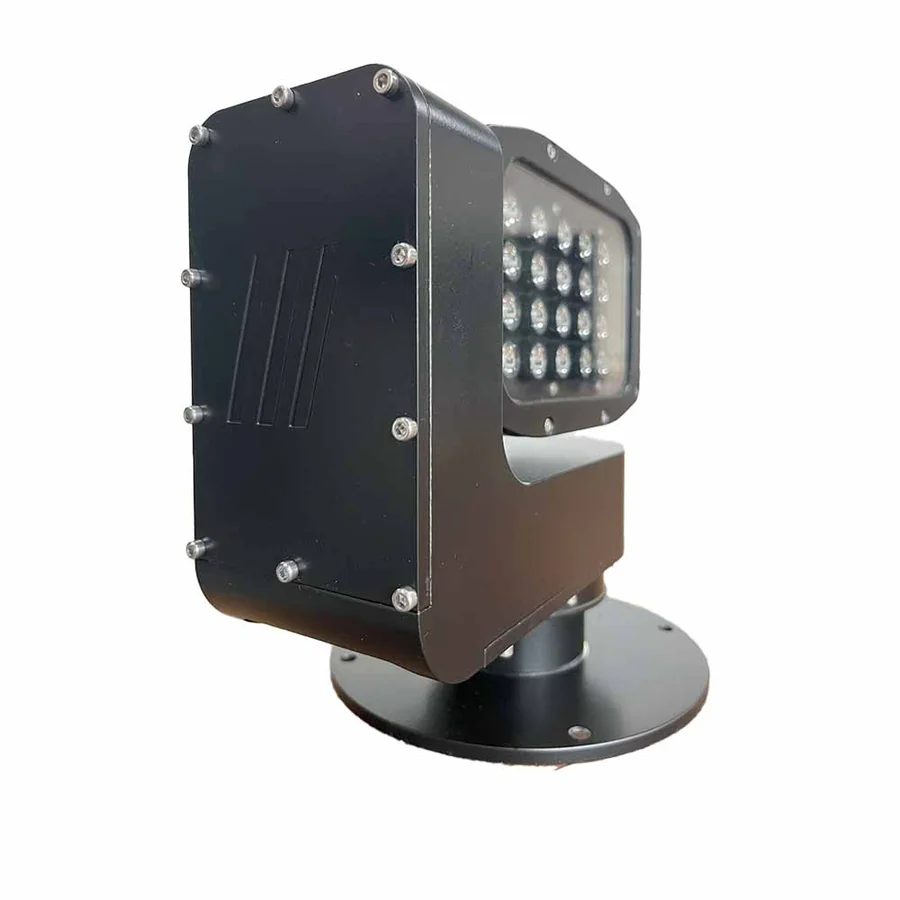
The TEDEG T-Light TWR belongs to the turret-integrated class: it turns through unlimited 360° horizontally with the weapon turret and moves 135° vertically with its own mechanism (+90° / −45° or symmetrical, depending on configuration).
Visible Light or Infrared? Two Different Mission Profiles
The first decision in searchlight selection is who is meant to see the light.
Visible-light searchlights illuminate for the human eye and standard daylight cameras. They deliver direct results in long-range search, target recognition, lighting a working area, checkpoints and rescue tasks. The trade-off is that a platform with its searchlight on is easy for the other side to spot.
Infrared (IR) illuminators emit in the near-infrared (NIR) band. This light is invisible or only faintly visible to the naked eye; it lights the scene for operators using night-vision goggles (NVGs) or NIR-sensitive cameras. The aim is surveillance without giving away the platform's position.
The two approaches are complementary rather than alternatives. On many platforms a visible-light searchlight and an IR illuminator are planned together as separate units. The TEDEG T-Light TWR is a visible-light searchlight: it produces light at a colour temperature of 6000–6500 K from 20 high-power white LEDs; it is not an IR illuminator.
940 nm IR vs 850 nm IR — A General Comparison
The most debated topic in IR illumination is the choice of wavelength. Both wavelengths fall in the near-infrared band and are detected by night-vision devices, but they strike a different balance between discretion and range:
850 nm IR
- LED sourcing is more widespread
- Closer to the visible spectrum — looking at the source, a faint red glow can be seen with the naked eye
- Image-intensifier tubes and silicon sensors are more sensitive in this band, giving longer effective range for the same power
940 nm IR
- Further from the visible spectrum; the source is practically imperceptible to the naked eye
- Night-vision devices are less sensitive in this band, so more optical power is needed for the same range
- Preferred for missions where discretion comes before range
Operational consequence: 850 nm has the edge in range, 940 nm in discretion. The right choice depends on the mission's need for concealment and on the spectral response of the night-vision devices in the inventory.
NVG Generations and IR Wavelength Compatibility
Military night-vision goggles generally fall into three generations:
- Gen-I — First-generation image intensifiers; largely superseded in military use because of low gain and noticeable image distortion
- Gen-II — The generation that raised gain and resolution with a microchannel plate (MCP)
- Gen-III — Uses a gallium arsenide (GaAs) photocathode for higher sensitivity, particularly in low light and in the near-infrared band
Each generation — indeed each tube model — has its own spectral response curve. For an IR illuminator to be considered "NVG-compatible", its wavelength should therefore be assessed against the response curve of the goggles that will be used, and ideally trialled together in the field.
Care is also needed when a visible-light searchlight is operated in the same area as NVG-equipped troops: a powerful white beam can briefly degrade the vision of personnel wearing goggles. Being able to switch the searchlight on and off quickly and to steer the beam in a controlled way matters for this reason. The T-Light TWR controller has separate on/off buttons for the white light and for the searchlight.
Dual-Mode (Visible + IR) Systems
Some searchlights combine visible and IR LEDs in a single housing. This approach offers:
- Visible mode — open surveillance, navigation, area lighting, search and rescue
- IR mode — covert surveillance and tracking with NVG-equipped operators
- A single mounting point — one housing instead of two separate units
On the other hand, in a dual-mode housing both light sources share the same optical volume and thermal budget, which can limit the output achievable in each mode. Where visible-light performance is the priority, a dedicated visible-light searchlight, accompanied by a separate IR illuminator on platforms that need IR, is an equally valid architecture.
Optical Performance — Luminous Flux, Lens Angle and Colour Temperature
The figure most searchlight catalogues highlight is total luminous flux in lumens. Range, however, is determined not by lumens alone but by how tightly that light is concentrated into a beam:
- Total luminous flux (lm): The total visible light produced by the source
- Lens (beam) angle: A narrow angle throws light further; a wide angle lights a broader sector. The angle is usually given as FWHM (the point where luminous intensity falls to half)
- Colour temperature (K) and CRI: Cool white light increases contrast; CRI indicates how accurately colours can be distinguished
In the T-Light TWR, the 20 LEDs deliver a total luminous flux of 4,590 lm (±10%). The system is ordered either as the narrow-beam long-range version with a 10° lens (TL-TWR-20W-10-135) or as the wide-area version with a 15° lens (TL-TWR-20W-15-135). Colour temperature is 6000–6500 K and CRI is ≥ 70.
Environmental Durability — IP Rating, Temperature and Standards
A civilian LED projector may look similar in a catalogue, but military field conditions are very different from a controlled environment. When assessing a military searchlight, look at the following:
- IP protection class — IP67 and IP68 define dust-tightness and resistance to immersion (IP67: 1 m depth for 30 minutes; IP68: a more severe immersion condition specified by the manufacturer). IP69K adds resistance to high-pressure, high-temperature wash-down; it is meaningful for vehicle equipment that works in mud and dust and is cleaned with pressurised water.
- Operating temperature — Should cover the whole mission profile, from winter conditions to desert heat.
- Vibration and shock — A vehicle produces continuous vibration, and weapon firing produces shock loads. This durability is usually verified with MIL-STD-810 test methods.
- Electromagnetic compatibility — The searchlight's driver electronics must not interfere with the vehicle's radios and mission systems; this is usually assessed under MIL-STD-461.
Which standard, and which revision, is required varies by programme; the specification and the product documentation should be checked together.
On the T-Light TWR, the projector unit is rated IP69K and the remote control unit IP65; the operating temperature is −32 °C … +60 °C.
Movement, Control and Diagnostics
A movable searchlight is not judged on light alone. The following parameters stand out in an assessment:
- Range and speed of movement — for fast transitions between targets
- Position accuracy and mechanical backlash — to hold the beam steadily on target and allow fine adjustment
- Calibration — keeping the movement axis accurate by returning to a reference (home) position
- Built-in test (BIT) — immediate reporting of faults to the operator
- Control interface — a dedicated control unit, or integration with the commander's display over the vehicle data bus
The T-Light TWR is operated from an IP65 remote control unit. The controller carries a power LED, vertical movement buttons, a BIT and error LED, white light on/off, projector on/off and a home button. The BIT system detects faults and signals them through the error LED on the controller; the home button is used for continuous calibration of the searchlight.
Typical Platform Applications
Military searchlight systems serve the following platforms:
- Main battle tanks — night search and target recognition
- Armoured fighting vehicles and vehicles carrying weapon turrets — lighting that points with the turret
- MRAP and patrol vehicles — border patrol, checkpoints, route security
- Naval platforms — night navigation, coastal surveillance, berthing and search and rescue
- Border outposts — continuous surveillance from fixed or semi-fixed installations
- Mobile command-and-control vehicles — perimeter security lighting
Platform-Specific Searchlight Selection — Land, Sea and Fixed Sites
The same searchlight does not perform equally on every platform. The right choice is platform-specific:
Armoured land vehicles (MBT, IFV, APC, MRAP)
- Priorities: Vibration and shock resistance, low weight, a supply compatible with the vehicle network, and pointing aligned with the turret or the commander's sight
- Mounting: On the turret or inside a protected housing, with a low profile
- TEDEG T-Light TWR: Weapon turret-integrated; unlimited 360° horizontally with the turret and 135° vertical travel. ~3.7 kg system weight, a Ø 156.8 mm round flange and 4 × M6 fixings. The 16–33 VDC input range covers the 24/28 VDC vehicle network; typical consumption is 50 W, maximum 60 W.
Naval platforms (ships, fast attack craft, patrol boats)
- Priorities: Salt-fog and corrosion resistance, high humidity, stabilised mounting, narrow and wide beam options
- Mounting: Mast-top, bridge-top or on the superstructure
- Note: For the marine environment, salt-fog and corrosion test results should be looked for separately in the product documentation.
Border outposts and fixed platforms
- Priorities: Long duty periods, high reliability, low maintenance and long LED life
- Mounting: Tower or mast-top, with a fixed power supply
- Note: An L70 rating for LED life is the time until luminous flux falls to 70% of its initial value; compare products on the same basis. For the T-Light TWR this is rated at ≥ 50,000 hours (L70).
Maintenance and Total Cost of Ownership (TCO)
The real cost of a searchlight is not just its purchase price. The following items should also be accounted for across the life cycle:
- Integration — mounting, cabling and connecting the control interface to the platform
- Maintenance — seal checks, cleaning of the front glass and optics, calibration of the movement mechanism
- Spare parts — LED module, front glass, movement mechanism parts
- Training — for operators and maintenance personnel
Long LED life, a high IP rating and built-in test (BIT) directly affect some of these items: a well-sealed housing needs less maintenance, and BIT shortens fault-finding. Working with a domestic manufacturer also keeps the point of contact for technical support, documentation and spare parts within Türkiye.
Comparison — Searchlight Classes
| Category | Fixed LED spot | Visible-light searchlight (turret-integrated / pan-tilt) | IR illuminator | Dual-mode searchlight |
|---|---|---|---|---|
| Light | Visible | Visible | Near-infrared | Visible + IR |
| Covert use with NVGs | No | No | Yes | Yes (in IR mode) |
| Pointing | Usually fixed | Remotely controlled | Fixed or movable | Remotely controlled |
| Typical task | Area lighting | Long-range search, target recognition | Covert surveillance | Both tasks |
| Operational discretion | Low | Low | High | High (in IR mode) |
Takeaway: There is no single "best" class; the choice follows the mission profile. Open search and target recognition call for a powerful, narrow-beam visible-light searchlight, while covert surveillance calls for an IR illuminator. The TEDEG T-Light TWR sits in the turret-integrated visible-light searchlight class.
The TEDEG T-Light TWR Advantage
The TEDEG T-Light TWR is a visible-light LED searchlight designed for integration into weapon turrets. Its key data are:
- 20 × 3 W high-power white LEDs (4 × 5 matrix), 4,590 lm (±10%) total luminous flux
- 10° (long-range) or 15° (wide-area) lens option — TL-TWR-20W-10-135 / TL-TWR-20W-15-135
- Unlimited 360° horizontal movement with the turret, 135° vertical travel
- 16–33 VDC input, 50 W typical / 60 W maximum consumption
- IP69K projector, IP65 remote control unit
- −32 °C … +60 °C operating temperature
- ~3.7 kg system weight, anodised aluminium alloy body
- BIT fault reporting and calibration via the home button
- ≥ 50,000 hours (L70) LED lifetime
Taking horizontal movement directly from the turret keeps the beam aligned with the direction the weapon is facing, and the lens choice made at the ordering stage matches the product to the mission profile.
For high-mast area lighting independent of the turret, see the T-Light Mobile Lighting Tower; for audible and visual warning, see the T-Light Programmable Warning Unit. All of these solutions are listed in the Tactical Systems category.
Corporate assurance: TEDEG Defence is an approved supplier of ASELSAN, Roketsan and the Turkish Ministry of National Defence (MSB), with NATO supplier registration under NCAGE: TM885.
Conclusion
Military searchlight selection cannot be reduced to a single feature. First decide whether the mission needs visible light or IR. On the IR side, the range-versus-discretion balance between 850 nm and 940 nm must be weighed together with the spectral response of the NVGs in the inventory. On the visible-light side, luminous flux, lens angle, movement capability, IP rating and compatibility with the vehicle network are decisive.
As a turret-integrated visible-light LED searchlight with 4,590 lm luminous flux, a 10°/15° lens option, an IP69K projector body and a 16–33 VDC supply, the TEDEG T-Light TWR is a solution for this second group.
For datasheet and technical documentation requests, visit the T-Light TWR product page; for an engineering conversation with our team, use the contact page.