
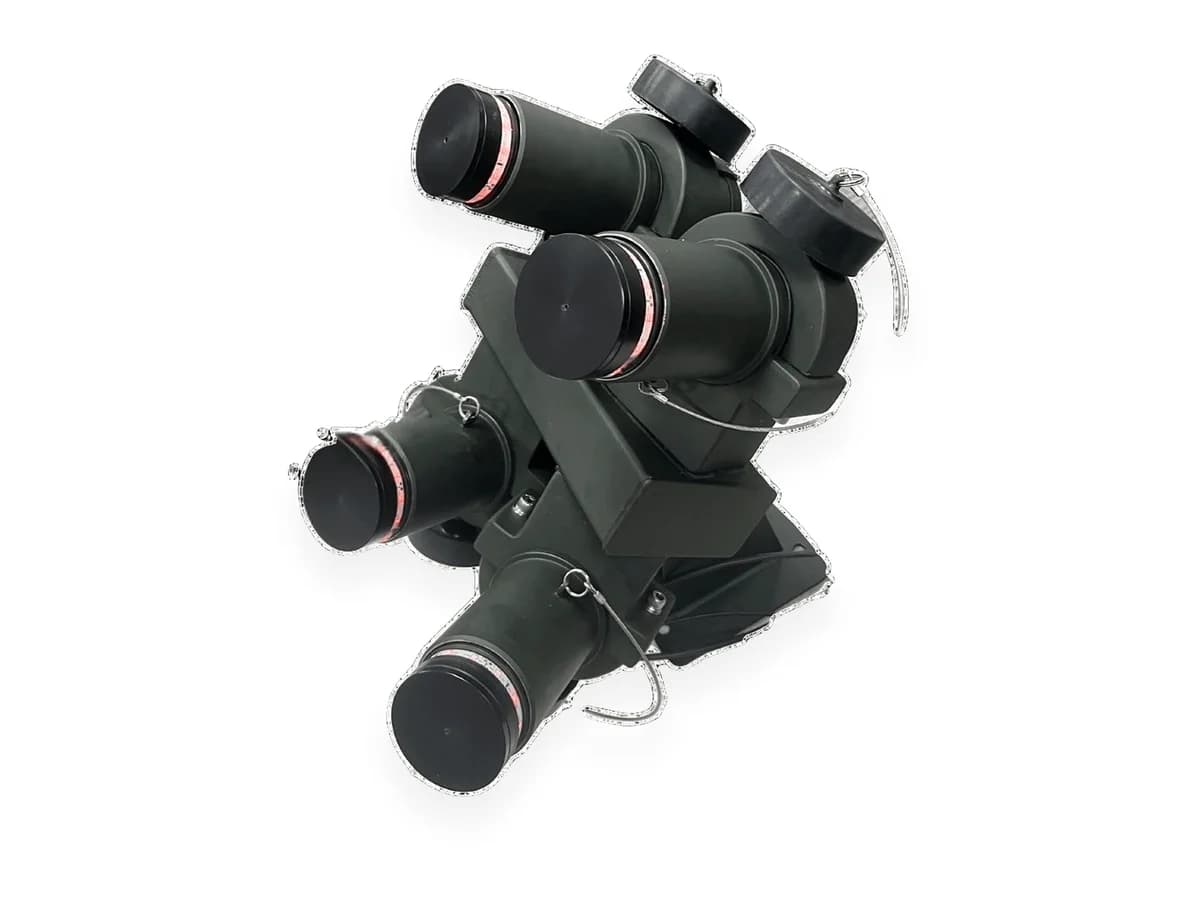
Why Passive Protection Matters in Modern Armoured Vehicles
The modern battlefield is dense with threats such as anti-tank guided missiles (ATGMs), thermal-sighted snipers, reconnaissance and surveillance sensors, and top-attack munitions. Every one of these threats relies on optical, thermal or imaging systems to acquire and track its target.
Armoured-vehicle defence is built on three layers: active protection systems (APS), passive protection (armour), and visual–thermal concealment. Smoke grenade launcher systems sit at the centre of this third layer. Once a vehicle is concealed, a missile operator or sniper trying to lock on often loses the target and cannot continue the engagement.
Smoke grenade launchers provide "invisibility on demand" within seconds — a relatively low-cost subsystem with a direct impact on mission success.
Why 76 mm Is the NATO Standard
In the smoke launcher market, 76 mm is the de-facto standard calibre across NATO. Its prominence has both industrial and operational reasons:
- Widespread use among allied armies — interoperability and shared munitions
- Wide munition ecosystem — visible smoke, IR, multi-spectral and decoy variants
- Logistics standardisation — stockpiles, training and supply chains are simplified
- Broad platform base — the smoke launcher systems on many NATO nations' armoured vehicles, as well as Türkiye's indigenous solutions, are built around 76 mm
Other calibres such as 66 mm and 81 mm appear on specific platforms, but mainstream procurement is centred on 76 mm. A vehicle manufacturer that selects a 76 mm-based system gains access to a far broader supply base for future munition variants.
How a Smoke Launcher Works
A 76 mm smoke grenade launcher system consists of three core components:
- Launchers (launcher tubes) — firing tubes mounted at angular positions around the vehicle
- Control unit — an electronic control unit operated from inside the vehicle
- Munitions — pyrotechnic smoke cartridges (which may be multi-spectral)
When a threat is detected — manually by the commander or in automatic mode linked to a threat-warning system — the control unit sends a firing command to the selected launcher. Pyrotechnic ignition throws the cartridge a set distance from the vehicle; that distance and the time it takes for the screen to form depend on the munition type used. The cartridge bursts in the target area and a smoke screen forms within a short time.
In modern systems this process is managed entirely electronically. Launchers are connected to the control unit inside the vehicle and, in many cases, to the vehicle's CANbus (J1939) data bus.
Multi-Spectral Smoke — Beyond Visible Obscuration
Classic smoke (effective only in the visible band) is no longer sufficient on its own. Modern threats use thermal imagers, short-wave IR, near IR and laser rangefinders. Modern smoke munitions are therefore designed to produce a multi-spectral screen:
- Visible light (400–700 nm) — the naked eye and optical sights
- Near IR / short-wave IR (700 nm – 2 µm) — night vision and image intensifiers
- Mid-wave IR / long-wave IR (3–14 µm) — thermal cameras and missile seeker heads
- Laser interruption — laser rangefinders and designators
Multi-spectral cartridges typically include aluminium, phosphorus, graphite or brass flakes in the pyrotechnic mix. These particles form a dense cloud that scatters radiation in the thermal and IR bands. As a result, the vehicle becomes far harder to detect for the naked eye, the thermal camera and the IR-guided seeker head.
Coverage Angles and Tactical Use
A launcher system's effectiveness depends on the number of launchers and their angular placement. The TEDEG TDG-76-SGL is configured to provide 90°, 120°, 180° or 360° smoke coverage. The typical logic behind these angles is:
- 90° — frontal only; small platforms where the threat is expected from one direction
- 120° — front and limited flanks; reconnaissance vehicles
- 180° — half perimeter; broad protection against threats from a known direction
- 360° — full perimeter; main battle tanks, MRAPs, mobile command vehicles
A tank platform typically uses 8–12 launchers (front, side and rear groups); lighter armoured personnel carriers or mine-resistant ambush-protected vehicles (MRAPs) may need only 4–8. The TDG-76-SGL is fitted with a minimum of 4 and a maximum of 16 launchers, so the same launcher and control architecture scales from directional protection to full perimeter coverage. How to decide on launcher count, arc and layout is covered in multiple smoke grenade launcher configurations.
Tactically, the operator can fire launchers individually, in groups or all at once, depending on the direction of the threat. The TDG-76-SGL remote control unit carries separate fire buttons for the left group, the right group and all ammunition, an indicator showing whether ammunition is loaded, and an arm/safe status LED. The system operates in manual and automatic modes.
MIL-STD Compliance — Field Reliability, Not Paperwork
The difference between a civilian launcher and a military launcher is not what is printed on the label — it shows in the field. Military standards are test and design requirements distilled from many years of field experience.
For 76 mm smoke launcher systems, the following standards typically come to the fore:
- MIL-STD-461G — electromagnetic interference and compatibility (EMI/EMC). No mutual interference with on-board radios, positioning receivers, mission computers and other sensitive systems.
- MIL-STD-810G — environmental durability. Defines test methods for conditions such as vibration, shock, high and low temperature, humidity, salt fog, sand and dust, rain and thermal shock.
- MIL-STD-1275E — the characteristics of 28 VDC power systems on military ground vehicles: surges, spikes, ripple and voltage dips during engine starting.
The TDG-76-SGL is designed to MIL-STD-461G, MIL-STD-810G and MIL-STD-1275E. Its −40 °C … +70 °C operating temperature, 95% humidity rating, vibration and shock resistance and zinc-nickel coating are how that design shows in the field. The system runs from 28 VDC nominal (16–32 VDC).
Without these standards a launcher might "work" — but its reliability at −30 °C in an Eastern Anatolian winter, in a desert sandstorm or under salt fog at sea cannot be guaranteed.
CANbus (J1939) Integration — Modern Vehicle Architecture
Smoke launcher systems from 10–15 years ago were mostly used with a separate control box and a button-based remote. Today's armoured vehicles have digital vehicle architectures, where subsystems communicate over CANbus — particularly the J1939 protocol widely used on heavy vehicles.
CANbus integration generally opens up the following:
- Managing defensive systems from a common commander interface
- The option of integration with threat-warning systems such as laser warning (LWS) and missile approach warning (MAWS)
- Monitoring launcher and ammunition status
- Fault and usage data for maintenance and logistics
- Configuration through software
With its CANBUS (J1939) infrastructure, the TDG-76-SGL communicates with the vehicle's other electronic systems over the same data bus. The remote control unit also has a CAN-Bus communication infrastructure and is fitted with military-grade connectors. Which data is shared on the bus should be defined during integration, according to the vehicle architecture.
Evaluation Criteria for Smoke Launcher Selection
When evaluating a 76 mm smoke grenade launcher system, the following points should be clarified:
- Calibre and munitions: 76 mm calibre and compatibility of the planned munition types (visible, IR, multi-spectral) with the launcher
- Launcher count and coverage angle: Platform geometry and the expected threat direction
- Firing and safety logic: Single, group and full salvo firing; arm/safe switch; ammunition indicator
- Vehicle integration: Supply voltage range, current draw when firing, and data bus
- Environmental and EMC compliance: Which MIL-STD revisions, temperature range, humidity and coating
- Maintenance: Tools needed for cleaning and routine checks in the field
The TEDEG TDG-76-SGL values against these points:
| Feature | TDG-76-SGL |
|---|---|
| Calibre | 76 mm |
| Number of launchers | Minimum 4, maximum 16 |
| Protection angle | 90° · 120° · 180° · 360° |
| Firing | Individually, in groups or all at once; manual and automatic modes |
| Power supply | 28 VDC nominal (16–32 VDC) |
| Power consumption | 120 mA ± 20 mA (nominal), 6 A ± 2 A (firing mode) @ 28 VDC |
| Communication | CANBUS (J1939) |
| Military standards | MIL-STD-461G, MIL-STD-810G, MIL-STD-1275E |
| Operating temperature | −40 °C … +70 °C |
| Humidity | 95% |
| Coating | Zinc-nickel |
| MTBF | Minimum 250,000 hours |
| Weight | 2.3 kg ± 0.5 kg |
The system's cleaning and maintenance kit contains a wire brush, a hex key set, an ammunition test simulator, snap ring pliers and a cleaning brush. It brings together the basic tools needed to clean the launchers and carry out routine checks in the field.
Corporate assurance: TEDEG Defence is an approved supplier of ASELSAN, Roketsan and the Turkish Ministry of National Defence (MSB), with NATO supplier registration under NCAGE: TM885.
Typical Platform Applications
76 mm smoke grenade launchers are typically used on the following platforms:
- Main battle tanks — 8–12 launchers, 360° coverage
- Armoured fighting vehicles — 6–8 launchers
- Armoured personnel carriers — 4–6 launchers
- MRAP vehicles — 4–8 launchers
- Mobile command and control vehicles — 4–6 launchers, concealing critical electronic payloads
- Border surveillance vehicles — tactical withdrawal cover
- Naval platforms — smoke protection integrated into the platform
- Tactical training — realistic scenarios on training areas
Smoke Grenade Launcher Manufacturer in Turkey: TEDEG Defence
For vehicle manufacturers and integrators looking for a smoke grenade launcher manufacturer in Turkey, TDG-76-SGL is a 76 mm smoke grenade launcher system developed by Ankara-based TEDEG Defence and manufactured in Turkey.
| Fact | Detail |
|---|---|
| Manufacturer | TEDEG Defence Industry A.Ş. |
| Location | Ankara, Turkey |
| Founded | 2023 |
| Product | TDG-76-SGL 76 mm smoke grenade launcher system |
| Registrations and certificates | NCAGE TM885, ISO 9001, EYDEP |
| Cluster memberships | OSSA, SAHA Istanbul |
What working directly with the manufacturer means for this system in practice:
- Direct access to the design authority: the number of launchers (4 to 16) and the coverage angle (90°, 120°, 180° or 360°) are configured to the platform. Mounting interface, 16–32 VDC supply and CANBUS (J1939) integration questions are resolved with the engineering team that designed the system.
- NATO supplier registration: the NCAGE code TM885 identifies the company in NATO supply systems, and Turkey is a NATO member country.
- Maintenance and spares: the cleaning and maintenance kit defined with the system and periodic field checks are supported directly by the manufacturer.
- Quality and company records: see Certifications & Quality and About.
Datasheet and CAD requests can be made directly from the product page.
Conclusion
76 mm smoke grenade launcher systems are a critical subsystem with a direct impact on an armoured vehicle's survivability on the modern battlefield. A widely used calibre, munition options, integration with the vehicle data bus and design to military standards are the core criteria to look at when evaluating a system.
The TEDEG TDG-76-SGL was developed along these criteria, with a 76 mm calibre, 4–16 launchers, 90°–360° coverage, CANBUS (J1939) communication and design to MIL-STD-461G/810G/1275E.
For the datasheet and technical documentation, visit the 76 mm Smoke Grenade Launcher System product page. For audible and visual warning on the vehicle, see the T-Light Programmable Warning Unit; for other solutions, browse the Tactical Systems category. For an engineering conversation with our team, use the contact page.