
Power Systems · 5 products
Power Distribution Units (PDU)
Protected, monitored power distribution — from shelters to armoured vehicles
A power distribution unit (PDU) decides which load gets power, in what priority and with what protection on a military platform. TEDEG's PDU family is organised by voltage and installation need — from rack systems in command-and-control shelters to the 28 VDC bus of armoured vehicles and outdoor AC distribution.
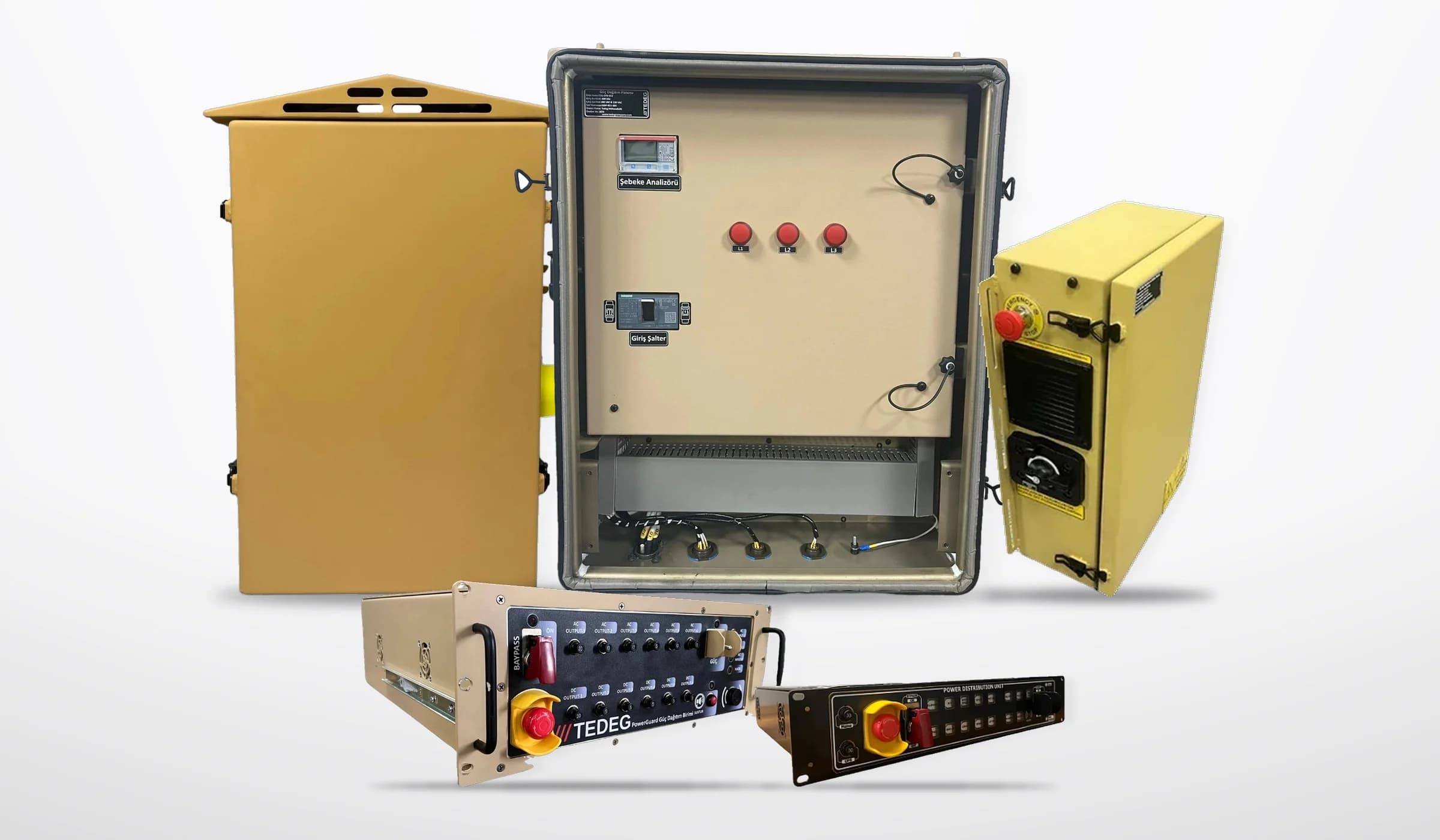
Power Distribution Units (PDU) — products
TEDEG Defence is an Ankara-based Turkish defence manufacturer that designs and builds rack-mount and vehicle power distribution units (PDUs) and power distribution panels for military platforms.
All products in this and the other six categories: Product Catalogue 2026 (PDF)
Model comparison
Key values from each model's specifications, side by side. Open a model for its full specifications.
Swipe sideways to see all columns.
| Model | Input | Output | Operating temperature | Weight |
|---|---|---|---|---|
3× 220 VAC, 50 Hz | 10× 25 A AC/DC outputs | Not listed | Not listed | |
180–240 VAC, 50 Hz, single phase | 8 AC + 2 DC | -30 °C to +50 °C | ≤ 10 kg | |
4 (Battery 1, Battery 2, Alternator, Battery charger) | Not listed | −32 °C to +52 °C | 14 ± 2 kg | |
400 VAC | 400 VAC / 230 VAC | −32 °C to +50 °C | 25 ± 5 kg | |
220 VAC, 50 Hz | 9 × 220 VAC, each fused | Not listed | 14 ± 1 kg |
— = not listed in the model's key specifications; see the product page for full details.
About Power Distribution Units (PDU)
Which PDU for which need?
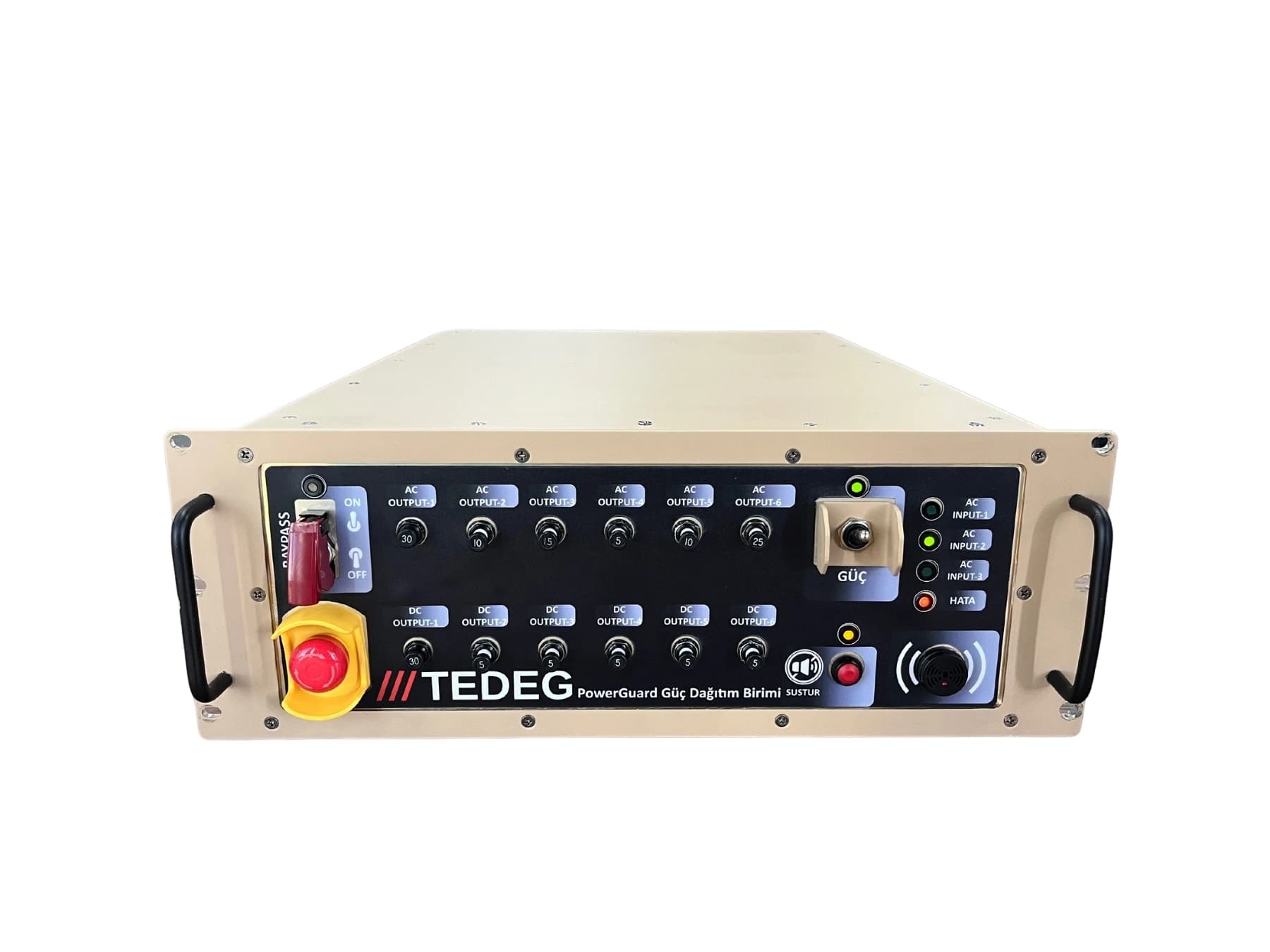
- 19-inch rack / shelter, three 220 VAC sources with automatic changeover: PDU-RT5002 — 10 × 25 A outputs, remote monitoring over Ethernet
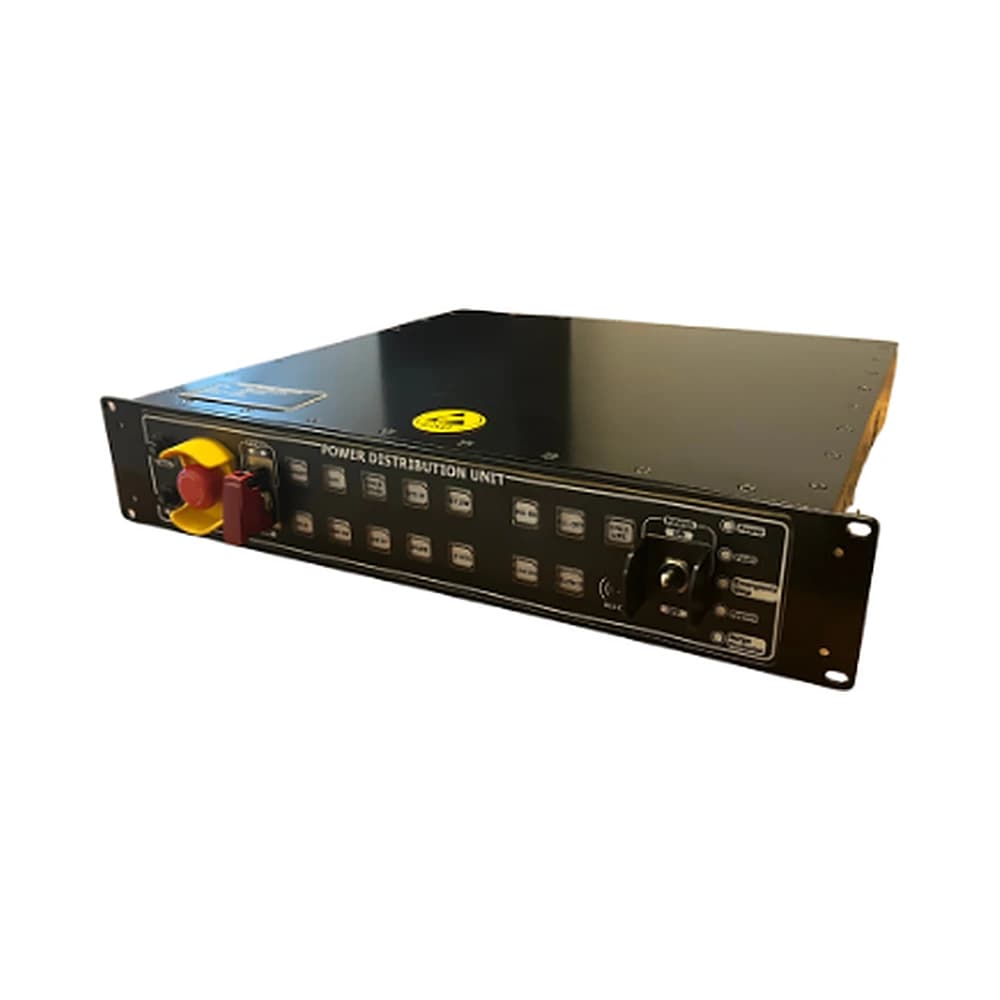
- 2U rack, dual-source single phase, AC and DC outputs together: PowerGuard PDU-R2D4 — 8 AC + 2 DC outputs
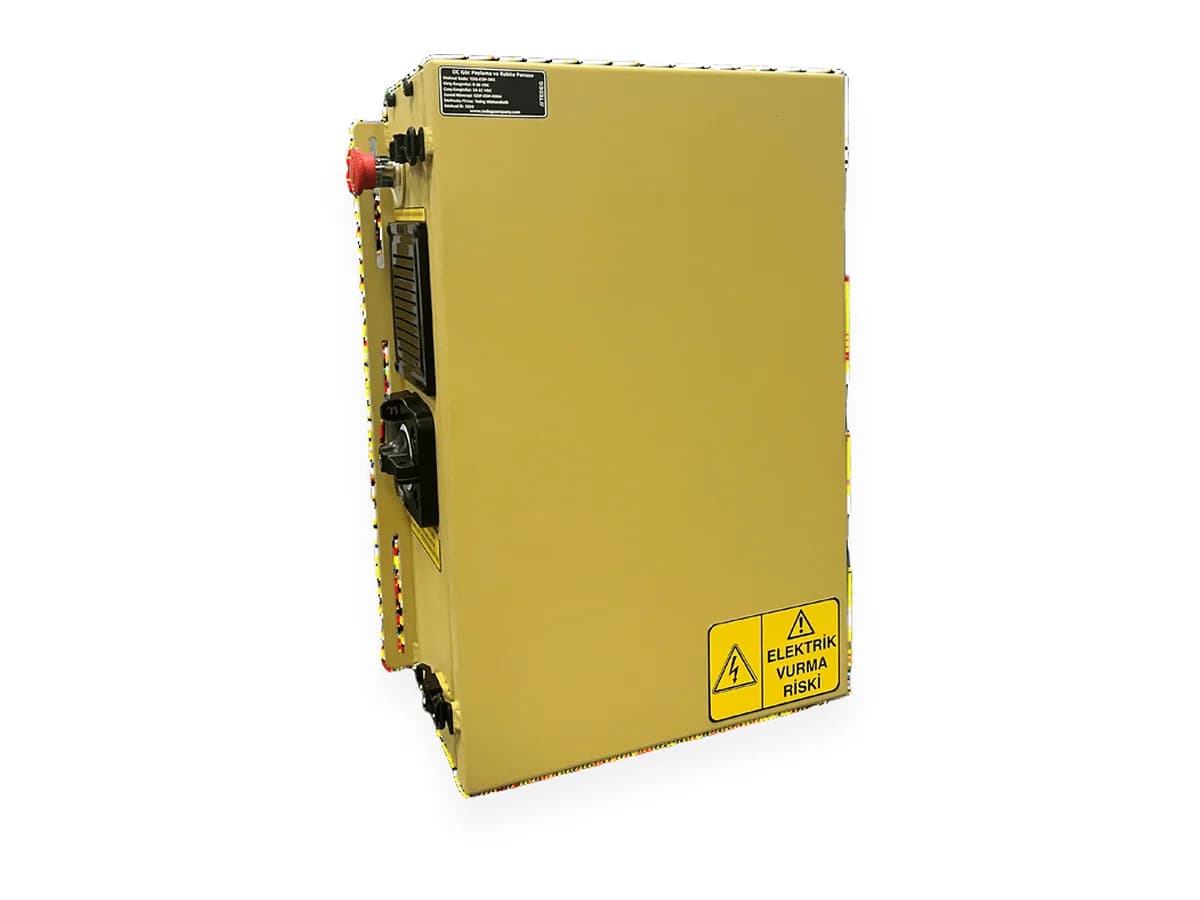
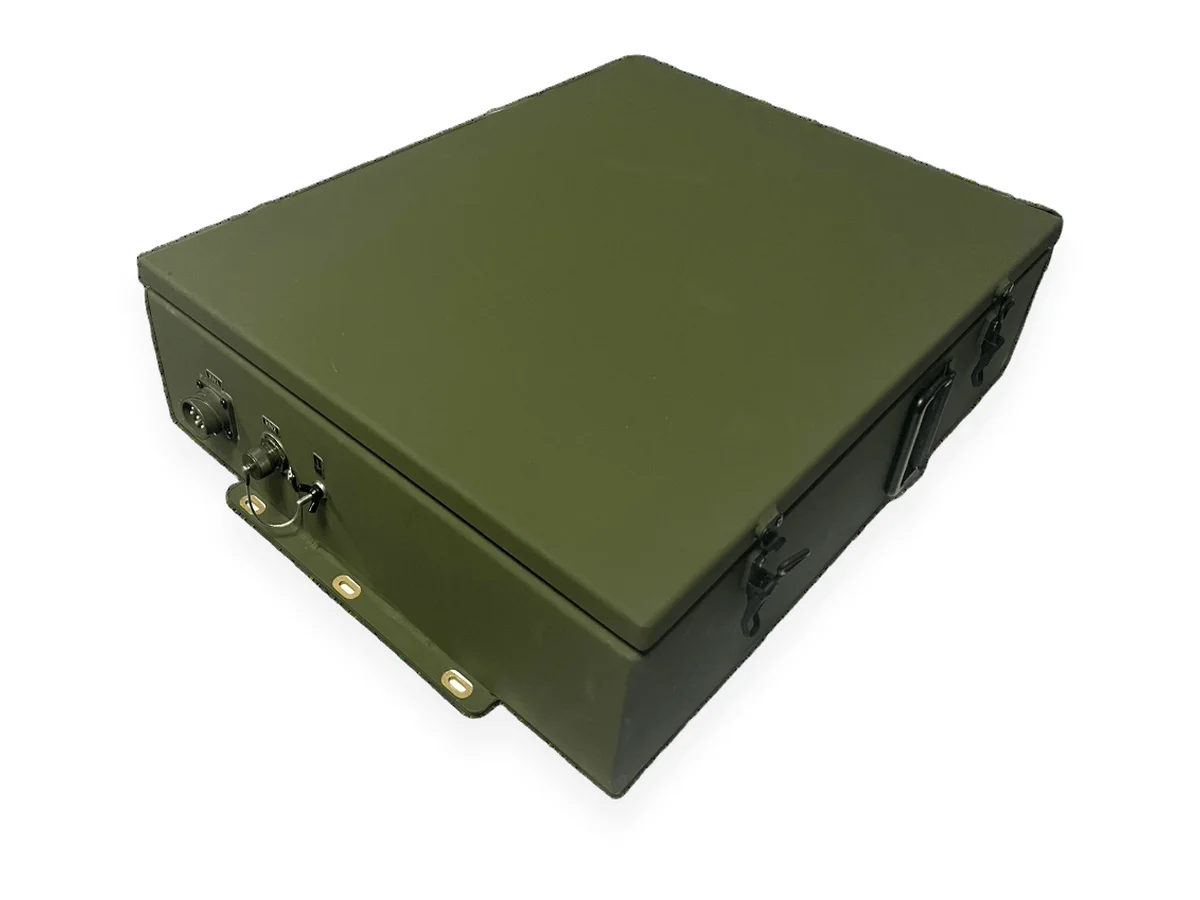
- Armoured vehicle 28 VDC bus: Military Vehicle DC Power Distribution Unit — 400 A busbar, 4 inputs, MIDI fused
- Outdoor 400 VAC distribution: Military AC Power Distribution Panel — MIL-DTL-38999 connectors
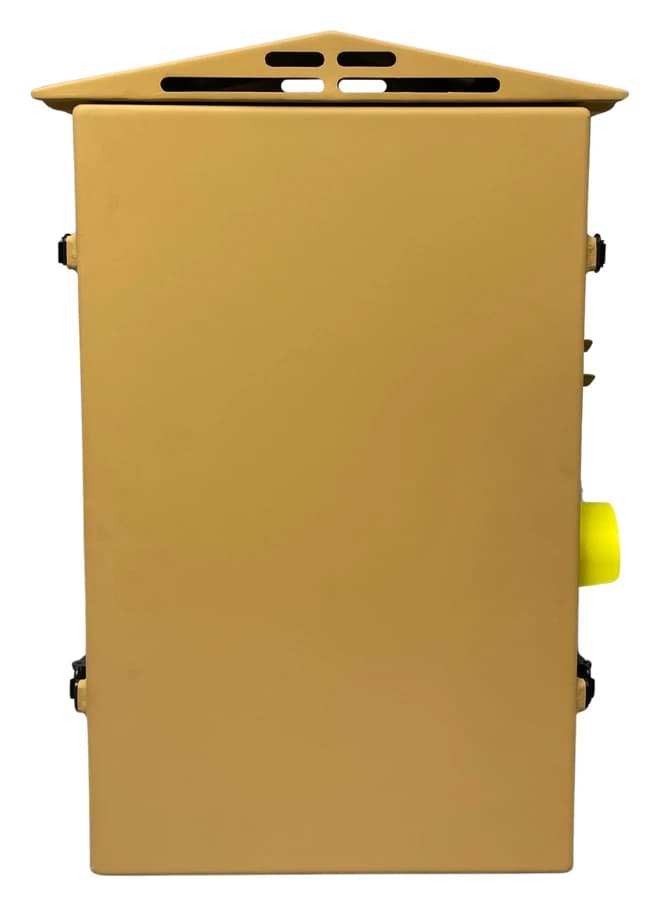
- 220 VAC outdoor panel with mains / generator selection: PowerGuard MAR-2 — 9 fused outputs, K1/K2 contactors, emergency stop, EMI-gasketed enclosure
What to check when choosing a PDU: input voltage and number of sources, number of output channels and current per channel, installation (rack, in-vehicle, outdoor), remote monitoring interface and operating temperature. Exact values are on each product page and datasheet.
For units that protect the electrical system — backup power, reverse polarity protection and voltage monitoring — see Power Management & Protection, and for field use cases read our military PDU guide.
FAQ
Which rack-mount PDU should I choose: PDU-RT5002 or PDU-R2D4?+
If you have three separate 220 VAC 50 Hz sources (UPS, mains, generator) and want automatic source changeover, choose PDU-RT5002: 19-inch 4U, priority mains → generator, 10 × 25 A AC/DC outputs, breaker protection, monitoring over Ethernet and a log of the last 100 records. For a more compact unit that takes single-phase 180–240 VAC mains and UPS on separate connectors, choose the PowerGuard PDU-R2D4: 2U, 8 AC + 2 DC outputs (nominally 220 VAC / 24 VDC, configured per project), Ethernet 100 Mbps and RS-422, surge arrester, emergency stop and bypass on the front panel, 10 kg.
What is the difference between the outdoor panels: AC Power Distribution Panel or MAR-2?+
The Military AC Power Distribution Panel takes a 400 VAC input and provides 400 VAC and 230 VAC outputs; every output has its own breaker rated for the line's current, selected outputs can be switched remotely with a 28 VDC or 230 VAC signal, and it operates at 0–3000 m and −32 °C … +50 °C (25 ± 5 kg). The PowerGuard MAR-2 is a 220 VAC 50 Hz panel with mains / generator selection: a manual source selector switch, 9 fused 220 VAC outputs (each with its own neutral and earth terminal), K1 / K2 contactors, a guarded emergency stop, a rain roof and an EMI-gasketed door (14 ± 1 kg). Choose the first for three-phase 400 VAC loads and the second for single-phase 220 VAC distribution with manual changeover to a generator.
Which unit is used for the 28 VDC bus of an armoured vehicle?+
The Military Vehicle DC Power Distribution Unit (TDG-EDP-D0X) brings four inputs — Battery 1, Battery 2, the alternator and the battery charger — together on (+) and (−) 400 A busbars; outputs are protected by 30 / 60 / 100 A @28 VDC MIDI fuses, with three spare fuses in each of four ratings. The built-in 12 VDC → 28 VDC 500 W converter feeds 12 VDC sources into the 28 VDC lines; the input contactor opens below 21 VDC and closes above 21.5 VDC, and all thresholds apart from the control unit's switch-on voltages are adjustable. It has an emergency stop button, a battery isolator, IP67 cable glands, an EMI gasket and a −32 °C … +52 °C operating range, and weighs 14 ± 2 kg. To protect the battery line against reverse connection it can be combined with the TPB-01 Reverse Polarity Unit.
Which standards are the PDUs designed to, and can I get a test report?+
The PDU-RT5002 datasheet lists MIL-STD-461F EMI/EMC (CE102, CS101, CS114, CS115, CS116, RE102, RS103) and MIL-STD-810G environmental test coverage across 11 methods; the PDU-R2D4 lists MIL-STD-810G and the IPC-A-610 Class 3 assembly standard; the Vehicle DC Power Distribution Unit specifies the MIL-STD-810G Method 506.5 Procedure I rain test (30 minutes, watertight). The AC Power Distribution Panel and MAR-2, with their EMI-gasketed aluminium enclosures, are designed to the operating conditions given in their datasheets. If your programme needs a test report, request it stating the standard and method number; we do not add a standard to a product page unless it appears in the datasheet.
Can the channel count, output voltage and connectors be changed for a project?+
Yes, to a degree that depends on the product. On the PDU-RT5002, channel count, voltage level and connector type are offered as customer configurations thanks to the modular design. On the PDU-R2D4, output voltage and current are set per project, and the individual, group or sequential switching scenarios of the outputs are configured in software without changing hardware. On the AC Power Distribution Panel, the number of outputs, the current rating of each output and the protection devices are defined for the project (ED0 / EDX panel types, three paint options); on the Vehicle DC Power Distribution Unit the threshold values are adjustable and four military paint options are available.
What information should I send for a quotation, and where do I find the datasheets?+
Input voltage and number of sources, number of output channels and current per channel, installation (rack, in-vehicle, outdoor), remote monitoring interface and operating temperature are enough for a quotation; send them through the quote form. Each product's datasheet is on its own page: Turkish and English for PDU-RT5002, PDU-R2D4 and MAR-2, and Turkish for the Vehicle DC Power Distribution Unit and the AC Power Distribution Panel.
What is a military power distribution unit (PDU)?+
A military power distribution unit (PDU) takes power from one or more sources — the vehicle's 28 VDC bus, batteries, the alternator, mains, a generator or a UPS — and distributes it to the platform's subsystems through individually protected outputs. Depending on the application it also handles source changeover, emergency stop, monitoring and remote switching. Unlike an IT rack PDU, a military PDU has to keep working on the platform's power quality (on 28 VDC vehicles the reference is MIL-STD-1275), coexist with the other electronics (MIL-STD-461 EMC) and withstand temperature, humidity, vibration and rain (MIL-STD-810). TEDEG's range covers rack units for shelters (PDU-RT5002, 19-inch 4U, and PDU-R2D4, 2U), the armoured vehicle 28 VDC distribution unit and outdoor AC panels.
How is a military PDU different from a commercial rack PDU?+
A commercial rack PDU is built for a data centre: clean mains, a conditioned room and no shock or vibration. A military PDU is chosen for the platform instead: a wide input range, several sources with changeover, a breaker or fuse sized for each output line, sealed military connectors (for example MIL-DTL-38999 on the AC Power Distribution Panel), EMI-gasketed enclosures and operating ranges such as −32 °C … +52 °C on the vehicle DC unit. Remote monitoring is common too: PDU-RT5002 reports over Ethernet, PDU-R2D4 over Ethernet and RS-422. For field scenarios read our military PDU guide.
Engineering Support
Our engineering services can adapt the products in this category to your platform, integrate them or test them against your programme requirements.
Related Guides
Other product categories
Looking for the full range?
Contact our engineering team for datasheets and quotations.