
Command and Control (C4I) Systems
Mobile Command Container — A Remotely Managed 2U PDU with Mains + UPS Dual Input
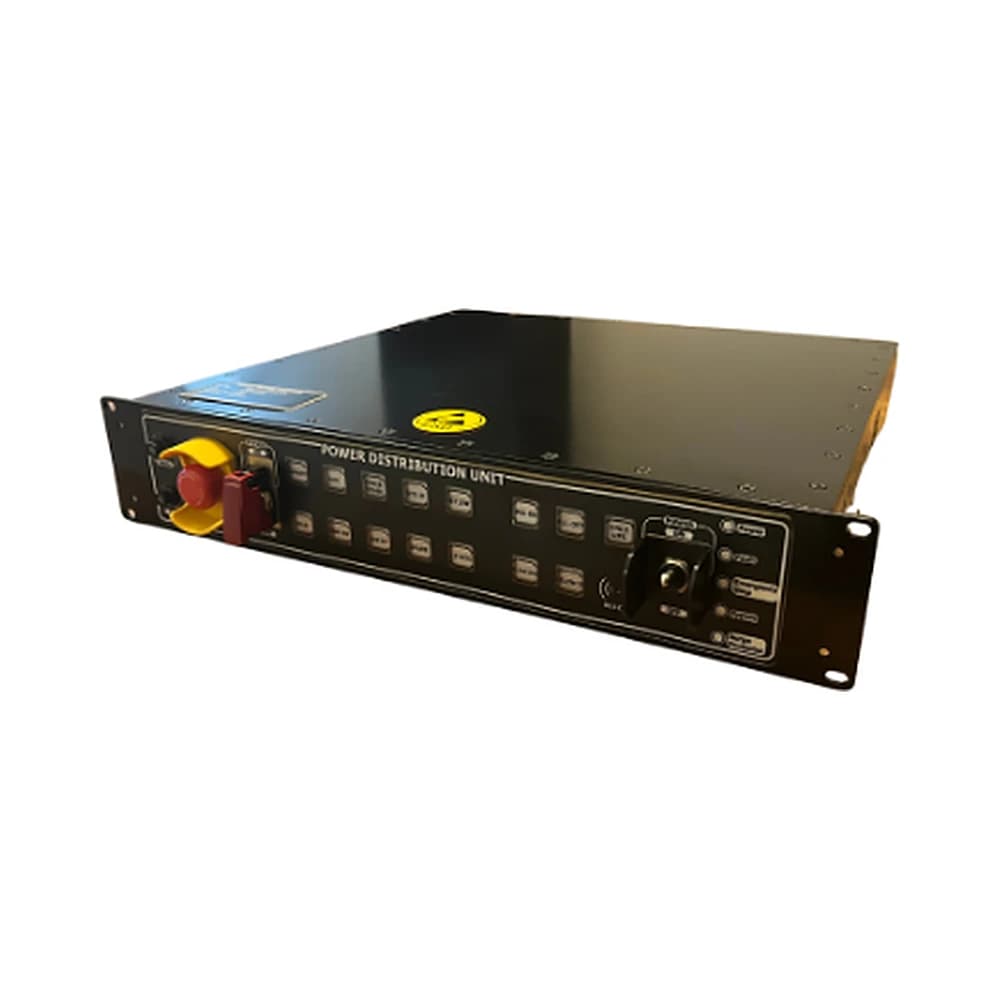
For a mobile command-and-control container whose rack cabinets had only 2U left for power distribution, the PowerGuard PDU-R2D4: mains and UPS on separate inputs, with every output managed in software.
- Platform
- Mobile command-and-control container — mission servers, network and communication equipment, operator consoles in 19-inch rack cabinets
- Customer
- Leading Turkish C4I System Integrator
- Sector
- Defence · command-and-control and communication infrastructure
- Year
- 2025
Customer & Context
A leading Turkish C4I system integrator approached TEDEG Defence for a mobile command-and-control container programme. The container housed mission servers, network switches and routers, communication equipment and operator consoles in 19-inch rack cabinets, and in the field it ran from mains or a generator, backed by a UPS.
Once the cabinet layout was frozen, only 2U was left in each cabinet for power distribution. The commercial rack PDUs the integrator had been using fitted that height, but they had a single input, their outputs could not be managed remotely, and they were not designed for field temperatures and vibration. The integrator prepared a technical requirements document that included fault records from the first field deployments and the cabinet layout drawings. The request was specific: a 2U PDU that takes mains and UPS on separate connectors, supplies AC and DC loads together, manages its outputs in software and withstands military environmental conditions.
Challenge
The container's first field deployments and the integrator's acceptance tests showed clearly where the commercial PDUs fell short:
- Single input: the commercial PDU ran from one supply line. Switching between mains and UPS was handled by an external arrangement ahead of the PDU, which added cables and connection points to the cabinet.
- No remote intervention: when a server or router froze in the field, the only way to restart it was for a technician to walk to the container and cut its supply by hand. During a mission that meant lost time and operational risk.
- Surges and monitoring: there was no surge arrester at the input against surges from the generator and long field cable runs. Cabinet temperature and humidity were not monitored, so overheating only came to light once a device failed.
- Fixed hardware: breaker layout and output allocation were fixed in hardware. Every new container configuration meant rewiring or replacing the PDU.
- AC and DC loads: a separate converter in the cabinet supplied the DC equipment.
- Environment: the commercial units did not operate reliably at −30 °C or under transport vibration, and were not designed to military environmental test requirements.
The integrator decided to have TEDEG build a military PDU that would meet all of these requirements within the same 2U height.
TEDEG Solution
TEDEG Defence brought the integrator's requirements together in the PowerGuard PDU-R2D4: mains + UPS dual input, AC and DC outputs, surge-protected inputs and remote management in a single 2U rack unit. Output voltage and current, together with the output scenarios, were configured to the container programme's load plan.
Dual Input, AC and DC Outputs
The unit runs from single-phase 180–240 VAC, 50 Hz and accepts the mains and UPS inputs through separate connectors, so loads stay powered from the UPS line when mains power fails. On the output side there are 8 AC and 2 DC outputs. Output voltage and current were configured for the project, with nominal values of 220 VAC and 24 VDC. The DC outputs are fed by at least two independent AC/DC converters with independent protection and distribution, which removed the separate DC converter from the cabinet. Efficiency is ≥ 85%.
Remote Management and Monitoring
The PDU communicates over Ethernet (100 Mbps) and RS-422. With the Windows 10 compatible management software, the operator can switch outputs individually, in groups or in sequence, restart a frozen device and ping connected equipment to check that it responds. Input and output lines, internal temperature and humidity, and system status are monitored in real time. Because output scenarios are configured in software, the container’s power-up sequence and load plan are set up for each configuration without changing hardware.
Protection, Mechanical Design and Environmental Endurance
The inputs have over / undervoltage protection, the outputs overcurrent and short-circuit protection, and the internal components thermal protection. The integrated surge arrester on the input line has LED status; the front panel carries physical emergency stop and bypass buttons, plus an LED status indicator and an illuminated control button for every output. The chassis is 2U, 19-inch rack compatible, powder-coated aluminium, measuring 482.6 × 500 × 87.1 mm and weighing no more than 10 kg. Filtering and a sealed gasket provide EMI/EMC protection. The operating range is −30 °C … +50 °C at 5–95% non-condensing humidity, with environmental endurance designed to MIL-STD-810G. Assembly follows IPC-A-610 Class 3, J-STD-001B and IPC/WHMA-A-620, and the unit travels to the field in a military-grade hard carrying case.
Outcome
PDU-R2D4 was delivered to the integrator's mobile command container programme and replaced the commercial PDUs in its cabinets.
- Dual-source distribution with mains + UPS in a 2U height; the external switching arrangement ahead of the PDU was removed.
- 8 AC + 2 DC outputs in one unit, with no separate converter needed for the DC loads.
- Frozen devices can be restarted remotely over Ethernet or RS-422, reducing the need for a technician to go to the container.
- Output scenarios are set up in software from project to project; a new configuration does not change the hardware.
- The surge arrester and temperature and humidity monitoring make cabinet risks visible before they turn into faults.
Technical Scope
Values are taken from each product's own technical data; full specifications are on the product page.
- Input
- 180–240 VAC, 50 Hz, single phase
- Input sources
- 1 × mains + 1 × UPS (separate connectors)
- Outputs
- 8 AC + 2 DC
- Efficiency
- ≥ 85%
- Communication
- Ethernet 100 Mbps · RS-422
- Protection
- Over/undervoltage, overcurrent, short circuit, thermal, surge arrester
StandardsMIL-STD-810GView product: PowerGuard PDU-R2D4 Military Rack-Mount Rugged PDU- Input
- 3 × 220VAC / 50 Hz
- Output
- 10 × 25A AC/DC
- Form factor
- 4U× 19 inch
- Cooling
- Fanactive
StandardsMIL-STD-461FMIL-STD-810GView product: PDU-RT5002 Military Power Distribution Unit — Rack-Mount Rugged PDU
More case studies
Land Platforms · 2024
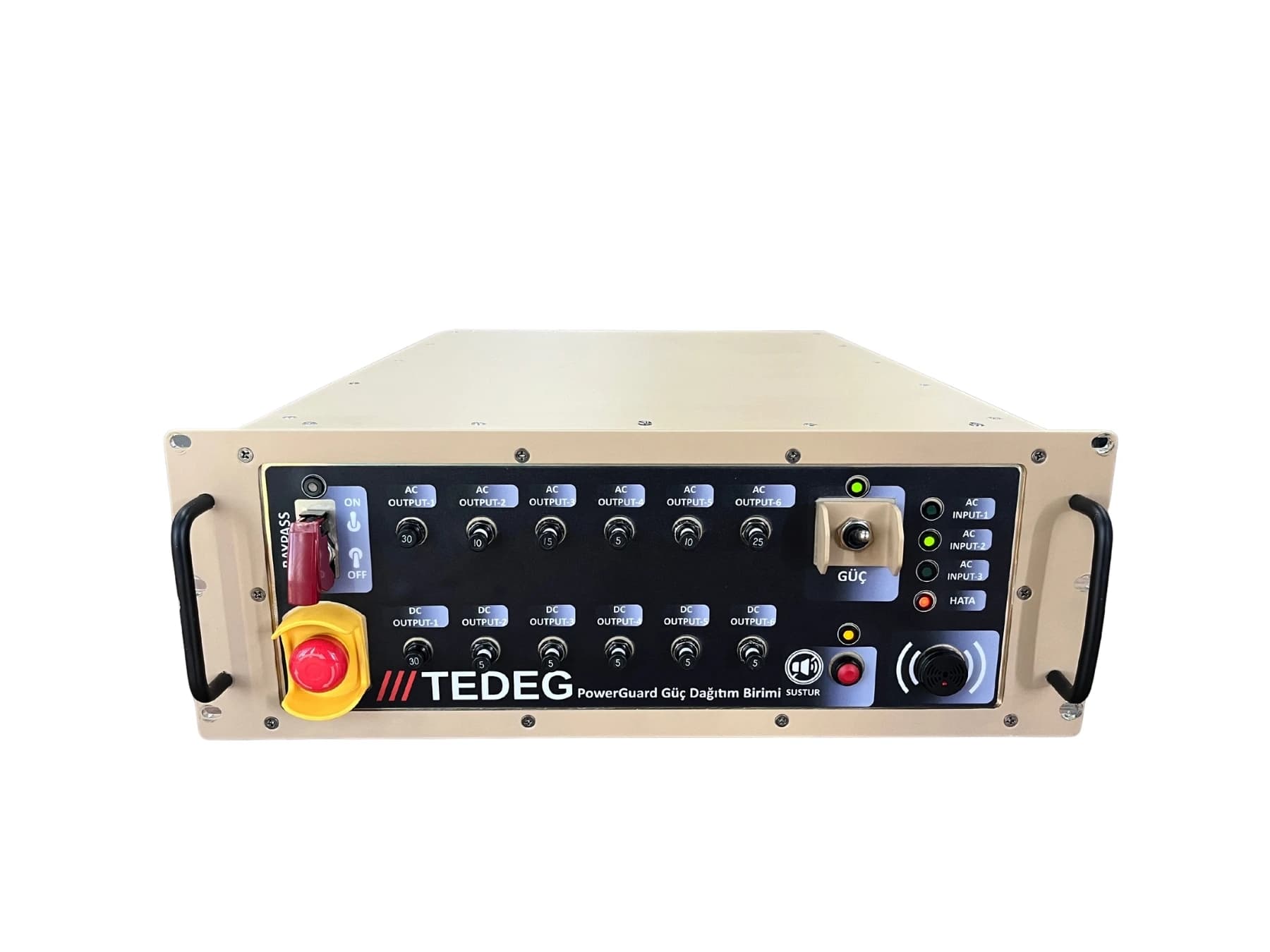
Tactical Truck Power Architecture Modernisation
An ageing PDU that could no longer keep pace with growing mission loads was replaced by a remotely monitored power distribution architecture built on the PDU-RT5002 and designed to MIL-STD requirements.
Read case study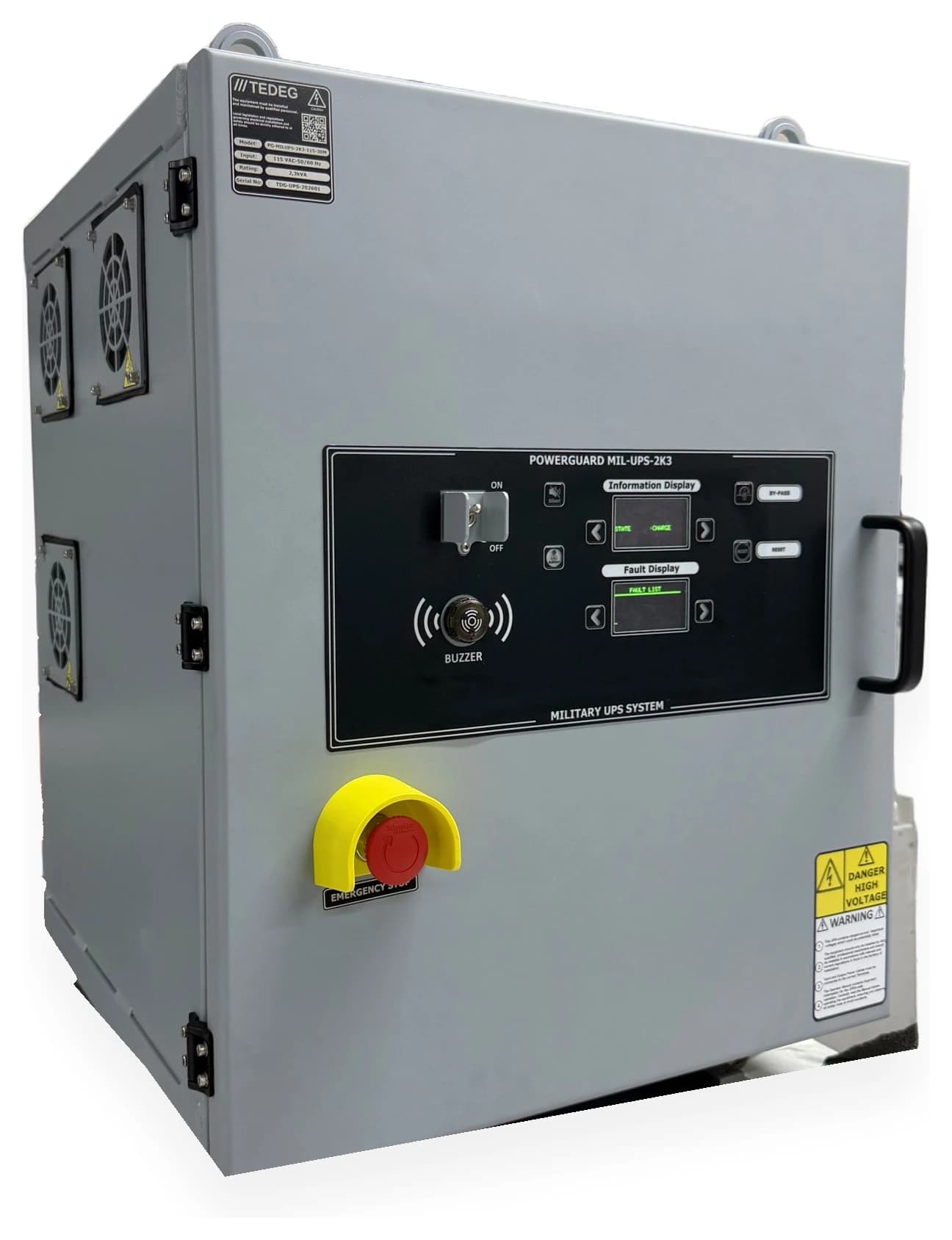
Missile and Air Defence Radar Systems · 2025
Missile and Radar Systems — Military UPS and 400 Hz Converter Stable Down to a 0.3 Power Factor
For the low-power-factor radar and fire-control loads that make commercial UPS units and converters alarm and shut down, a domestic pair built around a control algorithm and power stage designed for capacitive load.
Read case study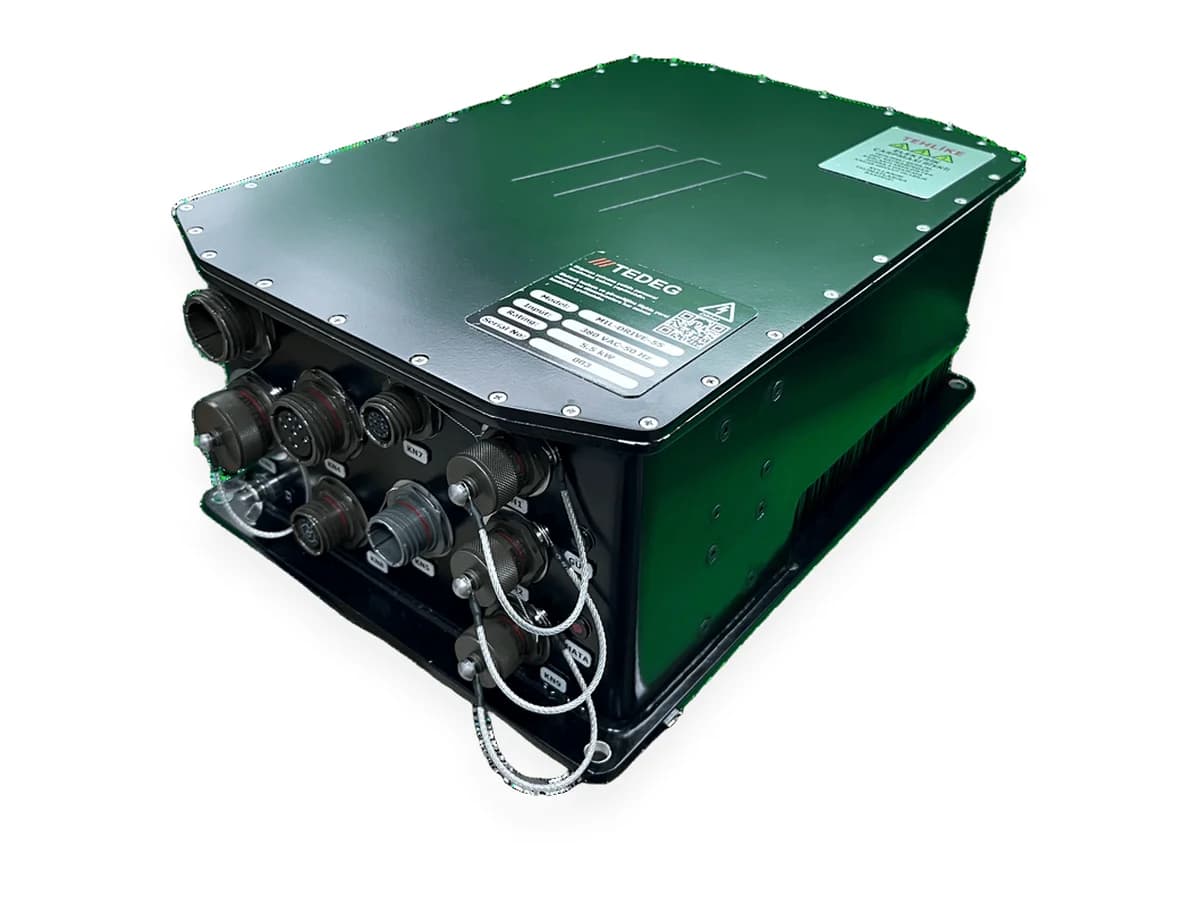
Air Defence · 2025
Mobile Air Defence Platform — Pedestal Motor Control & Radar Frequency Feed
A motor drive and a frequency converter sourced from separate foreign suppliers were replaced by a matched TEDEG pair, designed together so that neither interferes with the other.
Read case study