
Vehicle & Tactical Systems · 4 products
New Product LineVetronics (Vehicle Electronics)
Systems that power and connect cameras, displays and the mission computer
On a modern tactical vehicle, surround cameras, night-vision and driver-assistance cameras, operator displays, the mission computer and crew systems all work together. Feeding each from its own power source grows the wiring harness and multiplies failure points. The vetronics category brings together TEDEG's SENTRA family, which powers and connects these systems.
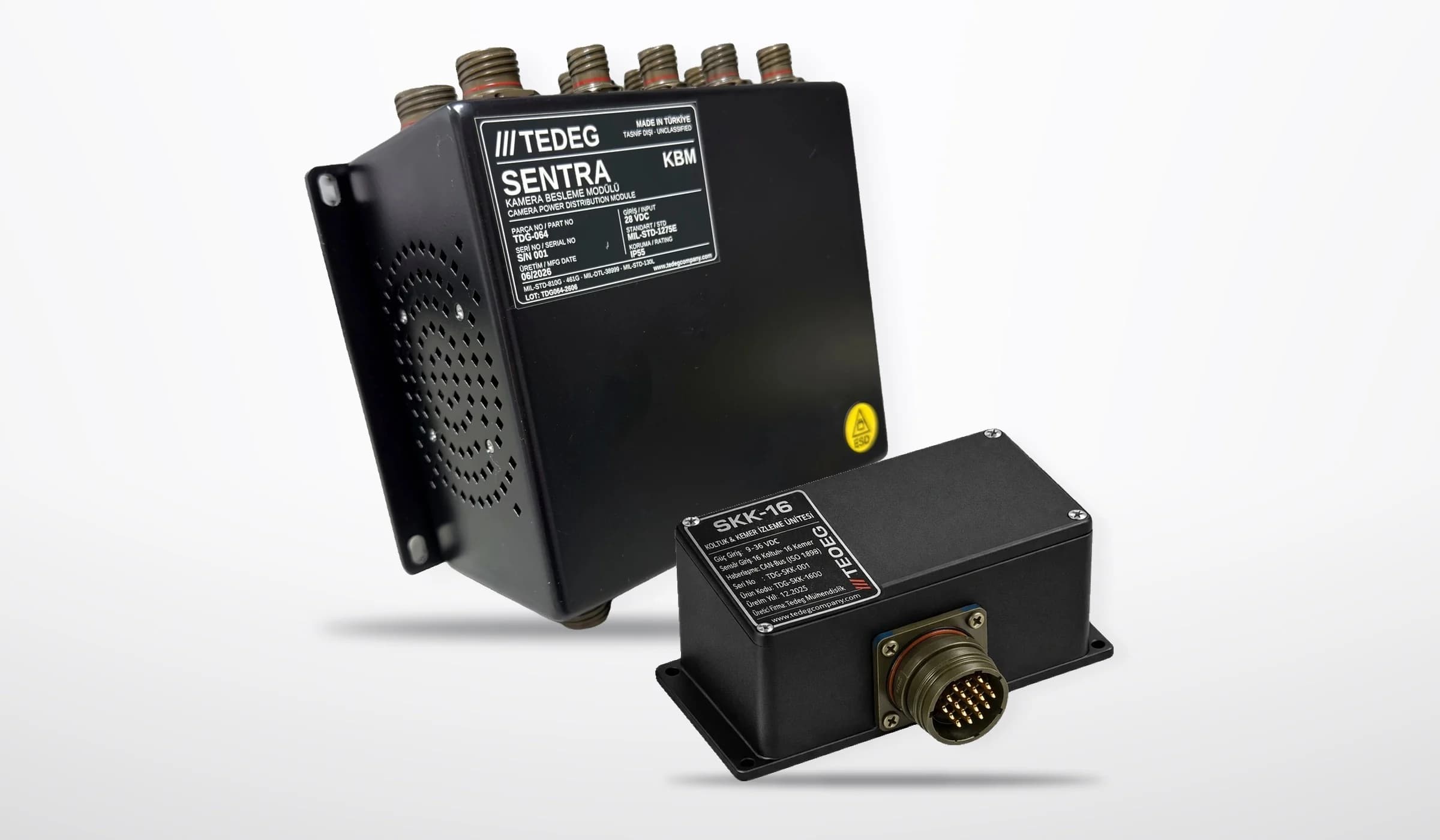
Vetronics (Vehicle Electronics) — products
TEDEG Defence is an Ankara-based Turkish defence manufacturer that designs and builds vehicle electronics (vetronics) for military vehicles, including a camera power distribution module and a seat and seat belt monitoring system.
All products in this and the other six categories: Product Catalogue 2026 (PDF)
About Vetronics (Vehicle Electronics)
Which product for which need?
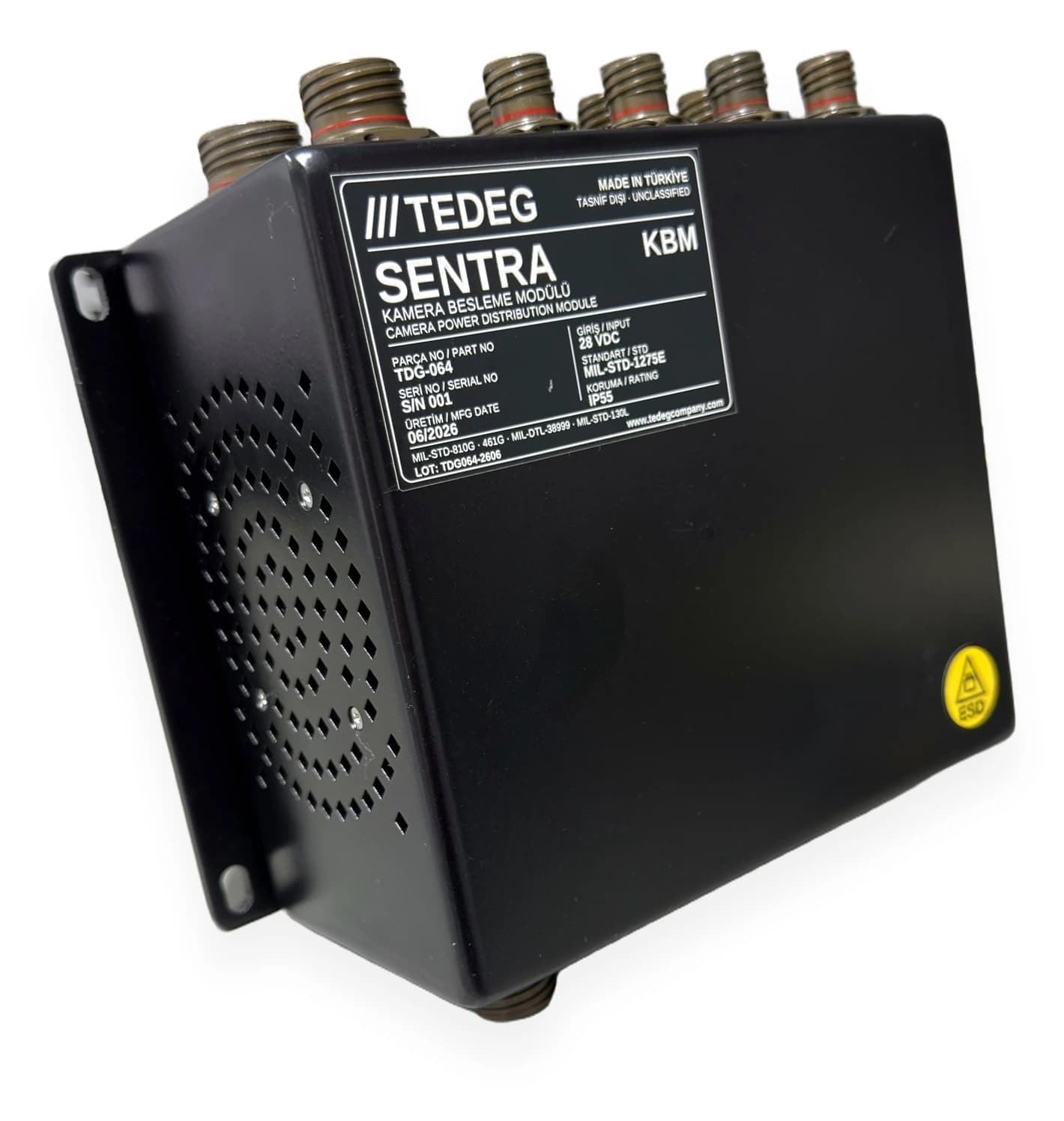
- Supplying multiple cameras, displays and the mission computer from one unit: SENTRA KBM Camera Power Distribution Module — 28 VDC MIL-STD-1275E input, 11 × isolated 12 VDC camera outputs, 24 VDC 200 W computer output, IP55
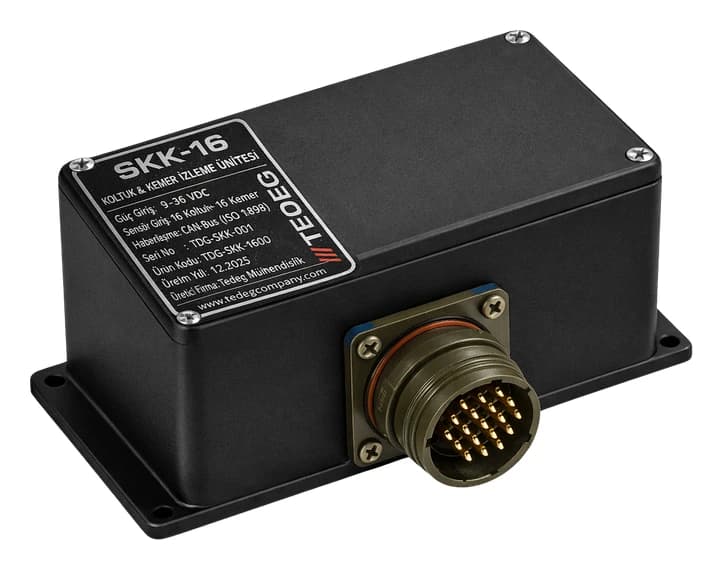
- Monitoring crew seat and seat-belt status: SENTRA-16 Seat & Seat-Belt Monitoring System — 32 channels (16 seats + 16 belts), CAN-Bus ISO 11898, IP65
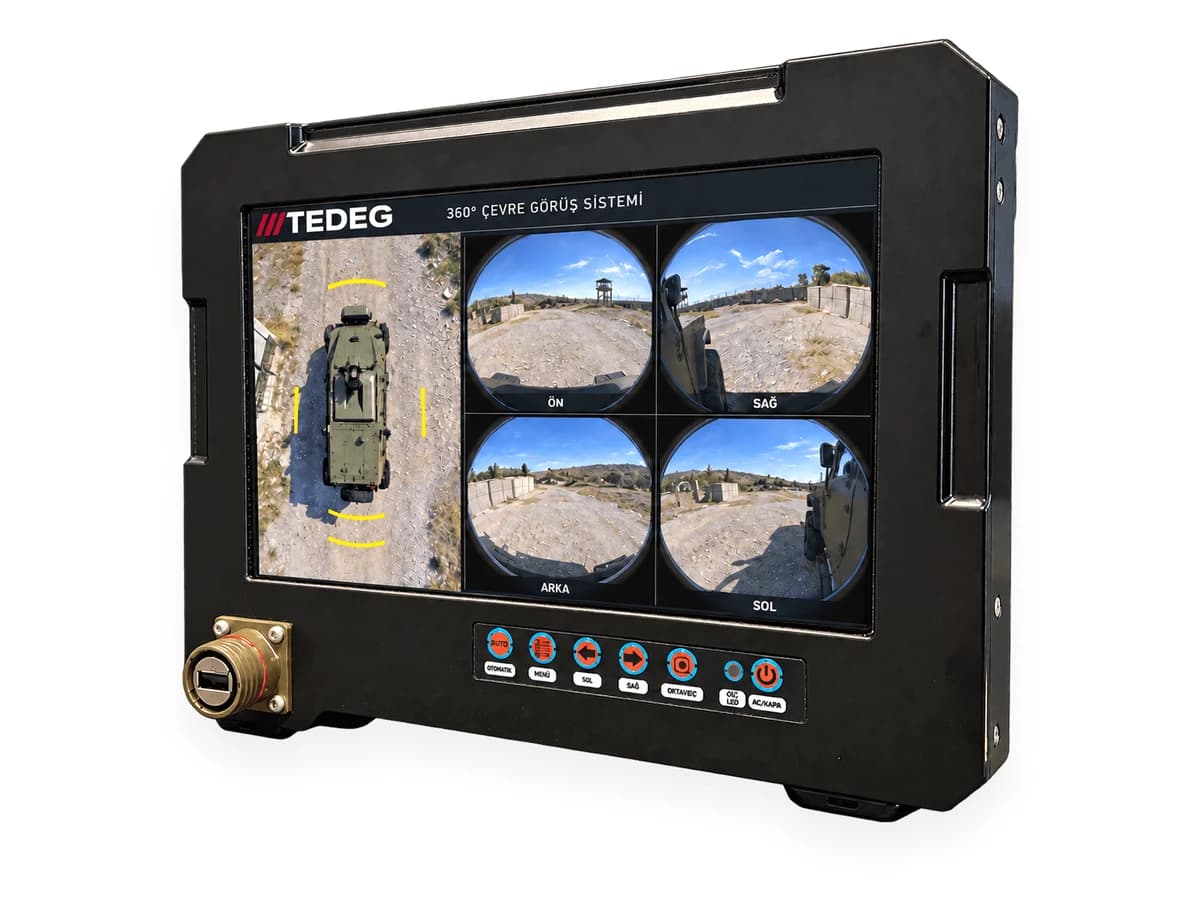
- Sunlight-readable operator screen for cameras and the mission computer: TDG-DSP-101 10.1" Rugged Vehicle Display — 1920 × 1200 WUXGA, PCAP multi-touch, 600 cd/m², 3 mm tempered anti-glare glass, HDMI and USB on MIL-DTL-38999 connectors, 9–36 VDC, IP65 front
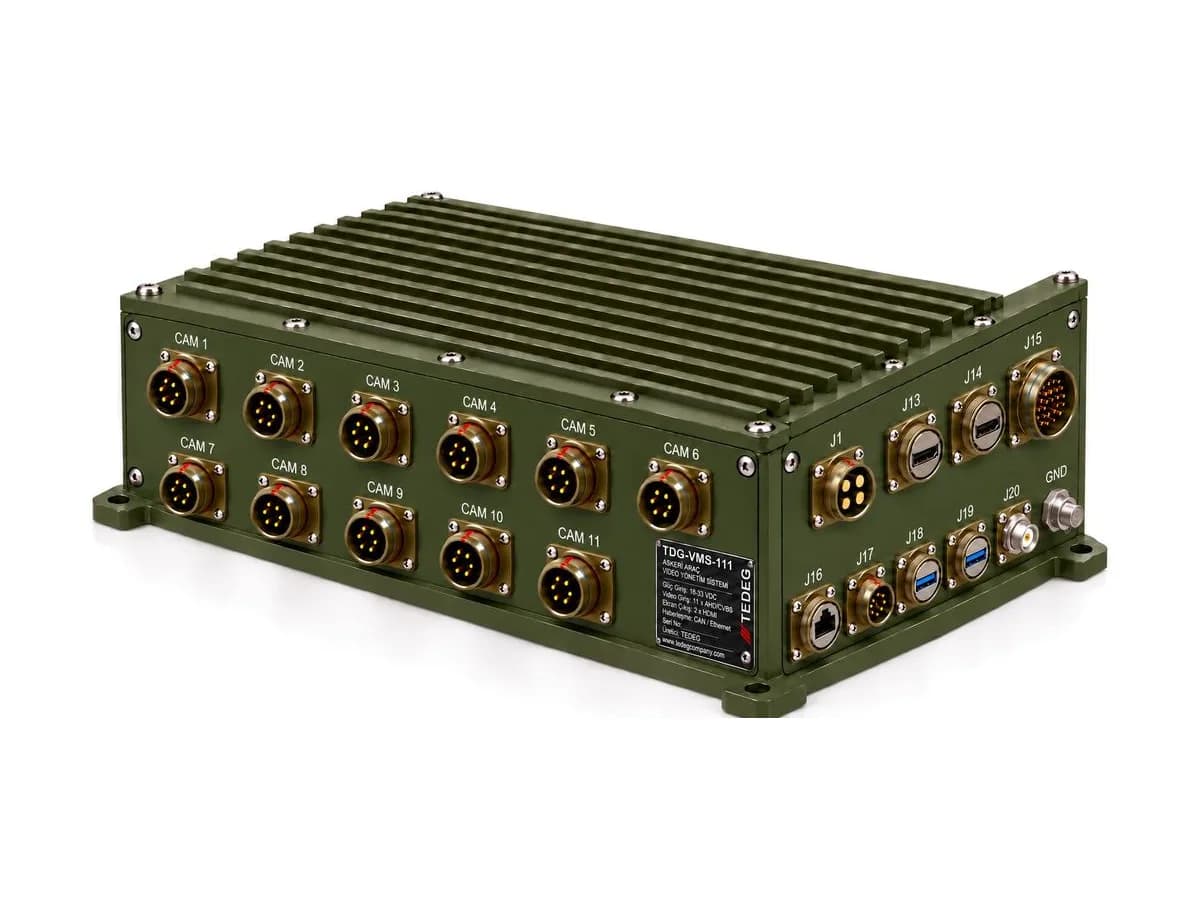
- Collecting, switching, recording and distributing up to 11 vehicle cameras: TDG-VMS-111 Military Vehicle Video Management System — 11 × AHD/CVBS inputs with isolated 12 VDC camera supply, real-time 360° bird's-eye view, 2 × HDMI outputs, CAN J1939 vehicle signals, optional H.265 recording and AI analytics, 28 VDC MIL-STD-1275E, IP67
SENTRA KBM carries power, video, audio and IR control lines together on a single MIL-DTL-38999 connector per camera. Configuration, pin assignments and harness interfaces are finalised for the platform through a pre-order ICD.
For the cameras themselves see Vehicle Camera Systems. For the vehicle's main electrical distribution see Power Distribution Units (PDU); for multi-level DC and AC supply from a 24 VDC vehicle bus see TPS-24DCAC.
The camera chain of this family — SENTRA KBM camera power, the TDG-VMS-111 video management unit, the TDG-DSP-101 display and the TDG-CAM cameras — is presented as one set in the End-to-End Vehicle Vision System catalogue (PDF).
FAQ
How do I choose between SENTRA KBM and SENTRA-16?+
The two products do different jobs and can be used together on the same vehicle. The SENTRA KBM Camera Power Distribution Module supplies the vehicle's cameras, operator display, mission computer and seat module from a single unit; choose it when power distribution and the collection of video lines are the task. The SENTRA-16 Seat & Seat-Belt Monitoring System monitors the occupancy of 16 seats and the fastened / unfastened status of 16 seat belts and passes the data to the mission computer over CAN-Bus. The cameras themselves are in the Vehicle Camera Systems category.
How does SENTRA KBM connect to the vehicle electrical system, and what outputs does it provide?+
The input is a 28 VDC military vehicle electrical system to MIL-STD-1275E, with reverse polarity protection and galvanic isolation. On the output side there are at least 11 isolated 12 VDC camera outputs, a 24 VDC ±0.2 V mission computer output (min. 200 W), an isolated 24 VDC display output (min. 25 W) and a separate seat module output. All connections use MIL-DTL-38999 connectors; a single 5-pin connector per camera carries video, audio and IR control lines together with the supply, and the video lines are collected on one harness (min. 12 × 75 Ω).
How does SENTRA-16 communicate with the vehicle mission computer?+
The unit reads its sensors over 32 channels (16 seats + 16 belts) and sends the data to the vehicle mission computer, and if required to the safety and warning systems, over CAN-Bus (ISO 11898, 500 kbps). It runs from 18–32 VDC (24 VDC nominal) and draws less than 15 W; the physical connection is a MIL-DTL-38999 connector, and the flanged base bolts to the vehicle chassis. If the vehicle has no display, SENTRA-16 can be supplied as a single package with an optional TEDEG military monitor.
What environmental conditions and standards are they designed for?+
The SENTRA KBM datasheet specifies −32 °C … +55 °C operation, a ≥ IP55 aluminium enclosure and humidity, altitude (≥ 2,500 m), rain, sand-dust, salt fog, solar radiation, vibration and 20 g / 11 ms shock to MIL-STD-810G CHG-1 methods; for EMI/EMC it lists MIL-STD-461G CE102, CS101/114/115/116, RE102 and RS103. SENTRA-16 is designed for an IP65 enclosure, −32 °C … +55 °C operation and −40 °C … +70 °C storage. If your programme requires qualification, we agree the test plan and your report requirements with you at the quotation stage.
Can pin assignments and the harness be adapted to our platform?+
Yes. SENTRA KBM is a COTS product, but configuration, pin assignments and harness interfaces are finalised for your platform through a pre-order ICD (Interface Control Document), and you can request a 3D CAD / STEP file for integration work. SENTRA-16's modular architecture adapts to different vehicle platforms, and the product can be supplied together with a TEDEG military monitor for visual monitoring.
What information should I send for a quotation and datasheet?+
Turkish and English datasheets for both products are on the product pages. For a quotation, send the platform type, the number and positions of cameras, the power needs of the display and mission computer, the number of seats to be monitored and the vehicle data bus (CAN-Bus) details through the quote form; the ICD and harness details are completed together before the order.
Engineering Support
Our engineering services can adapt the products in this category to your platform, integrate them or test them against your programme requirements.
Related Guides
Other product categories
Looking for the full range?
Contact our engineering team for datasheets and quotations.