
Armoured Vehicles and Military Trucks
Armoured Military Truck — From Video Interference on 11 Cameras to a Clean Picture with Isolated Power
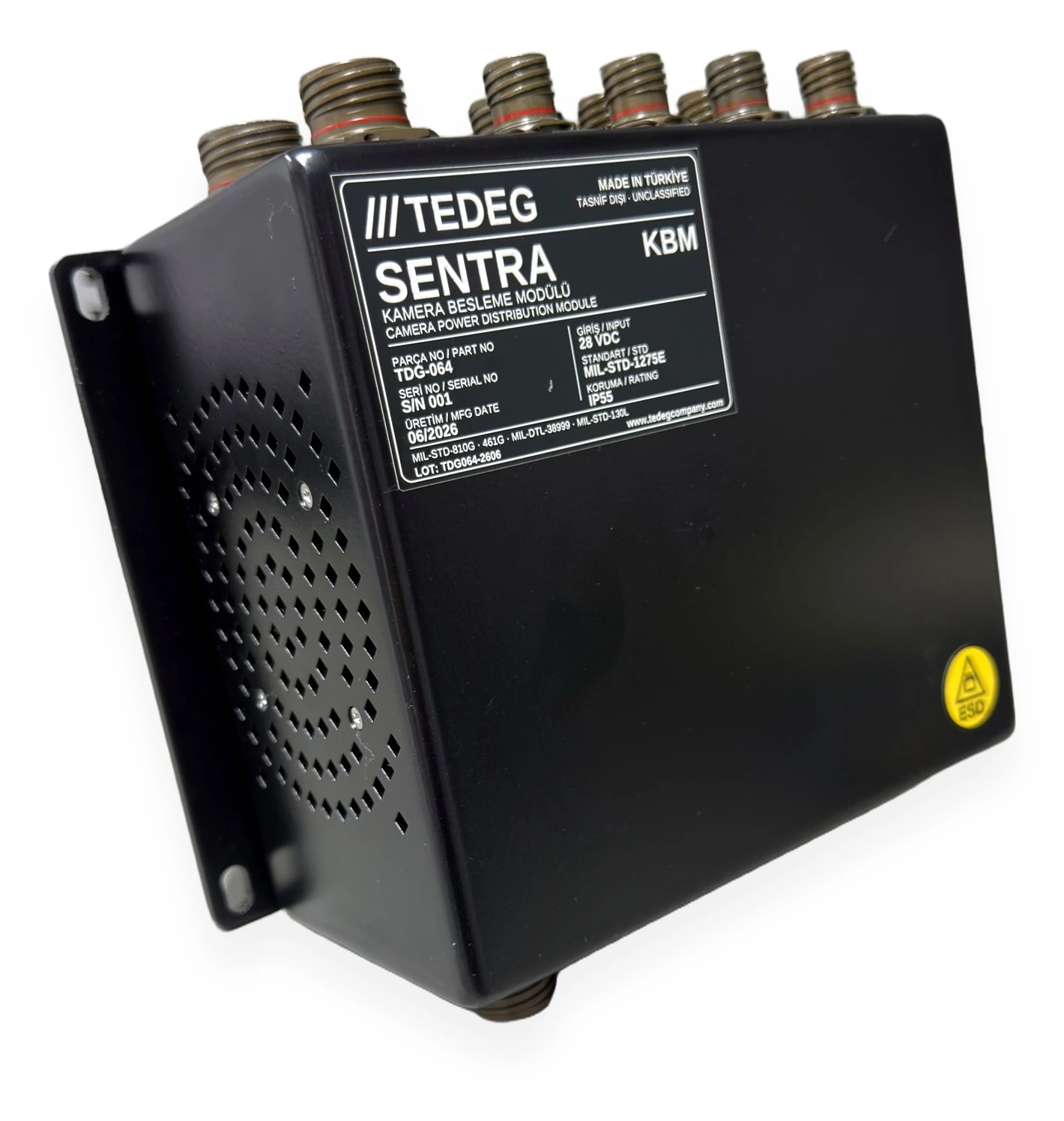
On an armoured truck platform whose display showed jagged, noisy camera images, the root cause was the vehicle ground; the fix was the isolated SENTRA KBM power module, which separates the cameras completely from the vehicle chassis.
- Platform
- Armoured military truck platform — 11-camera vision system and military display
- Customer
- Leading Turkish Armoured Vehicle and Military Truck Platform Manufacturer
- Sector
- Defence · vehicle electronics (vetronics)
- Year
- 2025
Customer & Context
A leading Turkish manufacturer of armoured vehicles and military truck platforms had integrated an 11-camera vision system on its armoured truck platform. The cameras were vehicle cameras from TEDEG's TDG-CAM range, and the images were shown to the driver and commander on a military display in the cab.
The system worked on the vehicle, but image quality fell short. Feedback from the manufacturer's field and acceptance trials was consistent: the images on the display were jagged, noisy and not sharp. At first it was not clear whether the cameras or the display were at fault; each unit worked without problems on its own.
In 2025 the manufacturer came to TEDEG Defence with one question: can this interference be eliminated? The expectation was a permanent fix on the vehicle, suitable for series production, without changing the camera or display hardware.
Challenge
TEDEG engineers examined the camera, display and power chain together on the vehicle. The cameras and the display were sound; the problem lay in how the power was connected to the vehicle:
- Common ground: the cameras were fed from lines tied directly to the vehicle battery and vehicle GND, that is, the chassis. The camera supply return and the video line reference shared the same vehicle ground.
- Ground loops: with 11 cameras placed at different points on the vehicle, each one was grounded to the chassis at a different point. Small potential differences between those points turned into loop currents flowing through the video lines.
- Vehicle noise: transients and ripple from cranking, the alternator and load switching rode straight onto the video signal through the common ground.
- The result on the display: jagged edges, interference lines and an unsharp picture, which made situational awareness unreliable for the driver and commander.
- Fixes that did not last: rerouting cables or adding filters could reduce the symptom but did not remove its cause.
The diagnosis was clear: the camera system's power had to be isolated from the vehicle electrics, and the cameras' GND had to be completely independent of the vehicle ground.
TEDEG Solution
TEDEG Defence turned the diagnosis directly into a product and developed a fully isolated camera power module for this platform: SENTRA KBM. The module takes the vehicle's 28 VDC supply, powers each camera from its own isolated output and separates the camera-side ground from the vehicle chassis. Configuration, pin assignments and harness interfaces were finalised for the manufacturer's platform through an ICD.
Camera Power Independent of Vehicle Ground
The module input was designed to MIL-STD-1275E for the 28 VDC military vehicle electrical system, with reverse polarity protection and galvanic isolation. On the output side there are at least 11 camera outputs at 12 VDC, each isolated, and each of the platform's 11 cameras is fed from its own isolated output. The cameras' GND is now completely independent of the vehicle battery and chassis: there is no longer a path for loop currents between cameras, or between a camera and the vehicle. An isolated 24 VDC ±0.2 V output of at least 25 W was also reserved for the military display.
Power and Video on One Connector
Each camera connects through a 5-pin D38999/24WA35PN connector, which carries video, audio and IR control lines together with the supply (V+, GND). Because the camera's supply return and its video reference stay within the same isolated circuit, the video signal no longer carries noise from the vehicle ground. At least 12 video lines at 75 Ω run through a single harness, so no separate power and video cable is routed for each camera.
Designed for the Vehicle Environment
For EMI/EMC, MIL-STD-461G CE102, CS101/114/115/116, RE102 and RS103 tests were specified. The module sits in a ≥ IP55 aluminium enclosure and was installed in the vehicle with an operating temperature of −32 °C to +55 °C and MIL-STD-810G CHG-1 environmental requirements.
Outcome
The isolated power module was delivered to the manufacturer and became the platform's standard camera supply. Today it is in service on close to 60 vehicles.
- The jagged edges and interference on the display were removed at the source, by separating the camera ground from the vehicle ground.
- The camera and display hardware stayed the same; the fix is entirely on the power side.
- Each of the 11 cameras is fed from its own isolated output.
- Power and video share one MIL-DTL-38999 connector per camera, on a single harness.
- The same solution is applied identically to every vehicle in series production.
Technical Scope
Values are taken from each product's own technical data; full specifications are on the product page.
- Input
- 28 VDC · MIL-STD-1275E
- Camera outputs
- Min. 11 × 12 VDC, isolated
- Computer output
- 24 VDC ±0.2 V · min. 200 W
- Display output
- 24 VDC ±0.2 V · isolated · min. 25 W
- Seat module output
- 24 VDC ±0.2 V · isolated
- Video lines
- Single harness · min. 12 × 75 Ω
StandardsMIL-STD-810GMIL-STD-461GMIL-STD-464CView product: SENTRA KBM Military Camera Power Distribution Module
More case studies
Tactical Wheeled Vehicles · 2026
Tactical Vehicle 360° Camera Suite — From 11 Separate Power Supplies to One Power Module
For a situational awareness suite that fed its cameras, mission computer, operator display and seat module from separate supplies, the SENTRA KBM camera power distribution module, built around the customer’s Technical Requirements Document and ICD.
Read case study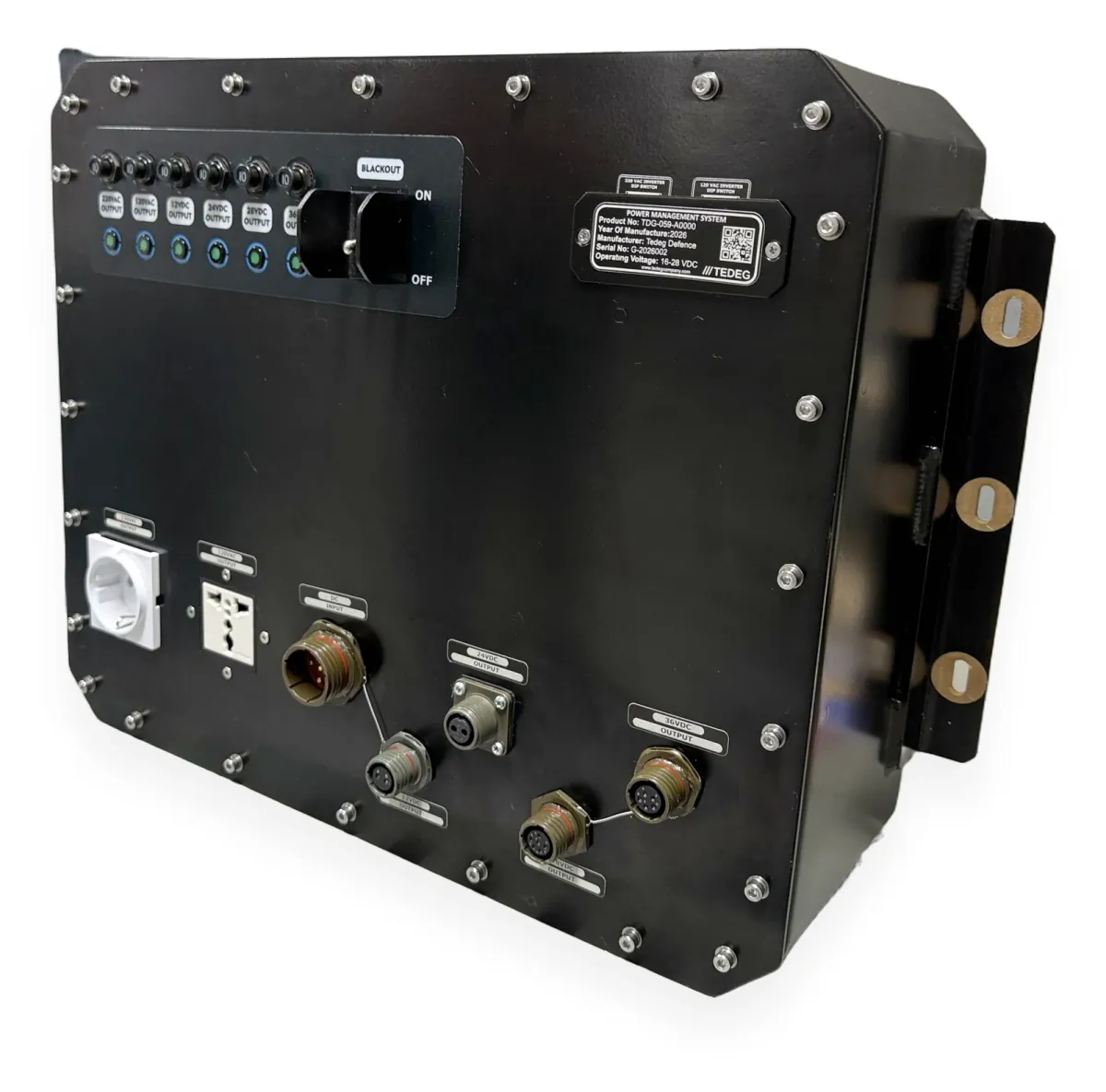
Reconnaissance and Surveillance Systems · 2024
Reconnaissance Vehicle — One Panel in Place of an Inverter, DC-DC Converters and a Distribution Panel
For a 4×4 reconnaissance and surveillance vehicle that fed four DC voltage levels and two AC outputs from separate devices, power conversion, distribution and BLACKOUT in a single 3400 W panel: the PowerGuard TPS-24DCAC.
Read case study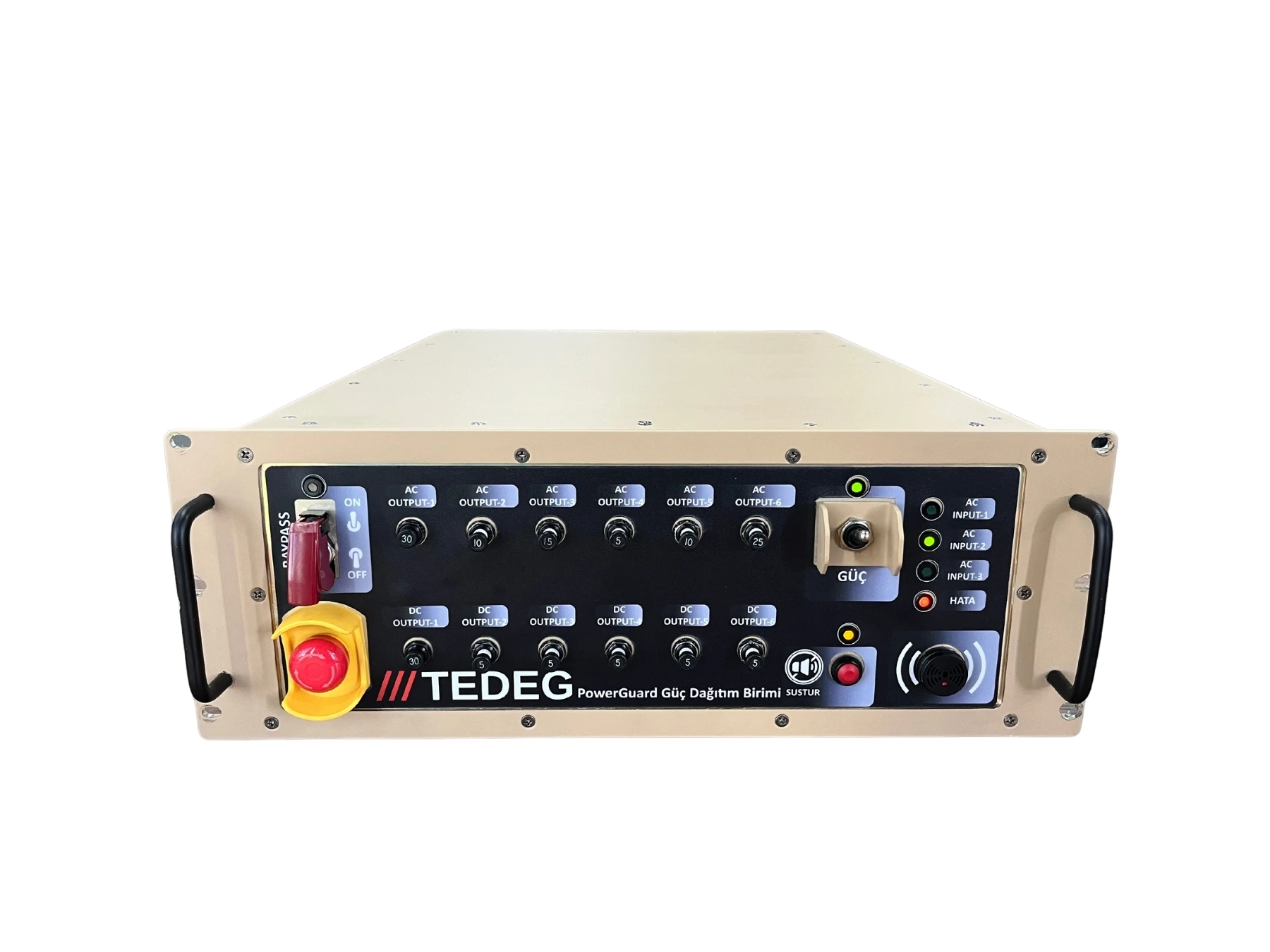
Land Platforms · 2024
Tactical Truck Power Architecture Modernisation
An ageing PDU that could no longer keep pace with growing mission loads was replaced by a remotely monitored power distribution architecture built on the PDU-RT5002 and designed to MIL-STD requirements.
Read case study