
Reconnaissance and Surveillance Systems
Reconnaissance Vehicle — One Panel in Place of an Inverter, DC-DC Converters and a Distribution Panel
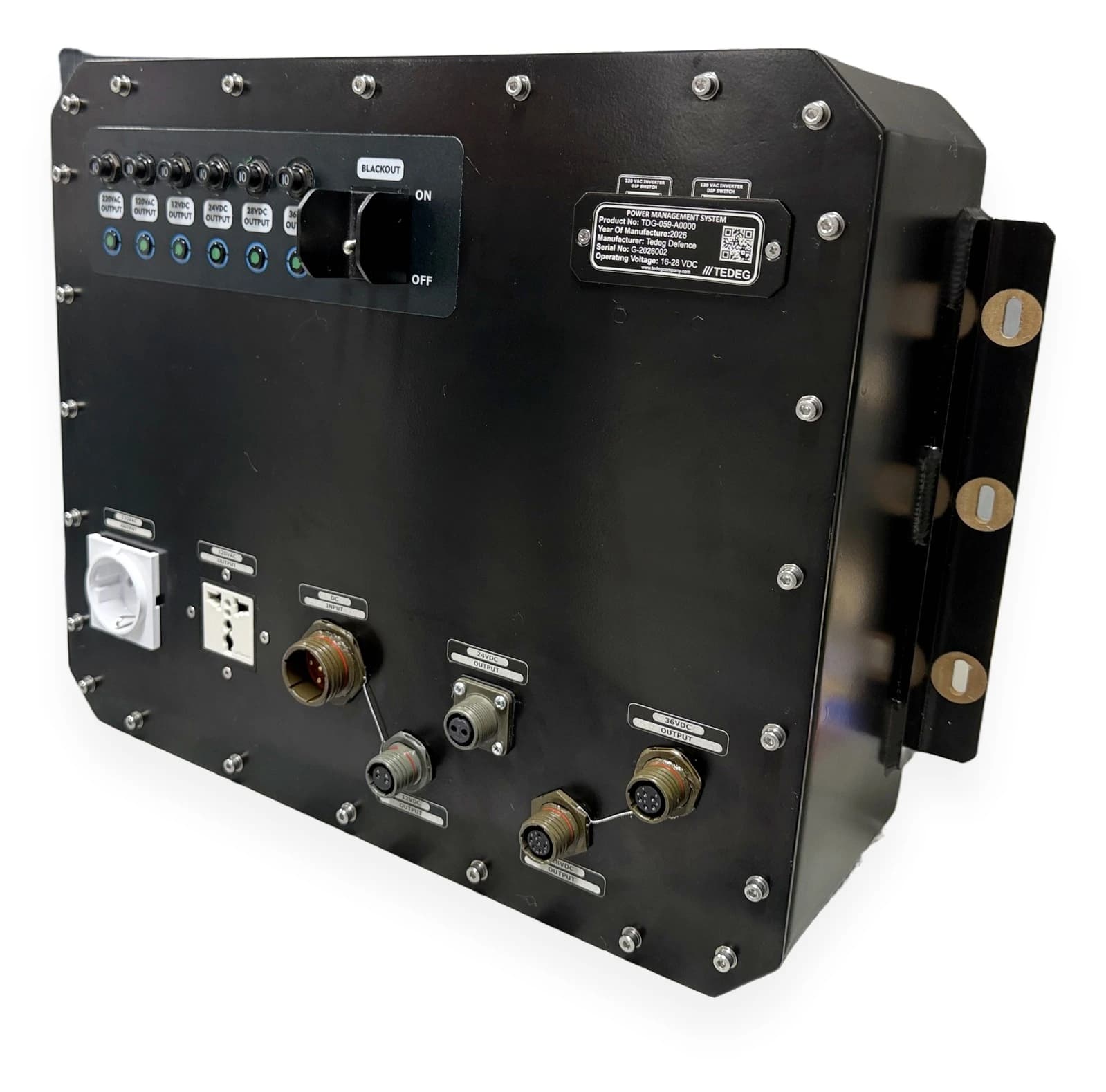
For a 4×4 reconnaissance and surveillance vehicle that fed four DC voltage levels and two AC outputs from separate devices, power conversion, distribution and BLACKOUT in a single 3400 W panel: the PowerGuard TPS-24DCAC.
- Platform
- 4×4 reconnaissance and surveillance vehicle — electro-optical / infrared (EO/IR) surveillance head on a telescopic mast, radios, mission computer, 220 VAC office and test equipment
- Customer
- Leading Turkish Electro-Optical Surveillance Systems Manufacturer
- Sector
- Land · reconnaissance and surveillance
- Year
- 2024
Customer & Context
A leading Turkish manufacturer of electro-optical surveillance systems approached TEDEG Defence for the power conversion and distribution subsystem of its 4×4 reconnaissance and surveillance vehicle programme. The vehicle powers an electro-optical / infrared surveillance head on a telescopic mast, military radios, a mission computer and the 220 VAC office and test equipment in the operator compartment, all at the same time. Between them these loads called for six voltage levels: 12, 24, 28 and 36 VDC plus 120 and 220 VAC.
On the first prototype vehicle each voltage level came from a separate device: a commercial inverter, several DC-DC converters and a separate fuse and distribution panel. The manufacturer sent TEDEG the field observation report from the prototype vehicle together with the vehicle's electrical architecture requirements. The request was for a military power conversion unit that runs from the vehicle battery, delivers all six voltage levels from one panel, produces pure sine AC and can be blacked out with a single switch on night missions.
Challenge
Field trials of the prototype vehicle and the integration team's observation report showed clearly where the scattered power architecture fell short:
- Space, weight and cabling: a separate inverter, separate DC-DC converters and a separate distribution panel meant three mounting points and three harnesses in the operator compartment. Each device had its own input cable run back to the battery line.
- Modified sine: the commercial inverter's modified sine output caused heating and noise in the surveillance head's power supply and in the measurement equipment; the sensitive electro-optical electronics needed grid-quality AC.
- Light signature at night: every device had its own status LED, and they could not be switched off together. In surveillance and ambush scenarios the indicator lights in the operator compartment were a risk in themselves.
- Protection and failure points: each device protected itself with its own thresholds; finding out which device an overcurrent on one line had affected meant working at the vehicle.
- Isolation: the DC output returns were bonded to the chassis differently in each device, and ground-loop noise had been reported on the sensor lines.
- Maintenance: replacing a failed converter meant disturbing the wiring of three separate devices.
The manufacturer decided to have TEDEG build a single military panel that would cover all of these requirements.
TEDEG Solution
TEDEG Defence brought the manufacturer's requirements together in the PowerGuard TPS-24DCAC Power Conversion Unit: four regulated DC levels, two pure sine AC outputs, a circuit breaker on every line and BLACKOUT mode in one aluminium panel. The output connector set and the mounting layout were defined to match the vehicle harness and the panel bay in the operator compartment.
Six Voltage Levels, One Input
The panel takes a wide-range 16–28 VDC input (24 VDC nominal) from the vehicle electrical system through a D38999/24WE6PN connector, protected by a 100 A fuse inside the enclosure. Six independent power lines are fed from the DC bus: the 12, 24, 28 and 36 VDC outputs at 10 A each (120, 240, 280 and 360 W), and the 120 VAC and 220 VAC pure sine outputs at 10 A and 1200 W each. Total installed output power is 3400 W; because the total current at simultaneous full load is limited by the 100 A input fuse and the vehicle supply capacity, the vehicle load plan was prepared with a diversity factor. All outputs are galvanically isolated from the input and from each other, and each DC rail has an independent return that is not bonded to the vehicle chassis. DC-DC efficiency is typically 80% and DC-AC efficiency typically 90%. Each DC rail terminates in its own military circular connector (D38999 and MS3102), and the AC lines in universal and Schuko sockets.
Protection, BLACKOUT and Night Missions
Every one of the six lines has a front-panel 10 A push-pull thermal circuit breaker and a green LED status indicator supplied at the rail voltage; overcurrent, overvoltage, short-circuit and over-temperature protection operate at panel level. The front-panel BLACKOUT switch extinguishes all status indicators in one action through a relay group; the power lines are not interrupted, only the light signature disappears. In a surveillance or night-movement scenario the operator therefore darkens every indicator light in the compartment with one switch. The EMI gasket at the front panel–chassis interface, the EMI mesh across the fan openings and the aluminium enclosure make up the EMI design of a panel that works in the same compartment as the surveillance electronics.
Thermal Management, Mechanical Design and Maintenance
Four 24 VDC fans on the underside are engaged automatically by a 60 °C thermostat. The panel runs continuously at 100% full load between −20 °C and +40 °C; at +60 °C the DC-DC modules continue at 70% and the DC-AC modules at 60% capacity. The enclosure is welded aluminium sheet with MIL-C-5541 Class 1A chromate conversion coating under RAL 9005 matte black powder coat. It measures 420 × 350 × 147 mm and weighs 17–20 kg; the two mounting brackets on the rear face were used to fit the vehicle's panel bay. The removable front panel, held by 24 × M4 perimeter screws, gives full access to the internal modules; thanks to the modular power boards a faulty module can be replaced in the field without returning the unit to a depot. A laser-marked metal label carries the part number, serial number and QR code.
Outcome
The TPS-24DCAC was delivered to the manufacturer's reconnaissance and surveillance vehicle programme and replaced the inverter, DC-DC converters and distribution panel of the prototype vehicle.
- One 17–20 kg panel in place of three separate devices; a single mounting point and a single input cable in the operator compartment.
- Six voltage levels (4 DC + 2 AC) from one panel, each with its own circuit breaker and connector.
- Pure sine AC supplies the surveillance head and the measurement equipment at grid quality.
- With the BLACKOUT switch every indicator is extinguished in one action on night missions, with no interruption to power.
- The removable front panel and modular boards allow maintenance on the vehicle.
Measurable Results
| Metric | Previous | TEDEG Solution | Gain |
| Power conversion and distribution devices | 3 (inverter + DC-DC converters + distribution panel) | 1 panel, 17–20 kg | Single mounting point, single input cable |
| Voltage levels | Each level from a separate device | 6 (4 DC + 2 AC) from one panel | 10 A circuit breaker and connector per line |
Technical Scope
Values are taken from each product's own technical data; full specifications are on the product page.
- Input
- 16–28 VDC (24 VDC nominal)
- DC outputs
- 12 · 24 · 28 · 36 VDC (10 A each)
- AC outputs
- 120 VAC + 220 VAC pure sine, 1200 W
- Total power
- 3400 W
- Efficiency
- DC-DC typ. 80% · DC-AC typ. 90%
- Operating temp.
- -20 °C to +60 °C
- Input
- 230 VAC ±10%, 50 Hz (universal 90–264 VAC)
- Output
- Isolated 28 VDC, 3 independent converter modules
- Switched outputs
- M1: 4 × 10 A + 1 × 50 A · M2/M3: 4 × 2 A + 1 × 10 A
- Total output power
- ≈1.7 kW
- Ripple and noise
- Max. 150 mVp-p
- Communication
- 1 × RS-485 HD, 4.2 Mbps; MCU-based control
StandardsMIL-STD-461MIL-STD-810GView product: PowerGuard TPS-28 Military Power Management Module (28 VDC Output)- Input
- 10–18 VDC (12 VDC nominal)
- Output
- 24 VDC regulated (23.8–24.5 V)
- Output current
- 41.7 A continuous (45 A max., current limit ~110%)
- Power
- 1000 W continuous, no derating up to +55 °C
- Efficiency
- ≥ 90% (12 V input, full load)
- Regulation
- ±1% typ., ±2% max. (line and load)
StandardsMIL-STD-461MIL-STD-810GView product: PowerGuard-D1000 Mil-Spec DC-DC Converter — 1 kW MIL-STD-1275
More case studies
Land Platforms · 2024
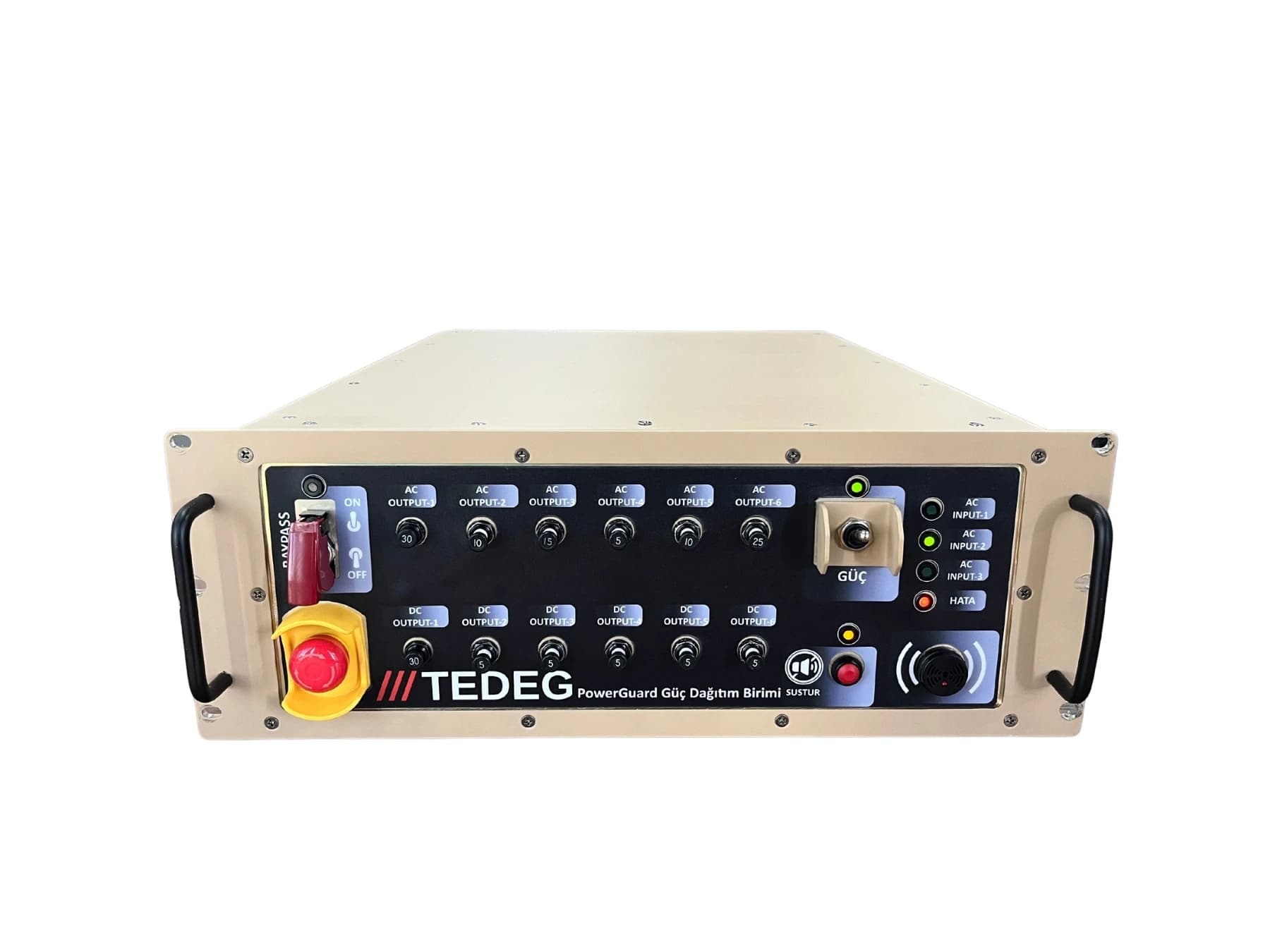
Tactical Truck Power Architecture Modernisation
An ageing PDU that could no longer keep pace with growing mission loads was replaced by a remotely monitored power distribution architecture built on the PDU-RT5002 and designed to MIL-STD requirements.
Read case study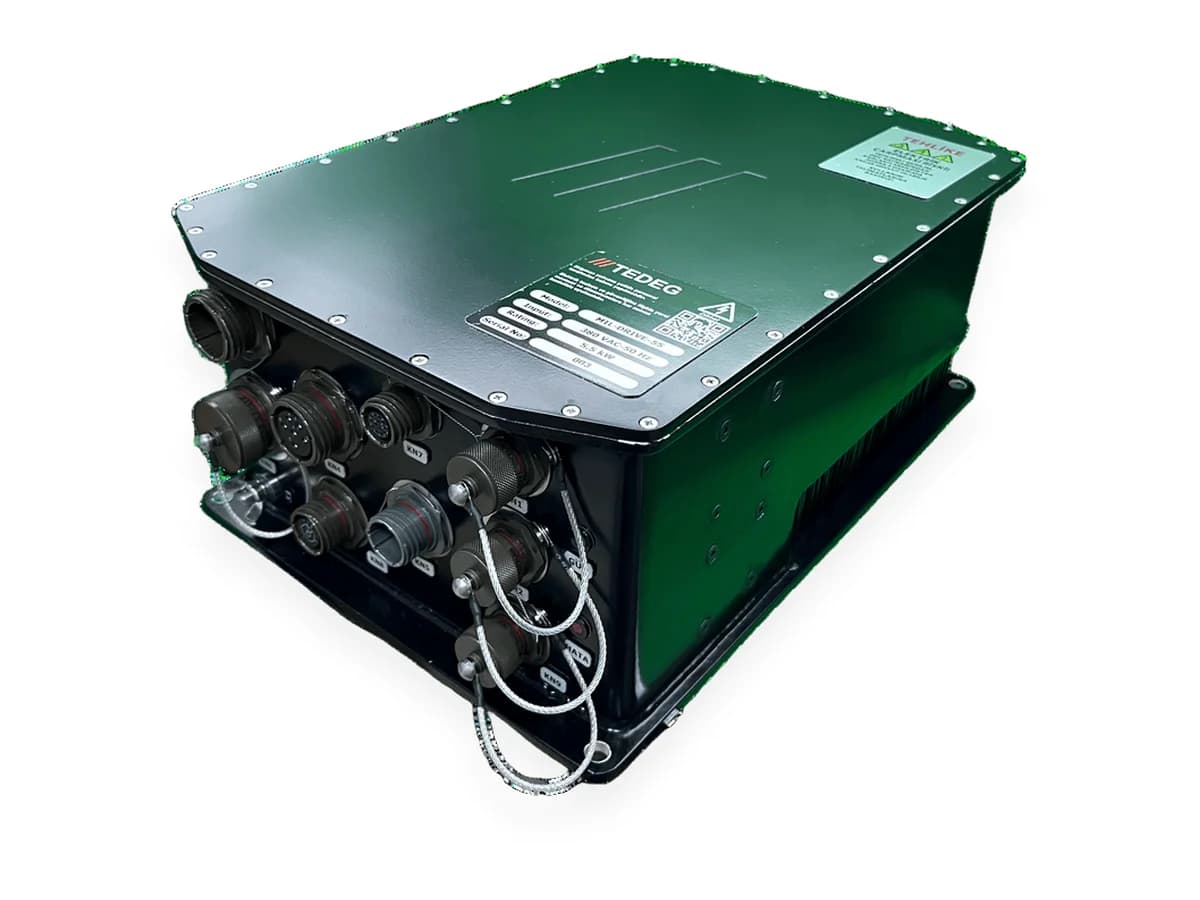
Air Defence · 2025
Mobile Air Defence Platform — Pedestal Motor Control & Radar Frequency Feed
A motor drive and a frequency converter sourced from separate foreign suppliers were replaced by a matched TEDEG pair, designed together so that neither interferes with the other.
Read case study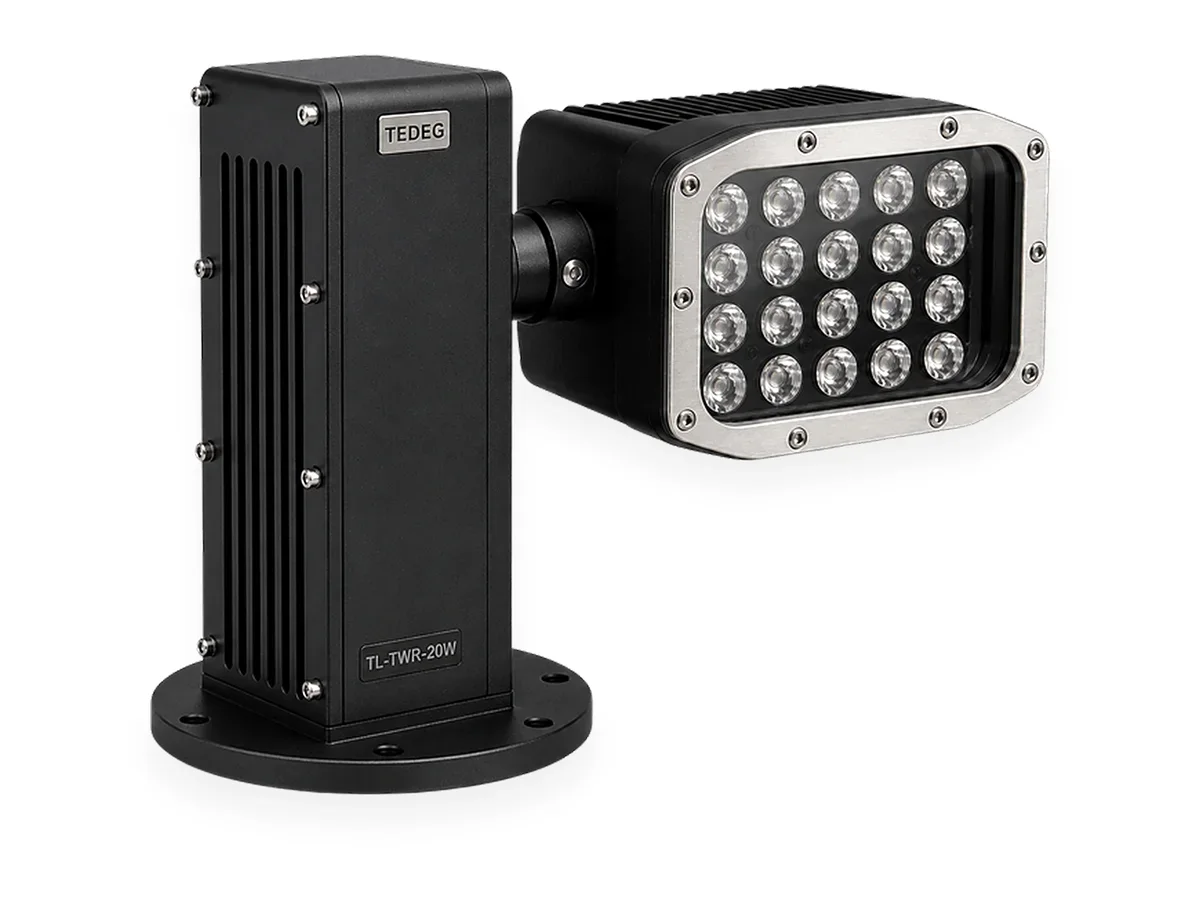
Lighting Systems · 2024
Supplier transitionMilitary Spotlight System — A Domestic LED Solution to Recurring Field Failures
A competitor's spotlight that kept failing in the field was replaced by a domestic design with a sealed enclosure, a reworked motion system and LED electronics.
Read case study