
TDG-VMS-111 Military Vehicle Video Management System — 11 Cameras, 360° Surround View, 28 VDC
Part number (P/N)
TDG-VMS-111
Camera inputs
11 independent channels · AHD 1080p / 720p and CVBS PAL/NTSC, auto-detected per channel
Camera supply
Isolated 12 VDC, 0.5 A per channel · short-circuit and over-current protected
Display outputs
2 × HDMI 1.4 (1920 × 1200 @ 60 Hz), independent content · 1 × CVBS
360° view
Real-time bird's-eye stitching of 4 wide-angle cameras · configurable vehicle model
Latency / boot
< 80 ms glass-to-glass (single view) · first image < 3 s after ignition
Vehicle interface
2 × CAN 2.0B (J1939) · 2 × RS-422/485 · 8 discrete inputs · 4 discrete outputs
Network
Gigabit Ethernet · RTSP / ONVIF Profile S streaming, H.264/H.265
Recording (option -R)
H.265, 11 channels at 1080p @ 25 fps · removable 2 TB SSD (up to 4 TB), AES-256
Supply
18–33 VDC (28 VDC nominal), MIL-STD-1275E · ≤ 25 W base, ≤ 40 W with recording + AI
Company:ITAR-FreeNCAGE: TM885
Overview
Product and Purpose
TDG-VMS-111 is a military vehicle video management system developed by TEDEG for armoured and tactical land vehicles. It collects, processes, records and distributes the imagery of up to 11 cameras in a single unit: 360° surround-view cameras, rear view, driver front view, interior, cargo bay and turret-line cameras all connect to the same box, and the driver and commander choose the views they need on two independent displays.
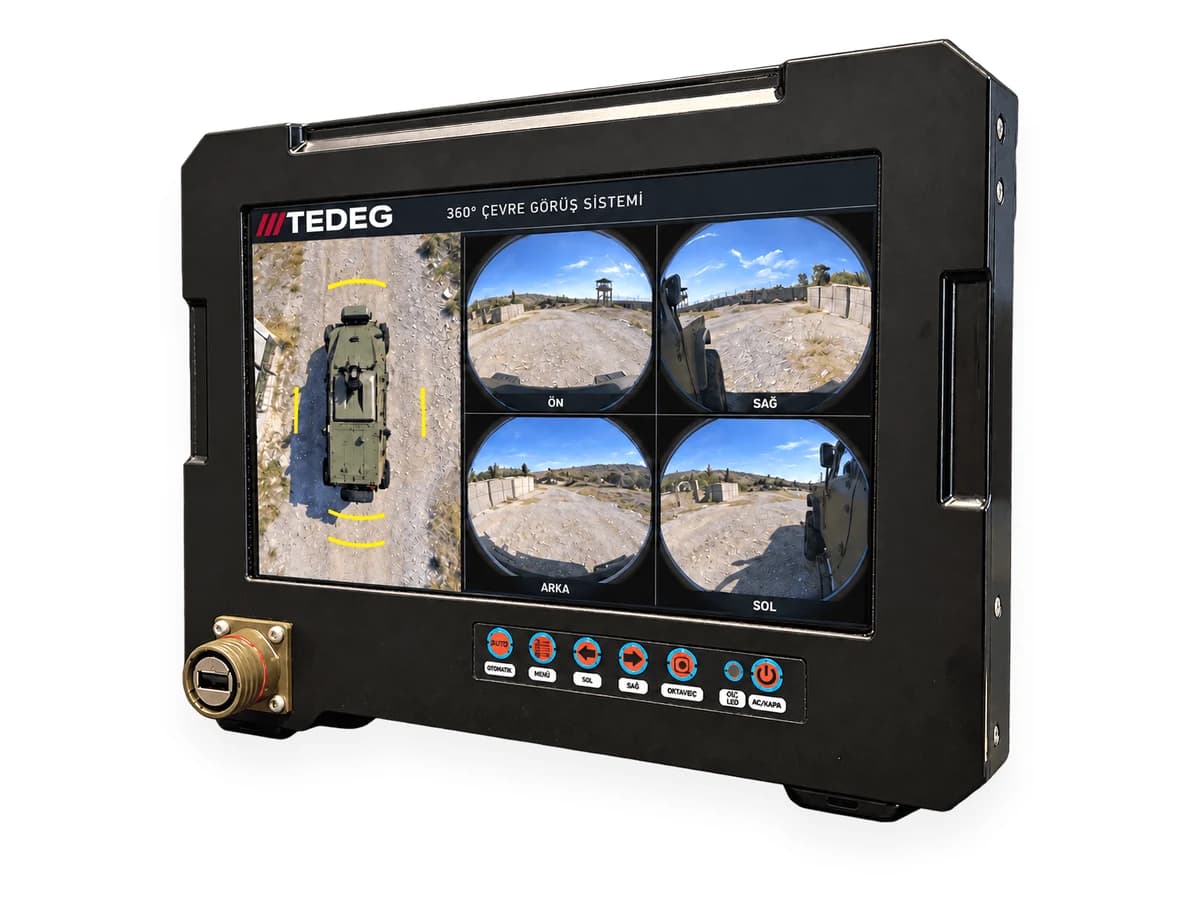
Instead of an operating-system based computer, the unit uses a real-time embedded video processor architecture. The first image is on screen less than 3 seconds after ignition, camera-to-display latency stays below 80 ms, and the views switch automatically from vehicle signals such as reverse gear, turn indicators and speed. The bird's-eye 360° view stitched from four wide-angle cameras completes the driver's field of view during closed-hatch driving and manoeuvres in confined spaces.
The optional recording module stores all 11 channels in H.265 on a removable SSD, and the optional AI analytics module detects personnel, vehicles and weapons and warns the crew. With a fanless aluminium enclosure, MIL-DTL-38999 connectors, IP67 protection and a design basis of MIL-STD-810G, MIL-STD-461G and MIL-STD-1275E, the unit mounts directly on the vehicle chassis. Together with TDG-DSP-101 displays, TDG-CAM vehicle cameras and the TDG-VMS-KP control panel it forms the end-to-end TEDEG vehicle vision package.
Engineering Capability
Video inputs and outputs:
| Parameter | Value |
|---|---|
| Camera inputs | 11 channels, independent (J2…J12) |
| Input video format | AHD 1080p / 720p (25/30 fps) and CVBS PAL/NTSC; automatic detection per channel |
| Camera supply | Isolated 12 VDC, 0.5 A per channel; short-circuit and over-current protected, per-channel switching |
| Display outputs | 2 × HDMI 1.4 (1920 × 1200 @ 60 Hz), independent content; touch return via USB 1 / 2 |
| Analogue video output | 1 × CVBS for a legacy monitor or recorder; AHD optional |
| Network video output | RTSP / ONVIF Profile S, H.264/H.265, 1080p per channel, to the mission computer over Gigabit Ethernet |
| Glass-to-glass latency | < 80 ms (camera to display, single view); < 120 ms (360° stitched view) |
| Boot time | First image < 3 s after ignition; full function < 10 s |
Image processing, recording and analytics:
| Function | Description |
|---|---|
| 360° bird's-eye view | Real-time stitching of 4 wide-angle cameras; configurable vehicle model and scale |
| View modes | Single, dual, quad, 3+1, 360°+rear, 360°+selected camera, picture-in-picture; 8 user-defined view presets |
| Automatic view switching | Driven by reverse gear, turn indicators, speed threshold and door/ramp signals (CAN or discrete input) |
| Image processing | Digital zoom ×2 / ×4, mirror / rotate, day–night mode, contrast and brightness, lens distortion correction |
| On-screen display | Camera name, time stamp, vehicle speed and gear, warning icons; rear-view distance guide lines (static and steering-linked) |
| Motion detection | Zone-based motion detection per channel in parking / surveillance mode with on-screen alert |
| AI analytics (-A) | Detection and classification of personnel, vehicles and weapons; blind-spot and approach warning; 11 channels at 1080p simultaneously |
| Recording (-R) | H.265 / H.264, 11 channels simultaneously at 1080p @ 25 fps; loop recording, event recording by G-sensor and external trigger, pre/post-event buffer |
| Storage (-R) | Removable industrial SSD 2 TB (up to 4 TB), −40 °C grade; AES-256 encryption; SD card backup |
| Recording time | 11 channels 1080p H.265 ≈ 60 h on 2 TB; depends on channel and quality settings |
Interfaces and connectors:
| Connector | Signals and type |
|---|---|
| J1 – Power | 18–33 VDC (28 VDC nominal), MIL-STD-1275E; ignition input; reverse polarity, over-voltage and surge protection; MIL-DTL-38999 Series III shell size 13, 4 contacts |
| J2…J12 – Camera 1–11 | AHD/CVBS video + 12 VDC supply + shield; MIL-DTL-38999 Series III shell size 9, 6 contacts; socket contacts on the unit |
| J13 / J14 – HDMI output 1 / 2 | HDMI 1.4 for the driver and commander displays; MIL-DTL-38999 Series III shell with HDMI insert |
| J15 – Vehicle interface | 2 × CAN 2.0B (J1939 / custom), 2 × RS-422/485, 8 discrete inputs (6–33 V), 4 discrete outputs (0.5 A); shell size 19 |
| J16 – Ethernet | 1 × 10/100/1000BASE-T for RTSP streaming, configuration and firmware update; MIL-DTL-38999 shell with RJ45 insert |
| J17 – Control panel | CAN + 12 VDC for the TDG-VMS-KP backlit 8-key panel; shell size 11 |
| J18 / J19 – USB 1 / 2 | USB 3.0 Type A; display touch return and service / recording export; MIL-DTL-38999 shell with USB 3.0 insert, capped |
| J20 – GPS antenna (-G) | TNC female, 50 Ω; 3.3 V feed for an active GNSS antenna |
| GND | M6 chassis ground stud |
| Power consumption | ≤ 25 W base unit; ≤ 40 W with recording + AI; camera supply excluded (max. 11 × 6 W = 66 W) |
On interfaces where the unit supplies power (camera, control panel, vehicle interface) the unit side has socket contacts, so no live pins are exposed; on the power input the unit side has pin contacts and the vehicle harness plug has sockets. Full connector part numbers and pin assignments are given in the interface control document (ICD).
Mechanical and environmental:
| Parameter | Value |
|---|---|
| Enclosure | Machined aluminium alloy 6061-T6, conduction-cooled finned top cover; fanless, no moving parts |
| Dimensions | 300 × 220 × 80 mm (excluding connectors); flanged base 328 × 248 mm |
| Weight | ≤ 4.5 kg (including SSD) |
| Mounting | 4 × M8 flange holes; optional shock-mount kit; any orientation |
| Finish | Chrome-free chemical conversion coating + polyurethane paint; RAL 6014 NATO green standard, RAL 7021 or customer colour optional |
| Ingress protection | IP67 (connectors mated or capped); IP6K9K wash-down option |
| Operating temperature | −40 °C … +70 °C (continuous, full load); cold start at −40 °C without heater |
| Storage temperature | −55 °C … +85 °C |
| Humidity | 95% RH, condensing (MIL-STD-810G Method 507.5) |
| Vibration / shock | MIL-STD-810G Method 514.6 (tracked and wheeled vehicle profiles), Method 516.6 (40 g, 11 ms) |
| Other environmental | Sand and dust (510.5), salt fog (509.5), altitude 4,572 m (500.5), fungus (508.6) |
| EMI/EMC | MIL-STD-461G: CE102, CS101, CS114, CS115, CS116, RE102, RS103 (ground vehicle) |
| Power quality | MIL-STD-1275E (28 VDC ground vehicle): ripple, spikes, surges and voltage dips |
| Reliability | MTBF > 50,000 h (MIL-HDBK-217F, ground mobile, +40 °C) |
Options and variants (order codes):
| Code | Description |
|---|---|
| TDG-VMS-111 | Base unit: 11 camera inputs, 2 HDMI display outputs, 360° stitching, view manager, CAN/discrete vehicle interface |
| TDG-VMS-111-R | Recording: built-in H.265 recording engine, 2 TB removable SSD, G-sensor, event recording |
| TDG-VMS-111-A | AI analytics: object detection and classification, blind-spot / approach warning, intelligent alarms and tagging |
| TDG-VMS-111-G | GPS/GNSS receiver and antenna port; position and time stamping, speed source |
| TDG-VMS-111-N | IP camera expansion: 4 × PoE+ Gigabit ports (M12 X-coded), up to 8 additional IP camera channels |
| TDG-VMS-111-T | Thermal camera input: 1 × digital (LVDS/Ethernet) LWIR camera channel, visible + thermal overlay |
| TDG-VMS-111-E | Extended recording: 4 TB SSD and 2 TB SD backup |
| TDG-VMS-KP | Backlit 8-key control panel (NVIS compatible), CAN connected, IP67 |
| TDG-VMS-CBL-xx | Camera and display cable assemblies: 3 / 5 / 10 / 15 m, armoured, MIL-DTL-38999 terminated |
| TDG-VMS-SM | Shock-mount kit (4 elastomer isolators + plate) |
Option letters can be combined (for example TDG-VMS-111-RAG: recording + AI + GPS). For applications with more than 11 cameras, the -N variant adds 8 IP camera channels while keeping all 11 analogue channels. View layouts, the vehicle model and OSD content are defined over Ethernet with the TDG-VMS Config software (Windows). Specifications are Rev. 01 preliminary design values and will be updated as qualification testing is completed.
Typical Applications
- Armoured combat and tactical wheeled vehicles: 360° situational awareness and closed-hatch driving
- Tracked and engineering vehicles: rear view, trailer and cargo bay monitoring
- Command-and-control and personnel carriers: interior and ramp surveillance, commander display
- Convoy and patrol vehicles: motion detection and recording in parking / surveillance mode
- Turreted platforms: turret-line camera and T-Light TWR searchlight integration
The TEDEG Advantage
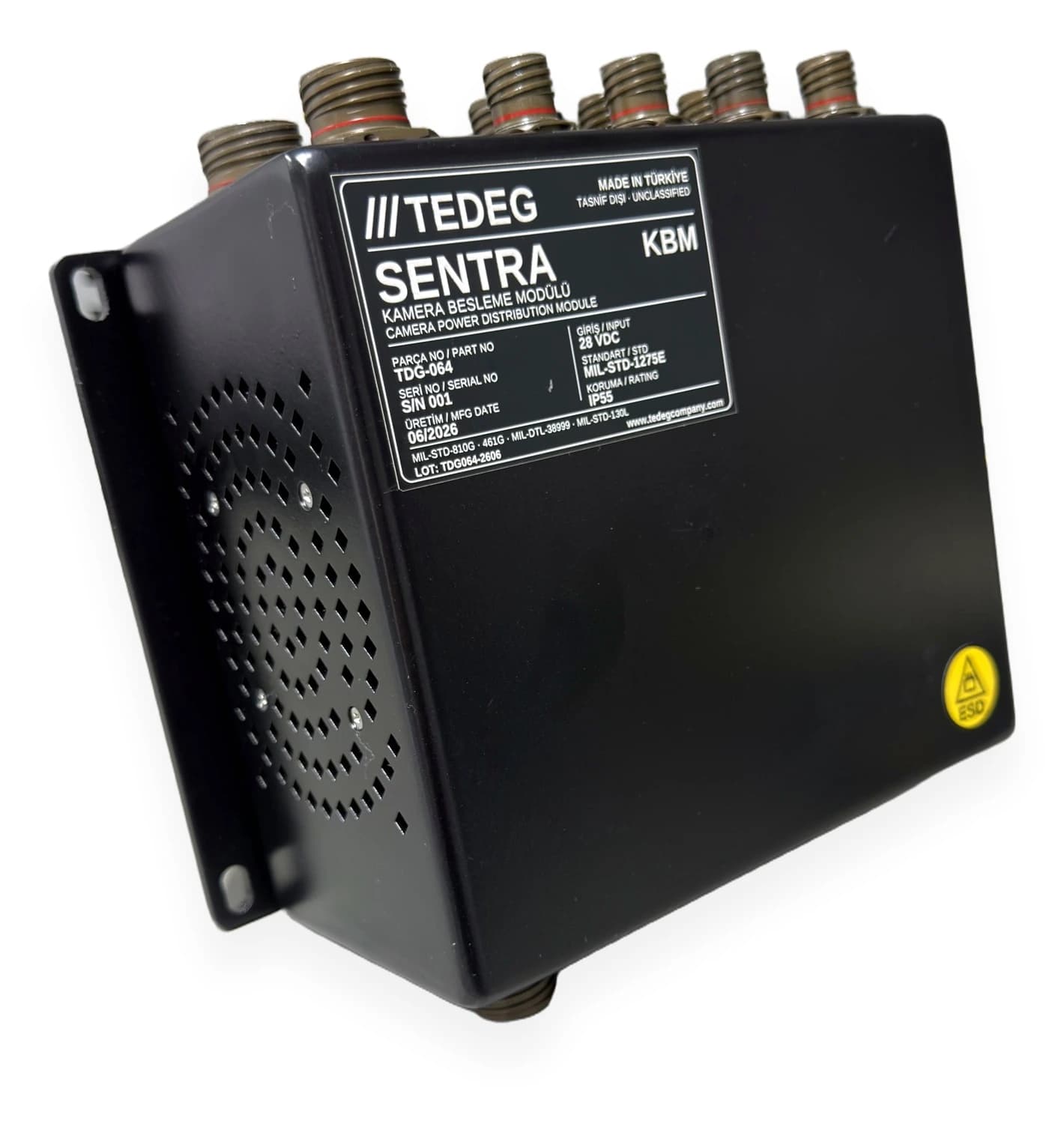
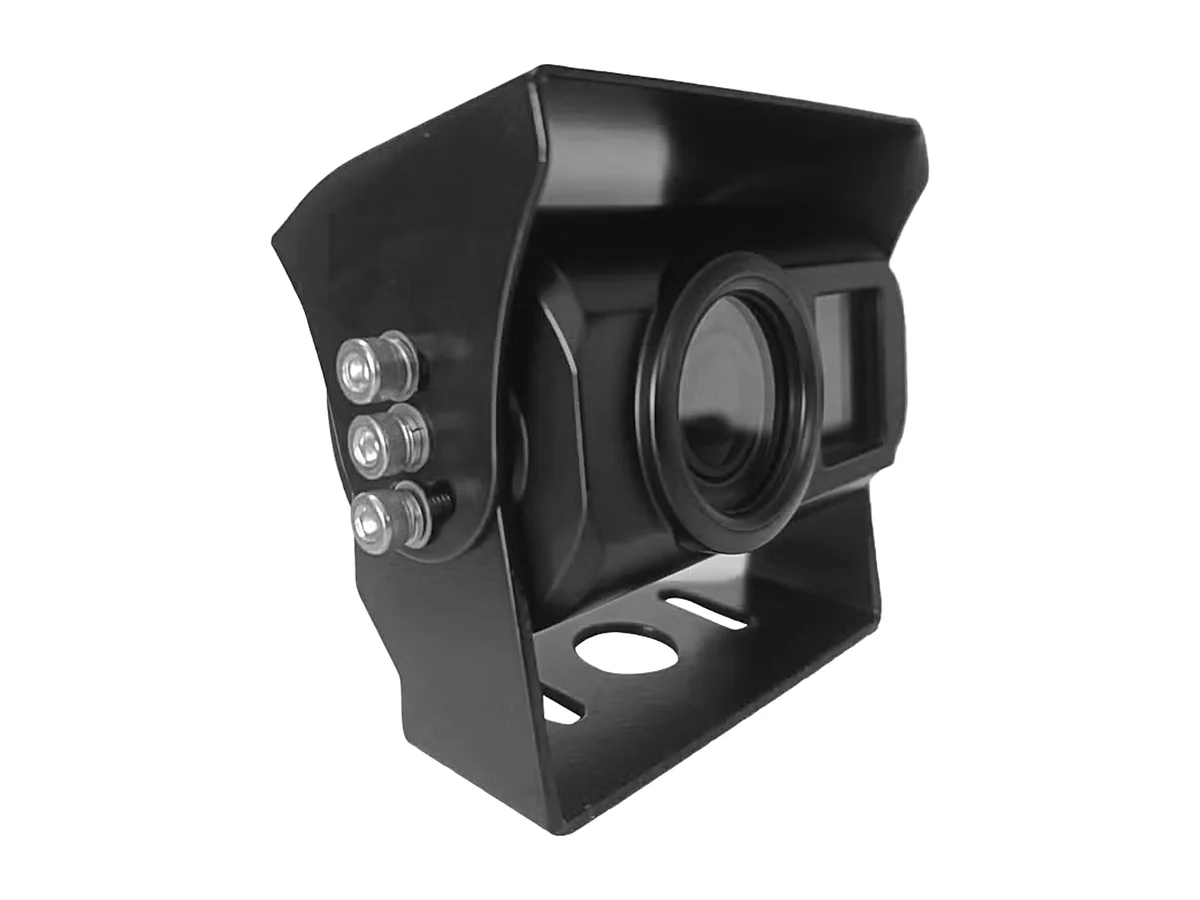
TDG-VMS-111 is the hub of the vehicle vision chain that TEDEG supplies from a single source: the TDG-CAM vehicle cameras capture the picture, the VMS powers them from its own isolated 12 VDC channels, stitches and switches the views, and the TDG-DSP-101 rugged displays show the result at the driver and commander positions over the same MIL-DTL-38999 cable family. Where the cameras are fed by the SENTRA KBM Camera Power Distribution Module, the VMS takes the video lines directly.
Because the unit is an embedded real-time processor rather than a PC, there is no operating system to boot, harden or patch: it is ready 3 seconds after ignition and keeps working at −40 °C without a heater. Recording, AI analytics, GPS, IP camera expansion and a thermal channel are order-code options on the same enclosure, so the configuration can grow with the platform. Connector part numbers, pin assignments, view layouts and the vehicle model are fixed with you in a pre-order interface control document, and TEDEG's engineering team supports integration and acceptance testing on the vehicle.
Corporate assurance: TEDEG Defence holds NATO supplier registration NCAGE TM885 and operates an ISO 9001 quality management system.
Specifications
| Part number (P/N) | TDG-VMS-111 |
| Camera inputs | 11 independent channels · AHD 1080p / 720p and CVBS PAL/NTSC, auto-detected per channel |
| Camera supply | Isolated 12 VDC, 0.5 A per channel · short-circuit and over-current protected |
| Display outputs | 2 × HDMI 1.4 (1920 × 1200 @ 60 Hz), independent content · 1 × CVBS |
| 360° view | Real-time bird's-eye stitching of 4 wide-angle cameras · configurable vehicle model |
| Latency / boot | < 80 ms glass-to-glass (single view) · first image < 3 s after ignition |
| Vehicle interface | 2 × CAN 2.0B (J1939) · 2 × RS-422/485 · 8 discrete inputs · 4 discrete outputs |
| Network | Gigabit Ethernet · RTSP / ONVIF Profile S streaming, H.264/H.265 |
| Recording (option -R) | H.265, 11 channels at 1080p @ 25 fps · removable 2 TB SSD (up to 4 TB), AES-256 |
| Supply | 18–33 VDC (28 VDC nominal), MIL-STD-1275E · ≤ 25 W base, ≤ 40 W with recording + AI |
| Enclosure / protection | Machined aluminium 6061-T6, fanless · 300 × 220 × 80 mm · ≤ 4.5 kg · IP67 |
| Operating temperature | −40 °C … +70 °C, continuous at full load |
| Design basis | MIL-STD-810G environmental · MIL-STD-461G EMC · MIL-STD-1275E power (Rev. 01 preliminary design values) |
MIL-STD Compliance
MIL-STD-810G
EnvironmentalMIL-STD-461G
EMI/EMCMIL-STD-1275E
28 VDC Vehicle Electrical SystemsSee Certifications & Quality for our test and validation approach, and our Test & Validation service for programme-specific testing.
Datasheet
Engineering Support
Our engineering services can adapt this product to your platform, integrate it or test it against your programme requirements.
Quality and Testing
FAQ
How many cameras can be connected, and which types?+
The base unit has 11 independent camera inputs that accept AHD 1080p / 720p and CVBS PAL/NTSC signals with automatic detection per channel; each input also delivers an isolated, protected 12 VDC camera supply. The -N variant adds four PoE+ Gigabit ports for up to 8 IP cameras, and the -T variant adds one digital LWIR thermal channel with visible + thermal overlay.
How fast is the image, and how long does the unit take to start?+
The embedded real-time architecture shows the first image less than 3 seconds after ignition and reaches full function within 10 s. Camera-to-display latency is below 80 ms for a single view and below 120 ms for the stitched 360° view.
Does it record, and for how long?+
Recording is the -R option: all 11 channels are recorded simultaneously in H.265 at 1080p @ 25 fps to a removable, −40 °C grade industrial SSD with AES-256 encryption and SD card backup. A 2 TB SSD holds about 60 hours of 11-channel 1080p video; the -E option extends storage to 4 TB plus a 2 TB SD backup. Loop recording, G-sensor and external-trigger event recording with pre/post-event buffers are included.
How does it connect to the mission computer or battle management system?+
Over the Gigabit Ethernet port the unit streams every channel as RTSP / ONVIF Profile S (H.264/H.265, 1080p), so the camera views can be placed as a window in map or BMS software. The same port is used for configuration and firmware updates with the TDG-VMS Config software.
Which displays and control panel does it work with?+
The two HDMI outputs are designed for the TDG-DSP-101 driver and commander displays; touch input returns over the USB ports, and the HDMI, RJ45 and USB connector inserts share the TDG-DSP-101 cable family. The optional TDG-VMS-KP backlit 8-key panel (NVIS compatible, IP67) connects over CAN for view selection without a touch screen.
How is it powered?+
From the 28 VDC vehicle network: 18–33 VDC with an ignition input, reverse-polarity, over-voltage and surge protection, and MIL-STD-1275E power quality (ripple, spikes, surges and voltage dips). The unit draws ≤ 25 W (≤ 40 W with recording and AI), excluding the camera supply of up to 66 W.
Which standards is it designed to?+
The datasheet specifies MIL-STD-810G environmental methods (vibration 514.6, shock 516.6, humidity, sand and dust, salt fog, altitude, fungus), MIL-STD-461G EMC (CE102, CS101, CS114, CS115, CS116, RE102, RS103) and MIL-STD-1275E power quality as the design basis, with an MTBF above 50,000 h per MIL-HDBK-217F. The Rev. 01 values are preliminary design values and will be updated as qualification testing is completed; if your programme requires test evidence, the test plan and report scope are agreed with you at the quotation stage.