
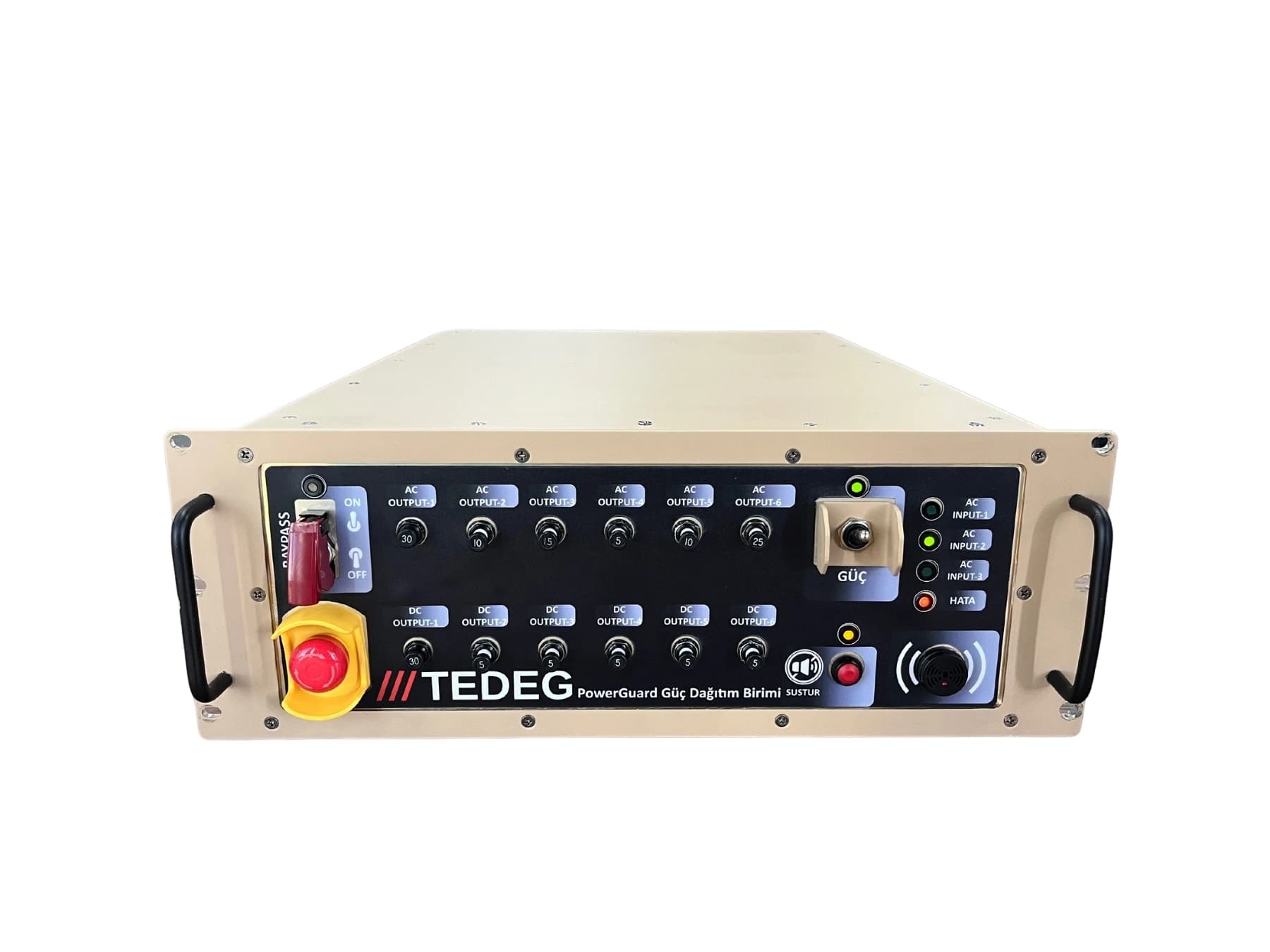
Why Power Distribution Matters in Modern Military Systems
Modern military platforms — tactical trucks, mobile command centres, field radar stations, weapon and fire-control systems — comprise dozens of electronic subsystems. All of them require stable, uninterrupted and prioritised power. At the architectural centre of this task sits the military power distribution unit (PDU).
A civilian PDU can operate reliably in an office server room or an industrial facility. But a military system in the field encounters EMI/EMC interference, vibration and shock, high and low temperatures, humidity, salt fog and sand-dust conditions that a civilian PDU cannot withstand. A mil-spec rugged PDU is the critical subsystem that closes this gap.
PDU Architecture — Core Components
A military PDU consists of three core architectural layers:
- Input layer — Receives, filters and protects energy from one or more sources (UPS, mains, generator, battery)
- Switching / priority layer — Automatic transfer switching (ATS), overcurrent protection, per-channel circuit breakers
- Output layer — A defined number of outputs (typically 6–20), each with independent protection and monitoring
Modern PDUs add a digital monitoring layer on top of these three: Ethernet, a web interface, log records.
Automatic Transfer Switching (ATS) — Operational Criticality
ATS (Automatic Transfer Switch) is one of the core functions of a multi-source military PDU. The operating logic:
- The PDU continuously monitors several power sources (e.g. mains, generator, UPS)
- When a source's voltage or frequency leaves the defined tolerance, the system transfers to the next source in priority order
- Whether the transfer is seen by the load depends on the switching technology and on whether a UPS sits in front of the load; for sensitive loads, continuity is usually provided by the UPS
- Logging each transfer enables fault analysis after the event
Transfer Time Categories
- Open-transition electromechanical ATS — A short interruption occurs during transfer, typically ranging from tens of milliseconds to seconds. Sensitive loads need a UPS in front of them.
- Static Transfer Switch (STS) — Semiconductor-based; transfer is typically completed within a few milliseconds. Used for sensitive loads such as radar and mission computers.
- Closed-transition (make-before-break) ATS — When the sources are synchronised, they run in parallel briefly to provide a seamless transfer.
Source management in TEDEG products is designed around different needs:
- PDU-RT5002 can be supplied from three separate 220 VAC 50 Hz sources (UPS, mains, generator); it uses the mains as its primary source and transfers automatically to the generator when necessary.
- PowerGuard PDU-R2D4 accepts one mains and one UPS input through separate connectors; if the mains fails, the loads continue to be supplied from the UPS line.
- On the PowerGuard MAR-2 panel, mains/generator selection is made with a manual source selector switch.
Rack-Mount, Outdoor Panel and Vehicle DC Distribution — Which Suits Which Scenario?
Military power distribution comes in three main physical forms:
Rack-Mount PDU (19-inch)
- Advantage: Standard cabinet compatibility, easy maintenance, modular expansion
- Typical height: 1U–6U
- Use: Fixed command centres, mobile command containers, radar and communications shelters, military data centres
- TEDEG examples: PDU-RT5002 (4U), PowerGuard PDU-R2D4 (2U)
Outdoor Distribution Panel
- Advantage: Sealed, EMI-gasketed enclosure; mounts on a wall, pole or shelter surface; per-line fuses or breakers
- Use: Field and forward base distribution, shelter and container supply, load distribution at military facilities
- TEDEG examples: PowerGuard MAR-2 (220 VAC, 9 fused outputs), PowerGuard AC Power Distribution Panel (400 VAC input, 400/230 VAC outputs)
Vehicle DC Distribution Unit (Busbar-Based)
- Advantage: High-current busbar, fused outputs, battery and alternator inputs gathered at a single point
- Use: The 28 VDC electrical system of military vehicles
- TEDEG example: TDG-EDP-D0X (4 inputs, 400 A busbar, MIDI-fused outputs)
Takeaway: Rack-mount PDUs lead in cabinet-based systems, sealed distribution panels outdoors, and busbar-based distribution units on the vehicle DC side.
Which Standard for Which Platform?
Different power interface standards apply in military power distribution depending on the platform type:
MIL-STD-1275E — Military Ground Vehicle 28 VDC Power Systems
- Application: Tanks, APCs, MRAPs, military trucks, mobile platforms
- What it defines: A nominal 28 VDC bus; steady-state limits, surges (e.g. up to 100 V, on the order of 50 ms), spikes, ripple and voltage dips during engine starting
- What the PDU needs: Transient tolerance, safe management of battery and alternator inputs, fused outputs
The risk of a reversed battery connection and the protection layer designed alongside distribution are covered in our reverse polarity guide. The vehicle's 28 VDC architecture as a whole, from sources and protection to distribution, conversion and loads, is explained in our military vehicle electrical architecture guide.
On this side, TEDEG's TDG-EDP-D0X DC power distribution unit combines the battery 1, battery 2, alternator and battery charger inputs on 400 A busbars and protects the outputs with MIDI-type fuses. The input contactor and control unit operate on voltage thresholds, most of which are adjustable.
MIL-STD-1399 — Naval Platform Power Systems
- Application: Surface ships and submarines
- What it defines: The interface characteristics of the ship's electrical system; typically 440/115 VAC 60 Hz supply, plus 400 Hz supply types for radar, weapon and fire-control systems
- Environment: Salt fog, high humidity, shock
- What the PDU needs: Corrosion resistance, isolation, a sealed enclosure
MIL-STD-461F and MIL-STD-810G — Platform-Independent Requirements
EMI/EMC (MIL-STD-461F) and environmental durability (MIL-STD-810G) requirements directly shape PDU selection on every land and naval platform.
Takeaway: No single PDU meets every platform standard at once; the platform type drives the choice. The 220 VAC rack-mount PDU-RT5002 is designed to comply with MIL-STD-461F EMI/EMC and MIL-STD-810G environmental durability standards, while the PowerGuard PDU-R2D4 complies with MIL-STD-810G.
Ethernet-Based Remote Monitoring — The Digital Layer of a Modern PDU
Older-generation PDUs worked with LED indicators and manual switches only. A modern military PDU has a digital monitoring layer. Commonly used interfaces and protocols include:
- Web interface — PDU status viewed from a browser or desktop application
- SNMP — Integration with central network monitoring systems
- Modbus TCP — Compatibility with industrial control systems
- CANbus (J1939) — Mobile platform integration
- Syslog — Event records forwarded to a central server
What is monitored?
- Current, voltage and temperature per channel
- On/off state and remote switching
- Historical records (logs)
- Fault modes (over/undervoltage, overcurrent, short circuit, temperature)
- Total consumption
This monitoring helps faults to be found faster in the field and lets maintenance move from unplanned downtime to data-driven planning.
Monitoring and control on TEDEG products:
- PDU-RT5002: Ethernet-based remote monitoring, 100-record log capacity and detailed fault modes
- PowerGuard PDU-R2D4: Ethernet (100 Mbps) and RS-422 communication; Windows 10 compatible software to switch outputs individually, in groups or in sequence; real-time monitoring of voltage, current, temperature and humidity; pinging connected devices
- PowerGuard AC Power Distribution Panel: Selected outputs controlled by a 28 VDC or 230 VAC remote on/off signal; a power analyser on the input line
Fault Isolation — Per-Channel Protection Logic
In a civilian-type PDU, if one channel short-circuits, the main fuse trips and the whole system loses power. Given the operational consequences in the field, this is an unacceptable design.
In a military PDU, each channel is protected independently:
- Per-channel overcurrent protection (typically 16–25 A)
- Thermal trip — detection of sustained low-level overload
- Magnetic trip — detection of an instantaneous short circuit
- The main bus voltage is preserved — the remaining channels keep running
The result: even if a radar fails, the mission computer, command console and other critical systems are unaffected, and mission continuity is preserved.
On TEDEG products, per-channel protection is implemented as follows. On the PDU-RT5002, the ten 25 A outputs are separated from one another by circuit-breaker-based overcurrent and short-circuit protection. On the MAR-2, every output is independently fused and has its own neutral and earth terminal. On the AC Power Distribution Panel, every output has its own breaker rated for the line's current. On the TDG-EDP-D0X, every output is protected by a MIDI-type fuse. How the fuse rating is matched to the cable cross-section is explained in our DC busbar guide.
MIL-STD-461F EMI/EMC — Why It Matters in the Field
Inside a vehicle or shelter, many electronic systems run at the same time: radios, positioning receivers, mission computers, radar, communications and fire-control systems. Mutual interference between them, or susceptibility to external electromagnetic fields, directly affects mission success.
Typical MIL-STD-461F requirements for a PDU:
- CE102 — Conducted emissions (10 kHz – 10 MHz, power leads)
- CS101 — Conducted susceptibility (30 Hz – 150 kHz)
- CS114 — Bulk cable injection (10 kHz – 200 MHz)
- CS115 — Bulk cable injection, impulse excitation
- CS116 — Damped sinusoidal transients
- RE102 — Radiated emissions (10 kHz – 18 GHz)
- RS103 — Radiated susceptibility (2 MHz – 40 GHz)
A PDU that meets these requirements neither becomes a source of interference in the field nor is vulnerable to external electromagnetic effects. The TEDEG PDU-RT5002 is designed to the MIL-STD-461F CE102, CS101, CS114, CS115, CS116, RE102 and RS103 requirements. On the MAR-2, the AC Power Distribution Panel and the TDG-EDP-D0X, an EMI gasket on the cover provides electromagnetic protection.
For the test groups, the differences between revisions and how to verify a compliance claim, see our MIL-STD-461 and MIL-STD-810 testing guide.
Typical Platform Applications
Military power distribution units and panels are used in the following applications:
- Fixed command centres — regional headquarters, crisis management centres
- Mobile command containers — field C2, operations centres
- Tactical truck power cabinets — 6×6 / 8×8 vehicles, communications trucks
- Radar stations — fixed and mobile radars
- Weapon and fire-control systems — supplying launch and control equipment
- Military data centres — redundant power distribution for information systems
- Naval platforms — rack units; supplying sonar, radar and communications systems
- Field and forward bases — distributing power from a generator or the grid through outdoor panels
- Military vehicles — fused distribution of 28 VDC vehicle loads
The TEDEG Power Distribution Family
| Product | Type | Input | Outputs | Highlights |
|---|---|---|---|---|
| PDU-RT5002 | 19-inch 4U rack PDU | 3 × 220 VAC 50 Hz (UPS, mains, generator) | 10 × 25 A | Automatic source transfer (mains → generator), Ethernet remote monitoring, 100-record log, MIL-STD-461F / 810G |
| PowerGuard PDU-R2D4 | 19-inch 2U rack PDU | 180–240 VAC 50 Hz; mains + UPS | 8 AC + 2 DC | Ethernet 100 Mbps + RS-422, surge arrester, emergency stop and bypass, MIL-STD-810G |
| PowerGuard MAR-2 | Outdoor panel | 220 VAC 50 Hz; mains / generator (manual selection) | 9 × 220 VAC, fused | K1/K2 contactors, emergency stop, EMI-gasketed enclosure, 14 ± 1 kg |
| PowerGuard AC Power Distribution Panel | Outdoor AC panel | 400 VAC | 400 / 230 VAC, a breaker per output | 28 VDC / 230 VAC remote on/off, −32 °C … +50 °C, 0–3000 m |
| TDG-EDP-D0X | Vehicle DC distribution unit | 4 inputs (2 batteries, alternator, battery charger) | MIDI-fused outputs, 400 A busbar | 12 → 28 VDC 500 W converter, MIL-STD-810G Method 506.5 rain test |
Corporate assurance: TEDEG Defence is an approved supplier of ASELSAN, Roketsan and the Turkish Ministry of National Defence (MSB), with NATO supplier registration under NCAGE: TM885.
Total Cost of Ownership
A PDU's purchase price is only part of its total cost of ownership. The evaluation should also account for:
- Installation — the integrator's engineering hours, cable management
- Maintenance — breaker and fuse checks, gasket replacement
- Spare parts — breakers, fuses, filters and controller cards
- Training — operator and maintenance staff training
Design choices affect these items directly: remote monitoring and log records speed up fault-finding; giving every output its own neutral and earth terminal reduces wiring errors in the field; and spare fuses held in the unit (three in each of four ratings on the TDG-EDP-D0X) make replacement in the field easier.
Conclusion
Military power distribution units are a cornerstone of operational continuity in modern military systems. Source management and automatic transfer, per-channel protection, MIL-STD-461F and MIL-STD-810G compliance, remote monitoring and a physical format suited to the platform are the core criteria to look at when evaluating a military PDU.
TEDEG's power distribution family was built to meet these criteria for different platform needs: rack-mount PDUs for inside the cabinet, sealed panels for outdoor use, and a busbar-based distribution unit for the vehicle DC side.
For technical documentation, see the PDU-RT5002, PowerGuard PDU-R2D4, PowerGuard MAR-2, PowerGuard AC Power Distribution Panel and TDG-EDP-D0X DC Power Distribution Unit product pages, or browse the Power Distribution Units (PDU) category. For vehicle power with the main engine off, read our military APU and Silent Watch guide; for an engineering conversation with our team, use the contact page.