Why Do These Two Standards Always Appear Together?
Open almost any technical specification for a defence power system and two lines will be there: MIL-STD-461 and MIL-STD-810. One governs the electromagnetic behaviour of the equipment, the other its resistance to environmental conditions. Systems engineers ask suppliers about these two standards first, and procurement specialists look for them on every datasheet when comparing bids.
The problem is that "MIL-STD-461 and MIL-STD-810 compliant" on its own says very little. Which revision? Which tests? Which levels? Who ran the tests, and where? This guide explains what the two standards actually require, why they are demanding for power electronics, and how to verify a compliance claim before it reaches your acceptance review.
In short:
- MIL-STD-461 defines requirements and test methods for controlling the electromagnetic interference (EMI) characteristics of subsystems and equipment. The goal is equipment that neither pollutes its electromagnetic environment nor is disturbed by it.
- MIL-STD-810 defines environmental engineering considerations and laboratory test methods. It exercises the effect of temperature, humidity, rain, salt fog, sand and dust, vibration and shock on the product.
MIL-STD-461: Controlling Electromagnetic Interference
On a modern land vehicle or ship, radios, radars, mission computers, sensors and power converters all share the same electrical network. If one of them emits excessive noise, radio range can drop, a sensor can produce false data or a control board can reset unexpectedly. MIL-STD-461 exists to make every piece of equipment a good neighbour in that shared electromagnetic environment.
Equipment Level vs System Level
MIL-STD-461 applies at equipment and subsystem level: a power distribution unit, a converter or a control unit is tested on its own. Electromagnetic environmental effects of the platform as a whole (lightning, high-power RF environments, intra-system compatibility) fall under MIL-STD-464. In practice, the prime contractor is responsible for MIL-STD-464 at platform level and flows MIL-STD-461 down to suppliers at equipment level.
Test Naming: CE, CS, RE, RS
MIL-STD-461 tests are named with two letters and three digits. The letters describe the type of test:
- CE (Conducted Emission): noise the equipment injects into the network through its cables.
- CS (Conducted Susceptibility): the equipment's immunity to noise injected onto its cables.
- RE (Radiated Emission): the electromagnetic field radiated by the equipment and its cables.
- RS (Radiated Susceptibility): correct operation while exposed to an external electromagnetic field.
The tests most frequently seen in power electronics specifications are:
| Test | Type | What is measured |
|---|---|---|
| CE101 | Conducted emission | Low-frequency noise on power leads (30 Hz – 10 kHz) |
| CE102 | Conducted emission | Noise on power leads (10 kHz – 10 MHz) |
| CS101 | Conducted susceptibility | Ripple injected onto power leads (30 Hz – 150 kHz) |
| CS114 | Conducted susceptibility | Bulk cable current injection (10 kHz – 200 MHz) |
| CS115 | Conducted susceptibility | Bulk cable injection, impulse excitation |
| CS116 | Conducted susceptibility | Damped sinusoidal transients on cables and power leads |
| RE102 | Radiated emission | Electric field emission (10 kHz – 18 GHz) |
| RS103 | Radiated susceptibility | Operation under an external electric field |
Depending on the platform, magnetic field tests (RE101, RS101) or antenna port tests may be added. The applicability table in the standard and the customer's specification decide together which tests apply.
Revisions: E, F and G
The standard is revised over time, and the revision letter matters. Current specifications most often call up MIL-STD-461F (2012) or MIL-STD-461G (2015). Revision G added tests such as lightning-induced transients (CS117) and personnel-borne electrostatic discharge (CS118) and redefined several test setups and procedures. A product tested to F therefore cannot be assumed to meet a specification that calls for G; a gap analysis is needed.
Different Limits for Different Platforms
MIL-STD-461 does not have a single limit curve. Limits for tests such as RE102 depend on the platform type: separate curves apply to ground platforms, to surface ships below and above deck, and to submarines. The same product may pass comfortably on a land vehicle and struggle against the tighter limit of a submarine application. Writing "MIL-STD-461G" into a specification is not enough; it must also state which platform limit applies.
Why the Test Setup Matters
To keep results repeatable, MIL-STD-461 measurements are made in a tightly defined setup. The unit sits on a conductive ground plane, its power leads are fed through 50 µH LISNs (line impedance stabilisation networks), and cables are routed at defined lengths and heights. Radiated tests are carried out in shielded, anechoic-lined chambers.
These details are not only the laboratory's concern. The cable type, shield termination and grounding used during the test must match the way the product will be installed in the field. A unit that passes with a shielded cable in the lab may not behave the same way when connected to an unshielded harness on the platform. That is why a good test report includes photographs of the setup and a description of every cable.
Why MIL-STD-461 Is Demanding for Power Electronics
Switch-mode power converters generate noise by nature. As semiconductor switches turn on and off at high frequency with fast edge rates, they create current ripple on the input leads and radiation from the cables. For a DC-DC converter, an AC-DC power supply or a motor drive, the critical tests are therefore usually CE102 and RE102.
On the immunity side the situation is reversed. A vehicle's 28 VDC network is not a clean laboratory supply: it carries alternator ripple, load-switching transients and noise from other equipment. CS101 injects ripple onto the power leads, while CS114 and CS116 inject current and transients onto the cable bundle to check that the equipment keeps working in that environment.
Compliance is rarely achieved with a filter bolted on at the end. Filters added to rescue a failing design bring weight, volume and heat, and sometimes force a board redesign. That is why EMI/EMC is addressed from the first day of design:
- Input filter design: separately sized stages for common-mode and differential-mode noise.
- Board layout: small high-current loops and clear separation between noisy and sensitive areas.
- Chassis and grounding: short, low-impedance chassis bonds and a deliberate grounding strategy.
- Enclosure and connectors: conductive gaskets, shielded cables and connectors with 360-degree shield termination.
- Pre-compliance testing: in-house measurements that catch problems before the formal test.
MIL-STD-810: Environmental Engineering and Laboratory Tests
MIL-STD-810 is often described as a "ruggedness certificate". The standard itself says the opposite: MIL-STD-810 is an engineering process plus a set of laboratory test methods used within that process.
Tailoring: The Heart of the Standard
The core concept is tailoring: adapting the tests to the product's real conditions of use. The process starts with the product's life cycle environmental profile. Where will it be stored? How will it be transported? Which platform will it be mounted on, in which climate and under which mission profile will it operate? The answers determine which test methods, which procedures and which levels apply.
That is why "MIL-STD-810 compliant" is meaningless without a test plan behind it. A vibration profile tailored for a tracked vehicle is very different from one tailored for a fixed radar shelter. The right question is not "did it pass 810?" but "which methods, with which procedures and levels, did it pass?"
Commonly Used Test Methods
MIL-STD-810 test methods are numbered in the 500 series. The ones most often used for power electronics and field equipment are:
| Method | Test | Typical purpose |
|---|---|---|
| 500 | Low pressure (altitude) | Operation and storage at high elevation |
| 501 | High temperature | Hot climates, closed cabins in direct sun |
| 502 | Low temperature | Cold-climate operation and cold start |
| 503 | Temperature shock | Sudden temperature transitions |
| 504 | Contamination by fluids | Fuel, oil, hydraulic fluid and cleaning agents |
| 505 | Solar radiation | Heating and material degradation |
| 506 | Rain | Water ingress and sealing |
| 507 | Humidity | Condensation and corrosion |
| 508 | Fungus | Fungal growth on organic materials |
| 509 | Salt fog | Corrosion in coastal and marine environments |
| 510 | Sand and dust | Abrasion, clogging, sealing |
| 512 | Immersion | Sealing when submerged |
| 514 | Vibration | Platform vibration and transport |
| 516 | Shock | Mechanical impact, drops, rough terrain |
There are also combined-environment methods (temperature, humidity, vibration and altitude applied together) and specialised shock methods. Test sequence matters too: exposing a unit to vibration before rain makes sure a seal loosened by vibration shows up in the water test.
Revisions: F, G and H
MIL-STD-810 revisions also coexist in specifications. 810F (2000) still appears on older programmes. 810G (2008) and its Change Notice 1 (2014) were the most common reference for years. 810H (2019) is increasingly called up on new programmes. Procedure details, test levels and some method definitions change between revisions, so the revision letter must always be written into the specification.
Other Standards That Sit Alongside MIL-STD-461 and MIL-STD-810
A power electronics specification rarely stops at these two standards:
| Standard | Scope |
|---|---|
| MIL-STD-1275 | Characteristics of 28 VDC electrical systems in military ground vehicles (voltage ranges, transients, ripple) |
| MIL-STD-1399 | Shipboard electrical interface and power quality |
| MIL-STD-464 | Electromagnetic environmental effects at platform level |
| MIL-STD-167-1 | Mechanical vibration of shipboard equipment |
| MIL-DTL-901E | Shock resistance of shipboard equipment |
MIL-STD-1275 in particular is as decisive as MIL-STD-461 and MIL-STD-810 for any power product mounted on a land vehicle: the transients of the 28 VDC vehicle network directly shape the design of the product's input stage.
How to Read "MIL-STD Compliant" on a Datasheet
The most common mistake in bid evaluation is to see the same standard code on two datasheets and treat the two products as equivalent. When you assess a compliance claim, ask five questions:
- 1.Which revision? "MIL-STD-461" or "MIL-STD-461G"? A code without a revision leaves the applied tests and procedures undefined.
- 2.Which tests or methods? For MIL-STD-461, a list such as CE102, CS101, CS114, RE102, RS103; for MIL-STD-810, method numbers and procedures should be stated explicitly.
- 3.Which limits and levels? Which platform limit curve for 461; which temperature range, vibration profile and shock level for 810?
- 4.Where and by whom was it tested? A supplier's in-house pre-compliance measurements and formal tests at an accredited laboratory do not carry the same weight. Both are valuable, but they prove different things.
- 5.Can the test report be shared? During acceptance, the test report, the test procedure and the configuration of the tested unit may all be requested.
Datasheet wording is a clue as well. "Tested", "designed to the requirements of" and "designed according to the principles of" describe different levels of evidence. None of them is bad in itself; what matters is that the evidence matches what the programme needs. A design target may be enough for a prototype programme, while a platform entering series production will require formal test reports.
Also, MIL-STD-461 and MIL-STD-810 are not certifications. There is no central certification body that issues a certificate for these standards. Compliance is demonstrated with test reports and becomes valid through the customer's acceptance. If you see "MIL-STD-810 certified" on a datasheet, asking for the underlying test report is the right next step.
From Design to Test: Planning for Compliance
A successful compliance programme starts with reading the specification, not in the test lab:
- 1.Specification analysis: which revision, tests, limits and environmental profile are required? Ambiguous clauses are clarified with the customer at this stage.
- 2.Test matrix: for each requirement, the test method, level, test sequence and acceptance criterion are captured in a single table.
- 3.Design measures: EMI filters, shielding, thermal design, sealing, conformal coating and mechanical retention are sized against the test matrix.
- 4.Pre-compliance testing: in-house EMI/EMC pre-scans and environmental pre-tests expose risk areas early.
- 5.Formal testing: carried out to an approved test procedure, at an accredited laboratory and under the customer's witness.
- 6.Configuration control: every design change after testing (a different filter component, a new board revision, a different connector) can affect the validity of the test. Change management decides which tests must be repeated.
When each step is run with traceable records, acceptance between supplier and prime contractor becomes much shorter. TEDEG Defence's test and validation services follow this approach: EMI/EMC pre-compliance tests, environmental pre-tests, load tests and long-duration operation tests are carried out with traceable engineering records. You can find our quality processes on the Certifications & Quality page.
Common Mistakes in Compliance Programmes
Most problems seen in the field are about planning rather than technology:
- Leaving testing to the end: running EMI/EMC and environmental tests for the first time after the design freeze means board and mechanical rework if anything fails. Pre-compliance testing reduces that risk.
- Not stating the revision: a standard code without a revision in the specification leads to disputes between supplier and customer at acceptance.
- Asking for the harshest levels without tailoring: levels the platform will never see increase cost and weight and stretch lead times. A realistic life cycle environmental profile protects both customer and supplier.
- Confusing system and equipment: equipment may pass MIL-STD-461, yet poor cable routing and grounding inside the platform can still cause problems at system level. Following installation instructions matters as much as the test.
- Changing the product after the test: a production lot that deviates from the tested configuration weakens the evidential value of the test. Configuration management is part of the quality system for this reason.
- Generalising one test report to a whole family: different power ratings or connector options within the same family can show different EMI behaviour. It must be clear which variant was tested.
MIL-STD-461 and MIL-STD-810 in TEDEG Products
We apply the same five questions to our own products. In the examples below, the datasheet states the revision and the test list explicitly:
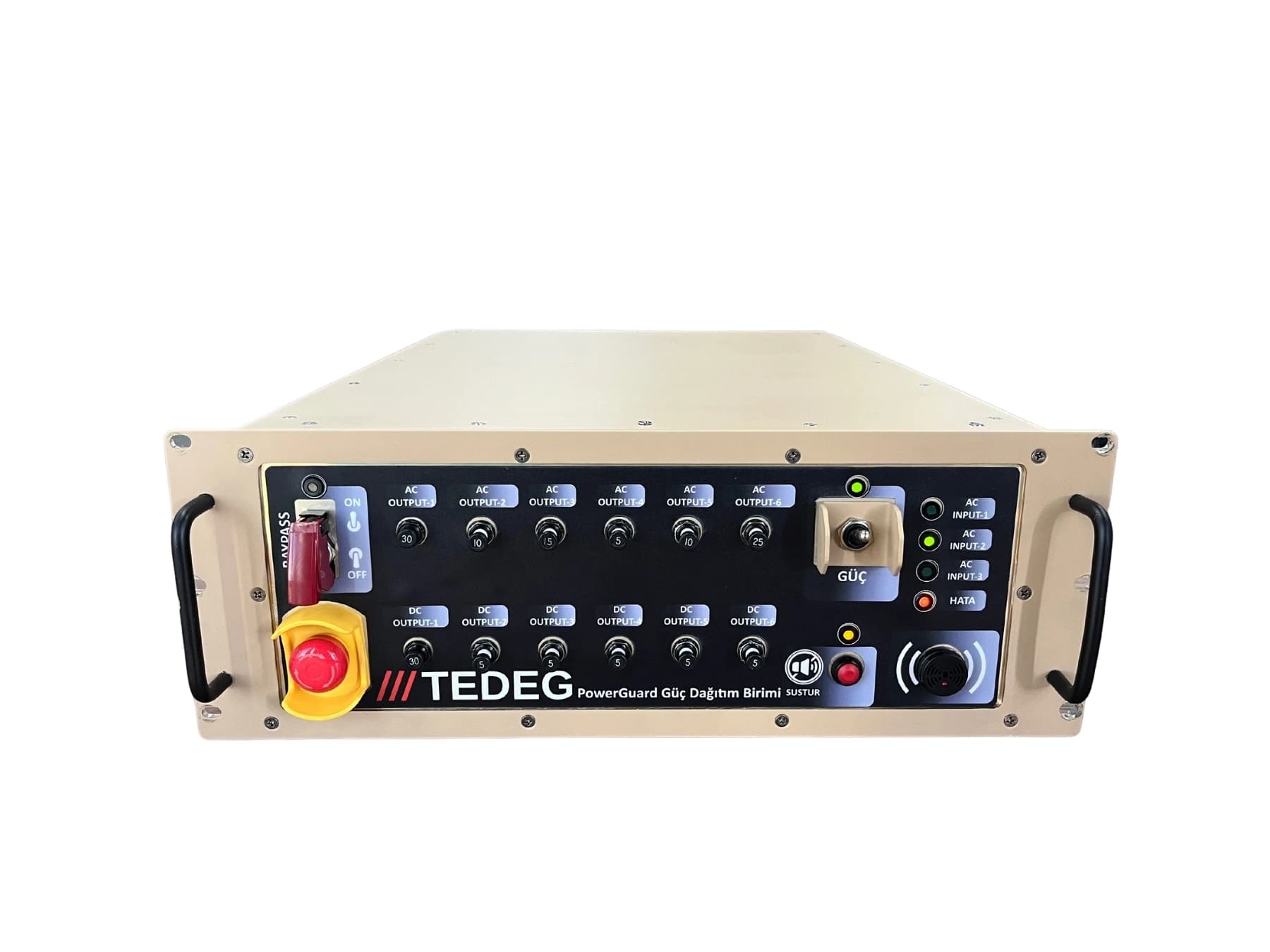
- PDU-RT5002 Military Power Distribution Unit: the datasheet lists CE102, CS101, CS114, CS115, CS116, RE102 and RS103 under MIL-STD-461F, and 11 methods under MIL-STD-810G: low pressure, low temperature, contamination by fluids, solar radiation, rain, humidity, fungus, salt fog, sand and dust, vibration and shock.
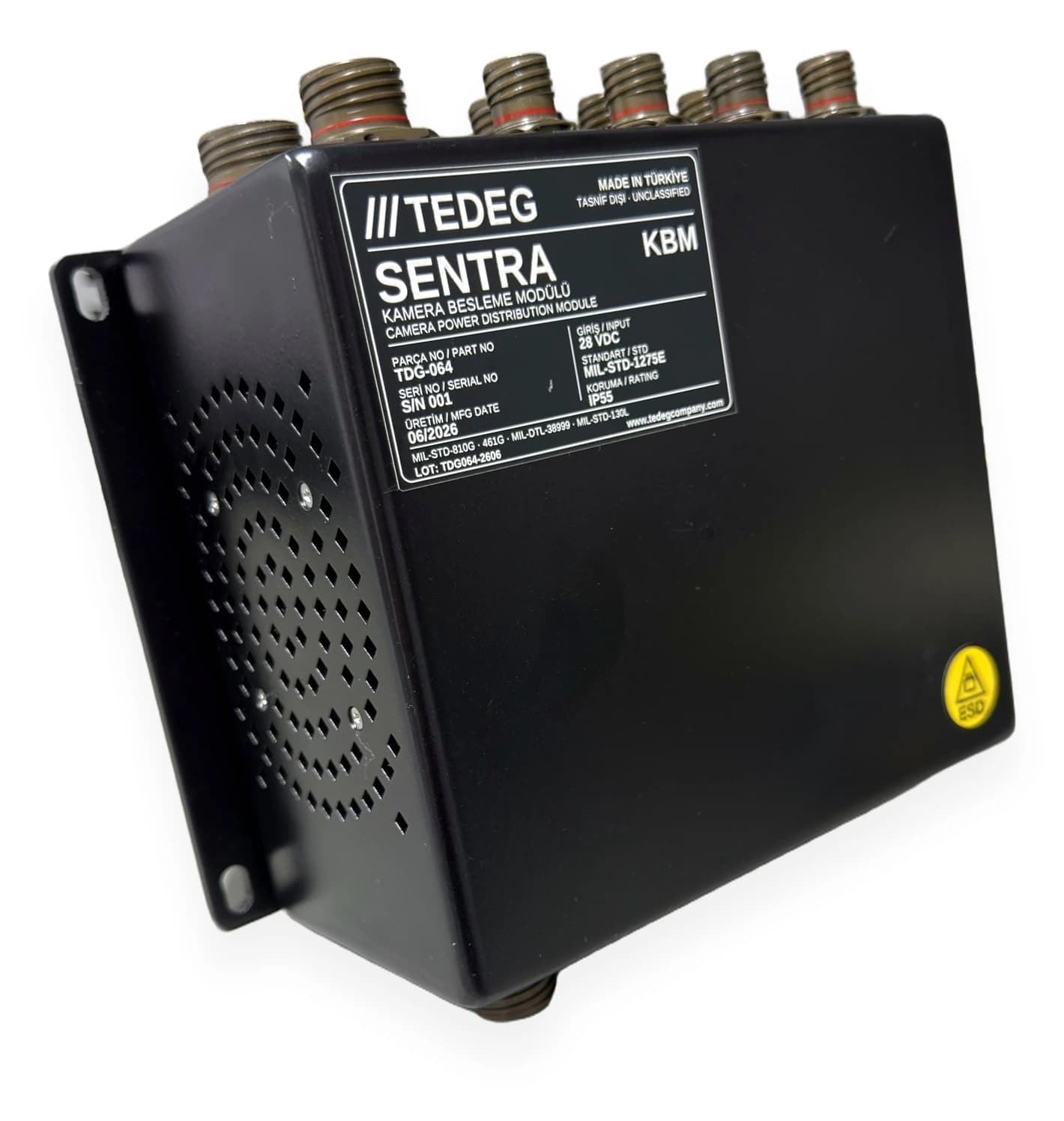
- SENTRA KBM Military Camera Power Distribution Module: CE102, CS101/114/115/116, RE102 and RS103 are defined under MIL-STD-461G. On the environmental side, humidity, rain, sand and dust, salt fog, solar radiation, vibration and shock are defined to MIL-STD-810G CHG-1 methods. The datasheet also states method and procedure: Method 501.6 / 502.6 (Procedures I and II) for −32 °C … +55 °C operating and storage temperature, and Method 516.6 (Procedure I) for a 20 g / 11 ms sawtooth shock. That is exactly the level of detail the second and third questions above are looking for. The module's compliance list also includes MIL-STD-464C and MIL-STD-1275E.
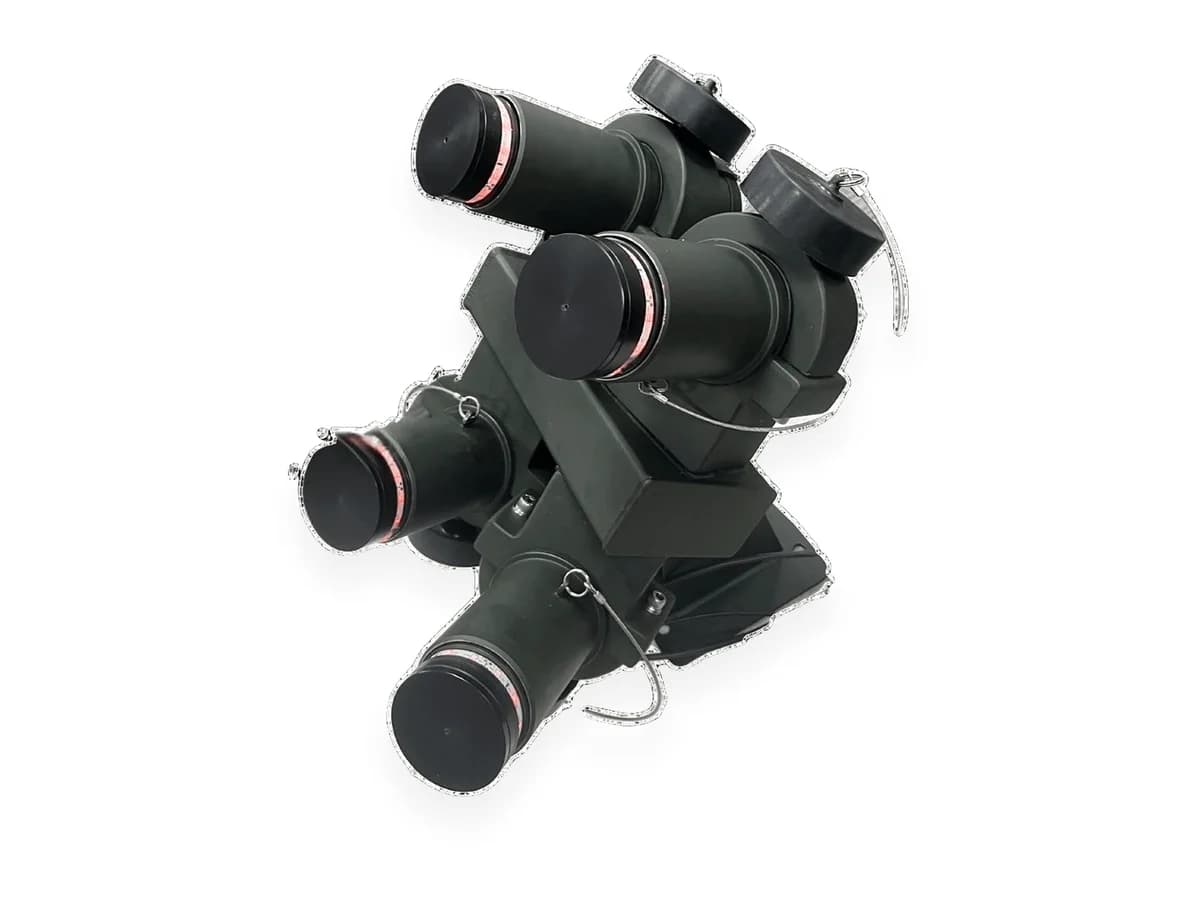
- 76 mm Smoke Grenade Launcher System TDG-76-SGL: military condition resistance is to MIL-STD-461G, MIL-STD-810G and MIL-STD-1275E, with an operating temperature of −40 °C … +70 °C. For launcher count and arc selection, see multiple smoke grenade launcher configurations.
- Mil-Spec AC/DC Converter: MIL-STD-810G environmental and MIL-STD-461F EMI/EMC requirements are addressed together with a fully sealed, fanless IP67 aluminium enclosure.
You can explore our product families from power distribution to vehicle electronics in the Power Distribution Units and Vetronics categories. We cover how MIL-STD requirements shape rack-mount PDU design in our military PDU guide, and the role of power electronics in defence systems in the strategic importance of power electronics.
Field example: read how a legacy power distribution unit on a tactical truck family was replaced with a remotely monitored architecture designed to MIL-STD requirements in the Tactical Truck Power Architecture case study.
Frequently Asked Questions
What is the difference between MIL-STD-461 and MIL-STD-464?
MIL-STD-461 defines the electromagnetic emission and susceptibility requirements of a single piece of equipment or subsystem. MIL-STD-464 covers the electromagnetic environmental effects of the platform as a whole. The prime contractor is responsible for 464 at platform level and flows 461 down to suppliers at equipment level.
Is MIL-STD-810 a certification?
No. MIL-STD-810 is a set of test methods tailored to a product's conditions of use. There is no central certification body; compliance is demonstrated by test reports showing the methods and levels applied.
What is the difference between MIL-STD-461F and MIL-STD-461G?
Revision G was published in 2015. It added new tests such as lightning-induced transients (CS117) and personnel-borne electrostatic discharge (CS118) and updated several test setups and procedures. For a product tested to F, a gap analysis is needed on a programme that calls for G.
Does an IP67 rating replace MIL-STD-810 testing?
No. IP ratings, defined by IEC 60529, describe protection against dust and water ingress. MIL-STD-810 covers a much wider environmental range, including temperature, vibration, shock, salt fog and solar radiation. IP67 tells you something about rain and immersion behaviour, but it does not replace the 810 methods. We cover the differences between IP65, IP67, IP68 and IP69K in our IP ratings guide.
Can a commercial power supply pass MIL-STD-461?
It may pass some tests, but commercial products are usually designed to civil EMC standards. MIL-STD-461 limits, measurement setups and immunity levels are different. Adding external filters and shielding to a commercial supply often turns into a weight, volume and heat problem. That is why mil-spec products, where compliance is built into the design from the start, are preferred.
Conclusion
MIL-STD-461 and MIL-STD-810 are the two foundations that allow a defence electronics product to be trusted in the field. One secures electromagnetic compatibility, the other environmental ruggedness. In both, the value is not in the standard code itself but in the detail: the revision, the test list, the levels applied and the test report that proves them.
If you need a power solution matched to a specific revision, test list or platform profile, review our product datasheets, send your requirements through the quote form, or contact our engineering team directly.