What Does an IP Code Tell You?
Almost every military equipment datasheet carries an ingress protection line: IP65, IP67, IP68 or IP69K. But what does an IP67 rating actually guarantee, how is an IP69K rating different, and is there a real ranking among IP ratings for defence equipment? The IP (Ingress Protection) code states how well an enclosure keeps out solid objects and water. The scheme is defined in IEC 60529; IP69K comes from ISO 20653, which was written for road vehicles.
An IP rating covers dust and water ingress only. Temperature, vibration, shock and salt fog belong to MIL-STD-810, and we explain how the two relate in our MIL-STD-461 and MIL-STD-810 guide. This article decodes the rating, shows which class belongs where on defence equipment and how to write it into a specification.
First Digit: Dust
The first digit, from 0 to 6, describes protection against solid objects. Two values matter for field equipment:
- 5 — dust-protected: some dust may enter, but not enough to interfere with operation.
- 6 — dust-tight: no dust should be found inside the enclosure after the test.
The dust test is typically run in a closed chamber that keeps fine powder suspended in the air. Enclosures whose internal pressure changes as they heat and cool fall into a more severe category, where a vacuum draws air inwards during the test. Land vehicles working in sand and dust almost always need a 6, and all four ratings in this article share that first digit; the difference is in the second.
Second Digit: Water
The second digit describes protection against water, and each value stands for a different test:
| Rating | Condition tested | Typical test condition |
|---|---|---|
| IPX5 | Water jets | 6.3 mm nozzle, 12.5 l/min |
| IPX6 | Powerful water jets | 12.5 mm nozzle, 100 l/min |
| IPX7 | Temporary immersion | 1 m depth, 30 minutes |
| IPX8 | Continuous immersion | Condition agreed between manufacturer and user, more severe than IPX7 |
| IPX9K | High-pressure, hot washdown | 80 °C water, typically 80–100 bar, from 0°/30°/60°/90° |
So IP65 means dust-tight and protected against water jets, and IP67 means dust-tight and able to survive 30 minutes at 1 m. IP68 on its own is incomplete: the depth and duration must be stated on the datasheet. IP69K is the high-pressure, high-temperature washdown test defined in ISO 20653 (formerly DIN 40050-9); IEC 60529 added a similar IPX9 definition in its 2013 amendment.
The Ratings Are Not Cumulative
The most common mistake is to treat the bigger number as "better". In IEC 60529 the second digit is cumulative up to 6, so a product that passes IPX6 also meets IPX5. That does not hold for 7 and 8. The immersion test is done in still water and includes no jets or pressure washing. Manufacturers that need both jet and immersion resistance therefore use a dual marking, for example IP66/IP67.
The same logic applies to IP69K. An enclosure that survives pressure washing may never have been tested for long periods under water. The right question is not "which is the highest rating?" but "what water will this equipment actually meet?"
Which Rating Goes Where on Defence Equipment?
Exterior and turret-mounted equipment
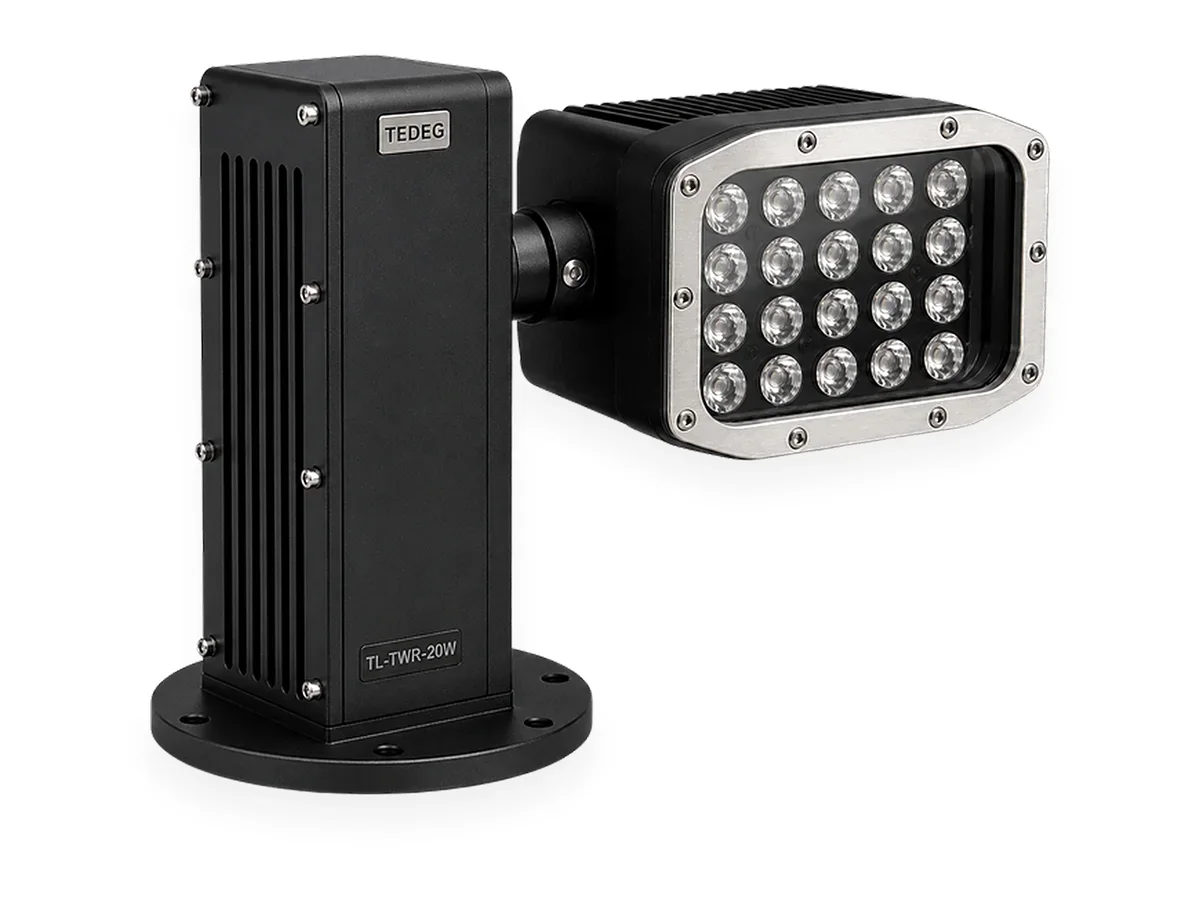
Exterior searchlights and cameras face rain, mud and pressure washing during maintenance. The projector unit of the T-Light Turret military searchlight is rated IP69K, which its datasheet defines as resistance to dust and to high-pressure, high-temperature wash-down. The TDG-CAM-203 HD mini vehicle camera is also rated IP69K and operates from −32 °C to +70 °C at up to 95% relative humidity. Other models are listed under military vehicle camera systems.
Mounting points with an immersion risk
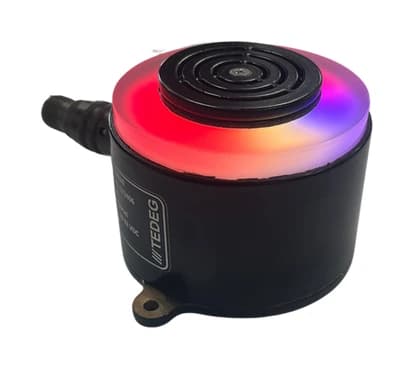
At low mounting points exposed to fording, flooding or standing water, the immersion rating comes first. The housing of the T-Light programmable warning unit is rated IP68, and the datasheet states the condition explicitly: 60 minutes at 1 m immersion, dust-tight. The unit connects through a military PT02E-10-6P connector with O-ring sealing.
Engine bay and battery line
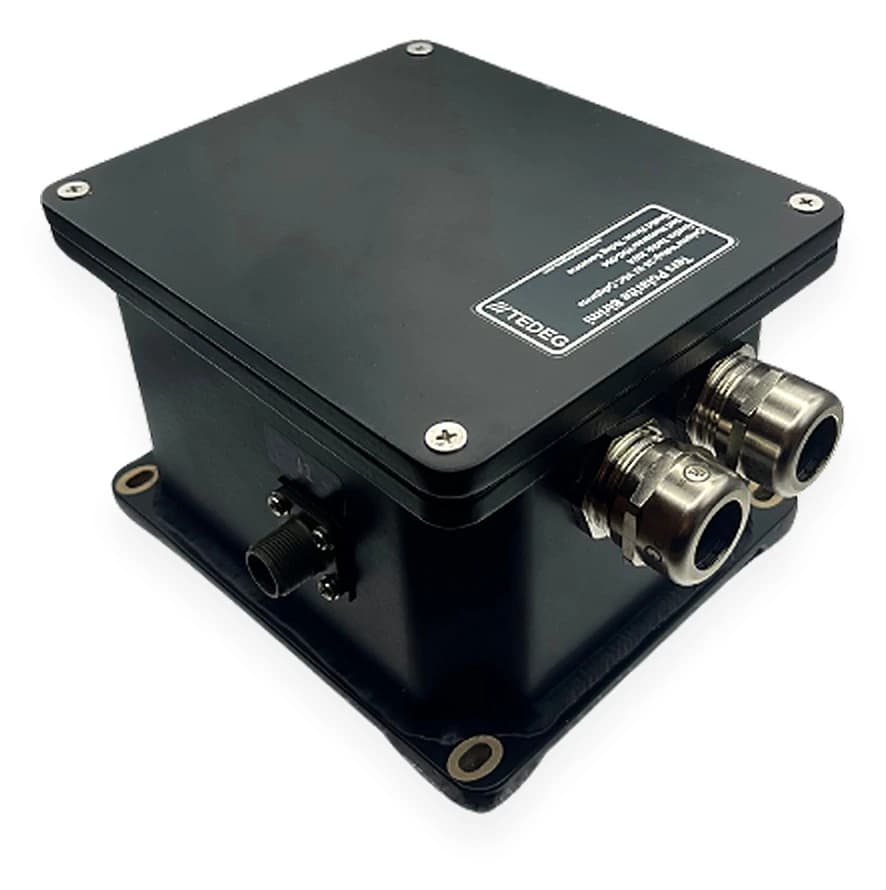
Units on the battery and alternator line see splashing water, fuel vapour and high temperatures. The PowerGuard TPB-01 reverse polarity unit has an IP67 enclosure with a bolted, gasketed lid and is designed for −40 °C to +120 °C operation. Searchlight, warning and smoke launcher solutions sit in the Tactical Systems category.
Read the Rating per Sub-Unit
A system does not always have a single IP rating. On the T-Light Turret, the projector is IP69K while the remote control unit installed inside the vehicle is IP65. That is not a weakness but a split that matches the installation: a controller in the cabin never sees a pressure washer.
Fan-cooled panels make the point even more clearly. The datasheet of the TDG-EDP-D0X DC power distribution unit states that the enclosure is watertight to the MIL-STD-810G Method 506.5 Procedure I rain test, that cable entries use IP67 PG cable glands, and that the cover carries an EMI gasket. When you review a specification, look for the enclosure, gland and connector ratings separately.
What an IP Rating Does Not Tell You
IP tests are usually run on a new sample, over a short time and close to room temperature. In the field, other effects come into play:
- Thermal cycling: a sealed enclosure that heats and cools "breathes" through pressure differences and can draw in moisture over time, which is why pressure equalisation is part of the design.
- Connector state: the rating usually applies with connectors mated. An open socket or an uncapped port makes the enclosure rating meaningless.
- Seal ageing: gaskets on lids that are opened during maintenance have a limited life.
- Other environmental conditions: in MIL-STD-810, rain (Method 506), sand and dust (Method 510) and immersion (Method 512) are separate methods, while salt fog, vibration and shock are outside the IP scheme altogether.
How to Specify an IP Rating
- 1.Name the standard: IEC 60529 or ISO 20653?
- 2.Give the rating per sub-unit: enclosure, controller, connector, cable gland.
- 3.State whether connectors are tested mated or capped.
- 4.If you require IP68, write the depth and duration.
- 5.If you need both jet and immersion resistance, ask for a dual marking (e.g. IP66/IP67).
- 6.Ask for the test report: standard, test condition, laboratory, date and the serial number of the unit tested.
Frequently Asked Questions
What is the difference between IP65 and IP67?
Both are dust-tight. IP65 is tested against water jets, IP67 against 30 minutes of immersion at 1 m. For units that only see splashing water, such as a controller in the cabin, IP65 is often enough; for exterior mounting and standing-water risk, IP67 or a dual marking is preferred.
What is the difference between IP67 and IP68?
Both are dust-tight. IP67 is a 30-minute immersion test at 1 m. The IP68 condition is defined by the manufacturer and must be more severe than IP67, so a buyer who sees IP68 should ask for the depth and duration.
Is IP69K better than IP68?
No, it is different. IP69K shows protection against hot, high-pressure washdown; IP68 shows protection against continuous immersion. Neither covers the other, so choose according to the water the equipment will meet.
Will an IP67 product withstand rain and water jets?
The immersion test does not include a jet test. If rain and jet resistance matter, ask separately for IPX5/IPX6 or for the MIL-STD-810 rain test.
Does an IP rating replace MIL-STD-810 testing?
No. An IP rating defines dust and water ingress only, while MIL-STD-810 covers a much wider range, including temperature, vibration, shock, salt fog and solar radiation.
Conclusion
An IP code is short but dense: the first digit describes dust, the second a specific water test. On defence equipment, the right rating is chosen by mounting location and written per sub-unit. If you want to review protection ratings and environmental requirements together for a land vehicle, turret or fixed-site project, request a quote or reach our engineering team through the contact page.