Why Selecting a Defence Power Electronics Supplier Is a Different Kind of Decision
Choosing a defence power electronics supplier is not the same as picking a part from a catalogue. A frequency converter or power distribution unit touches every subsystem on the platform; when it fails, the radar, camera or mission computer it feeds goes down with it. These units are adapted to the platform, built in one configuration for years and repaired in service: you are buying a ten-year engineering relationship, not a box.
A domestic or regional supplier brings real advantages: engineering support in your working hours, site visits, joint testing and supply that does not wait on a foreign export licence. But proximity alone is not competence. This guide gives system engineers and procurement specialists a 10-point checklist, a scoring table and site-visit questions, with examples from land vehicles, naval platforms, radar and fixed sites.
Three Things to Prepare Before You Evaluate
Put three things in writing before you talk to a supplier.
1. The core of the need. Input source (28 VDC vehicle bus, three-phase mains, generator), output voltage and power, environment (in-vehicle, outdoor, shipboard, shelter) and applicable standards. See the military vehicle electrical architecture guide for the 28 VDC layers and how to specify a military PDU for requirement wording.
2. The evidence level you expect. Is a "designed to the standard" statement enough, or do you need an accredited laboratory report? This drives both price and schedule, so decide it up front.
3. The weights. Not all ten points matter equally on every project. Adaptation capability leads at prototype stage; configuration control and delivery performance lead in series production. Set the weights before you see the offers.
The 10-Point Checklist
1. Design ownership: who designs it and who builds it?
The first question is who holds the design data. When schematics, PCB layout, embedded software and the mechanical model sit with the supplier's own team, change requests and failure analysis are solved at one table. A relabelled unit is not a defect in itself, but you need to know who you depend on for adaptation and root-cause analysis. Ask: do you hold the schematics and source code? Which activities are subcontracted?
2. The evidence behind standards claims
"MIL-STD-461" or "MIL-STD-810" on a datasheet can mean three different things: designed to the standard, pre-compliance tested in-house, or tested and reported by an independent laboratory. All three are legitimate but not equivalent. Ask for the revision letter, the test methods applied (CE102, RS103, Method 514 vibration and so on) and a report summary. Check that the laboratory is ISO/IEC 17025 accredited and that the report covers the offered configuration. We explain how to read these statements in the MIL-STD-461 and MIL-STD-810 guide.
3. Datasheet maturity
The datasheet is the quickest indicator of a supplier's engineering discipline. In a mature datasheet, values come with conditions (efficiency at which input voltage, full power up to which temperature), tolerances are stated, connectors are listed by part number and pin count, and the document carries a revision and date. Adjectives without numbers ("high efficiency", "wide temperature range") and unconditional peak values are warning signs. A product still in validation should say so openly.
4. Interface control and adaptation capability
A power unit meets the platform through connectors, harnesses, mounting points and a communication protocol. Unless those interfaces are written into an Interface Control Document (ICD) before the order, integration problems surface in the field. Ask for the ICD template, 3D (STEP) models and how changes to pin assignment, output count or communication interface are handled.
5. Quality system and traceability
An ISO 9001 certificate is the starting point; the real question is how the system runs on the production floor. Can each serial number be traced to component lots, test records and software version? Is each nonconformance closed with a root-cause analysis and corrective action record? If the contract carries AQAP requirements, verify that scope separately. We describe who owns this work inside a plant in what does a quality systems engineer do.
6. Test infrastructure and acceptance testing
Which tests does every unit pass before delivery? For power electronics the minimum expectation is a functional test under load, verification of protection thresholds, insulation and dielectric measurements and, where appropriate, burn-in. The acceptance test procedure (ATP) should be written, results recorded per unit and witnessing possible on request. Find out which equipment the supplier owns (electronic loads, programmable sources, climatic chambers) and which tests go outside.
7. Configuration and change management
Will the unit ordered in three years match the first lot? Configuration management is the assurance: the bill of materials is under revision control, component and software changes go through an engineering change record, and changes that affect form, fit or function are notified to the customer in advance. Ask for a first article inspection (FAI) report on the first lot and a certificate of conformance (CoC) with each delivery. Without a contractual change-notification clause, a well-meant component substitution can affect the platform's qualification unnoticed.
8. Supply chain and export-control dependency
Security of supply is a domestic supplier's main promise, and it is only as strong as the critical components inside the product. Is there a second source for power semiconductors, magnetics and connectors? Are end-of-life (EOL) notices tracked? Does the product contain components subject to another country's export-control regime? For platforms sold to third countries, that needs a written answer before the contract. Buying from authorised distributors to manage counterfeit risk also belongs here.
9. Delivery schedule and production maturity
Read the quoted lead time against the maturity of the product. A standard configuration and a platform-specific adaptation should be quoted on separate lines. Ask: how many units have been delivered? Which components have long lead times? Are qualification tests inside or outside the schedule? A milestone schedule, rather than one optimistic date, shows a supplier who knows their process.
10. Field support, documentation and life cycle
The period after delivery drives much of the total cost. Are the maintenance manual, fault code list and spare parts list part of the delivery? Are warranty terms and repair turnaround defined? Does the product report its own faults through built-in test (BIT), an event log or remote monitoring? Finally, ask how many years the product will be supported and with what component strategy.
Scoring Table: Comparing Offers on the Same Scale
The table summarises the ten points with the evidence to request and a typical warning sign. Weight each point for your project and score candidates from 1 to 5, with every score resting on a document.
| # | Point | Evidence to request | Warning sign |
|---|---|---|---|
| 1 | Design ownership | Organisation chart, design tools, sample design file | "Our design partner", with no name given |
| 2 | Standards evidence | Revision letter, method list, report summary | "MIL-STD compliant" with no revision |
| 3 | Datasheet maturity | Revision-controlled values with conditions and tolerances | Adjectives without numbers, unconditional peak values |
| 4 | Interface control | ICD template, STEP model, change process | "We will adjust it on site" |
| 5 | Quality and traceability | ISO 9001 certificate, sample serial-number record | Records kept at lot level only |
| 6 | Test infrastructure | ATP, per-unit test record, equipment list | A power-on check only |
| 7 | Configuration management | Revision-controlled BOM, change record, sample FAI | Component changes without notice |
| 8 | Supply chain | Critical parts list, second source, EOL tracking | Single-source critical part with no plan |
| 9 | Delivery and maturity | Milestone schedule, units delivered | One date, no conditions |
| 10 | Field support | Manuals, spare parts list, warranty terms | Support scope left verbal |
8 Questions to Ask on a Site Visit
A site visit shows whether the documents are real. Ask questions whose answers you can see:
- 1.Can you show me, now, the test record and software version for a serial number I pick at random?
- 2.What was the last engineering change, and from which units did it apply?
- 3.Where is nonconforming material quarantined, and how is it labelled?
- 4.Where does the ESD-protected area begin, and are wrist-strap and floor checks recorded?
- 5.Which instruments do you use for acceptance testing, and are the calibration labels current?
- 6.Can I talk to the engineer who designed the power stage of this product?
- 7.Can I see the root-cause report for the last customer return, with the customer name redacted?
- 8.Where do you track stock and order plans for long-lead components?
5 Common Mistakes in Supplier Selection
- Looking at unit price alone. One integration problem or one repeated qualification test quickly outweighs a price difference.
- Leaving the evidence level until after the quote. A test report requested after the order reopens schedule and budget.
- Treating prototype performance as series-production capability. Making one unit work and delivering the hundredth at the same quality are different competences.
- Not writing change notification into the contract. Configuration control should rest on a written rule, not on goodwill.
- Treating "domestic" as a label only. The real value is access to design data, joint testing and fast engineering support.
How the Checklist Reads on Three TEDEG Products
Here is the same lens applied to three published datasheets, to show how a checklist point appears in practice.
Evidence level (point 2): The PowerGuard 115/200 VAC 400 Hz static frequency converter is an 8 kVA unit that converts a 3-phase 360–440 VAC, 50–60 Hz input to a variable 115–220 VAC, 60–400 Hz output. Its datasheet gives method-by-method tables for MIL-STD-810G CHG-1 and MIL-STD-461G; the tests were performed and reported at an ISO/IEC 17025 accredited laboratory. The same product illustrates point 10: built-in test (BIT), RS-422 and Ethernet-based monitoring software are specified.
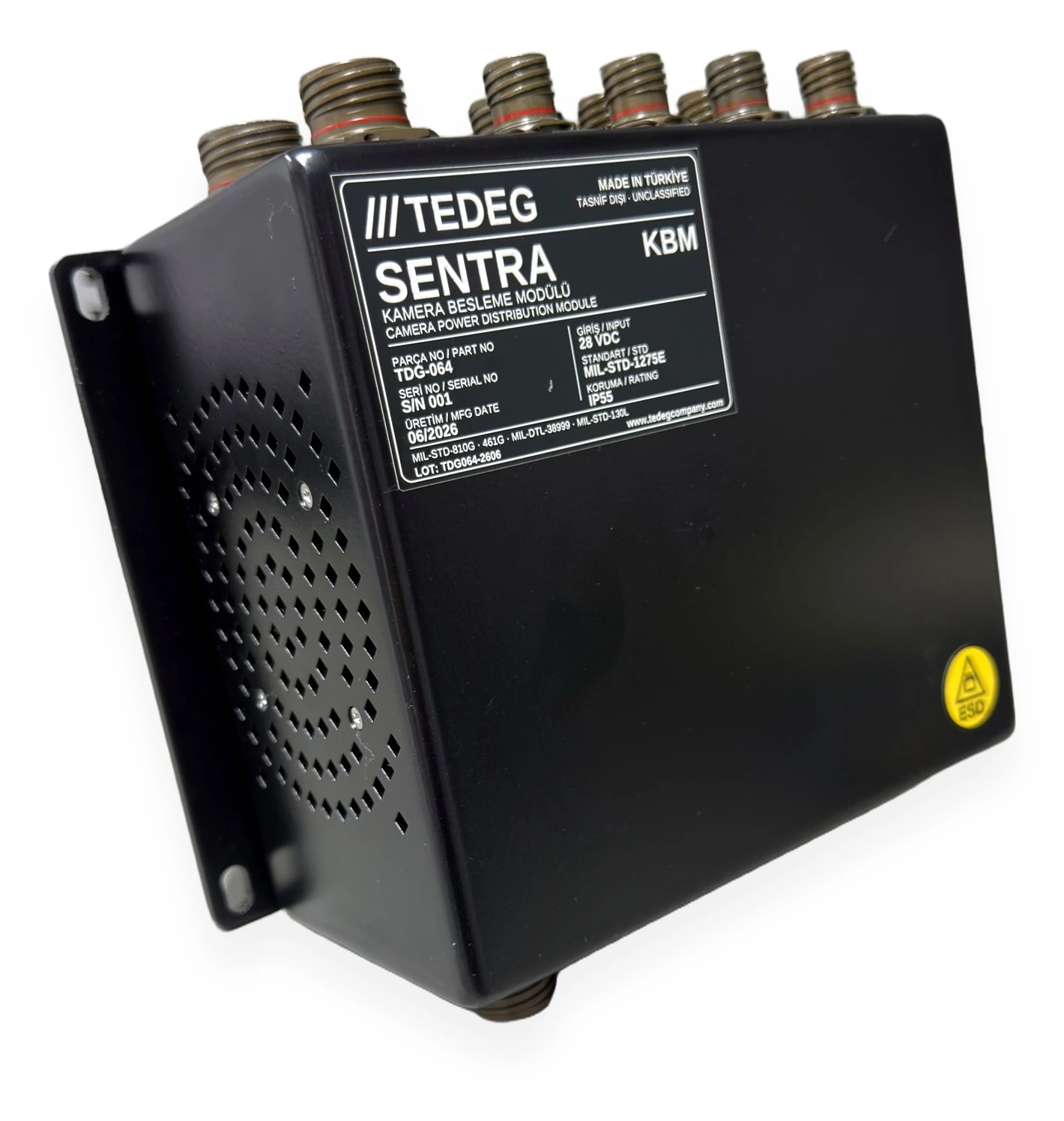
Interface control and a maturity statement (points 3 and 4): The SENTRA KBM camera power distribution module provides at least 11 isolated 12 VDC camera outputs from a MIL-STD-1275E compliant 28 VDC input. The datasheet states that configuration, pin assignments and harness interfaces are finalised through a pre-order ICD; connectors are listed by part number and the identification plate is MIL-STD-130L compliant. Environmental and EMI requirements are specified against MIL-STD-810G CHG-1 methods and MIL-STD-461G tests, and the page states openly that the images show a pre-series validation unit. Here the evidence wording is at "specified" level, visibly different from the previous example.
Adaptation and monitoring (points 4 and 10): The PDU-RT5002 military power distribution unit distributes three 220 VAC 50 Hz inputs to 10 outputs of up to 25 A each in a 19-inch 4U enclosure. The datasheet lists channel count, voltage level and connector type as customer configurations and describes Ethernet remote monitoring with a log of the last 100 records. MIL-STD-461F and MIL-STD-810G are cited with their test and method lists.
Other product families are on the military frequency converters, military power distribution units and mil-spec AC-DC and DC-DC converters pages.
Defence Power Electronics Manufacturer in Turkey: TEDEG Defence
TEDEG Defence is an Ankara-based defence company that designs and manufactures power conversion, power distribution and vehicle electronics products for military platforms.
| Profile | Details |
|---|---|
| Company | TEDEG Savunma Sanayi A.Ş. (brand: TEDEG Defence) |
| Headquarters | Ankara, Turkey |
| Founded | 2023 |
| Registrations and certificates | ISO 9001, EYDEP |
| Cluster membership | SAHA Istanbul |
- Certificates and test reports: Quality certificates and independent laboratory test report summaries are on the Certifications and Quality page.
- Engineering scope: Electronic hardware, embedded software, mechanical design, system integration and test and validation are described on the Services page.
- Reference work: Problem and solution summaries of completed projects are on the Case Studies page.
- Product range: The full range is in the product catalogue.
Frequently Asked Questions
What should I check first when selecting a defence power electronics supplier?
Design ownership and the evidence level behind standards claims. Design data held by the supplier speeds up adaptation and failure analysis; the evidence level (design statement, pre-compliance test or accredited laboratory report) determines how much of the platform qualification burden the product carries.
Which documents should I request from a supplier?
A revision-controlled datasheet, a draft ICD and 3D model, the quality system certificate, test report summaries, the ATP, a first-lot FAI report and a CoC with each delivery. Sharing sensitive documents under a non-disclosure agreement is normal.
What is the difference between "MIL-STD compliant" and "MIL-STD tested"?
"Compliant" or "designed to the requirements of" describes a design target. "Tested" says a specific configuration was tested with specific methods and a report shows it. What matters is that the wording in the quote matches the evidence level your specification asks for.
Is a small or young supplier a risk?
Size or age alone is not a risk indicator. What decides is whether this list is met with documents: design data, traceable test records, written change management and a critical-components plan. A small team that can show these often adapts faster; a large company that cannot carries the same risk.
Does the checklist apply to international buyers too?
Yes. The ten points are independent of country. For an international buyer, point 8 carries more weight: whether the product contains components subject to another country's export-control regime.
Conclusion
Selecting a defence power electronics supplier should rest, before price and lead time, on documented answers to ten questions. Score the list with your own weights, verify it with a site visit, and you can compare offers on one scale.
If you would like to evaluate TEDEG against this list, send your requirement through the quote form or contact our engineering team directly.
Field example: read how multi-source power distribution was handled on a land platform in the tactical truck power architecture case study.