Start with the Installation Conditions
An induction motor needs to raise an antenna mast on a radar vehicle or move the levelling legs of a missile vehicle. Is an industrial variable-frequency drive (VFD) installed in a cabinet enough, or does the application call for a custom military motor drive?
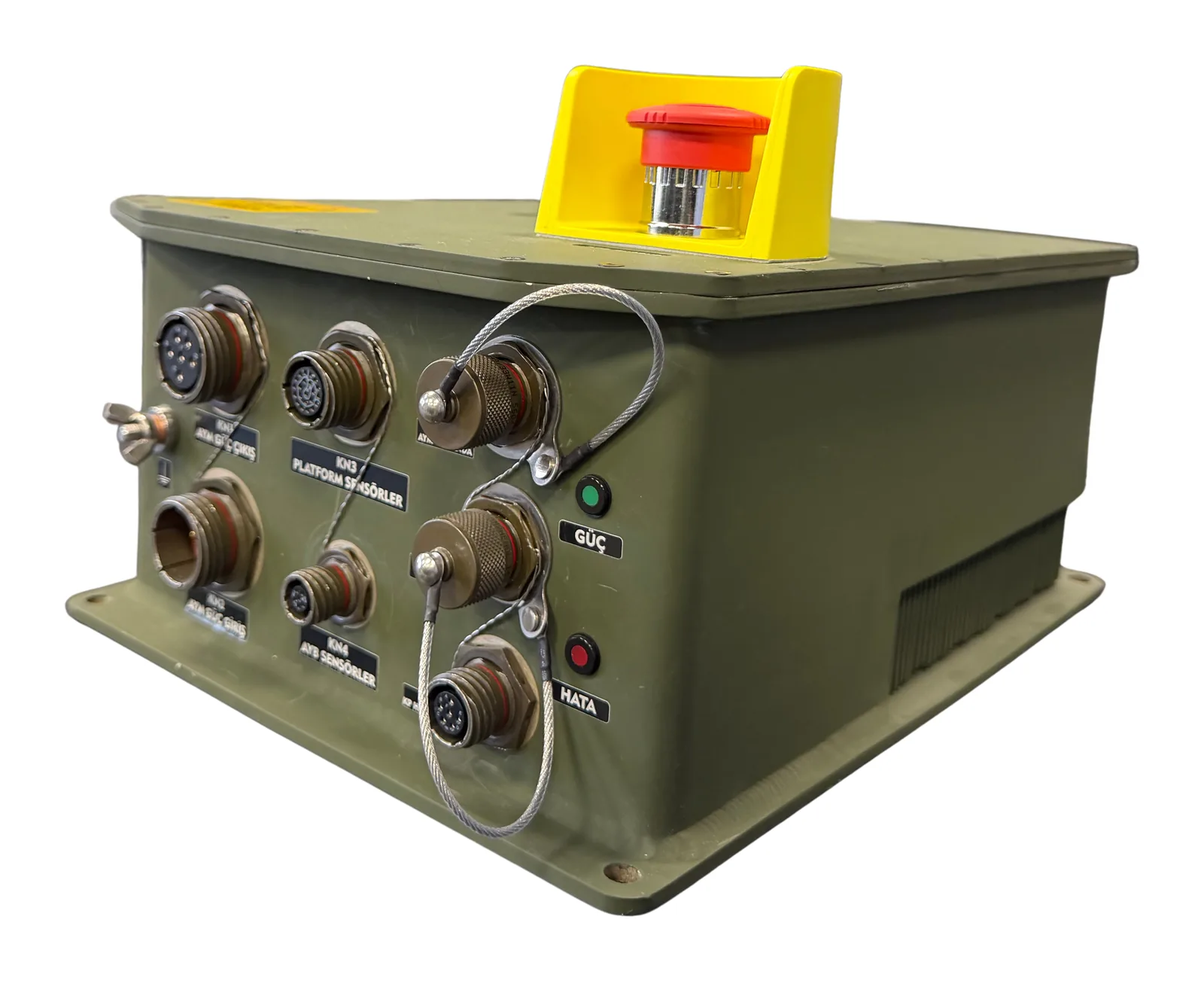
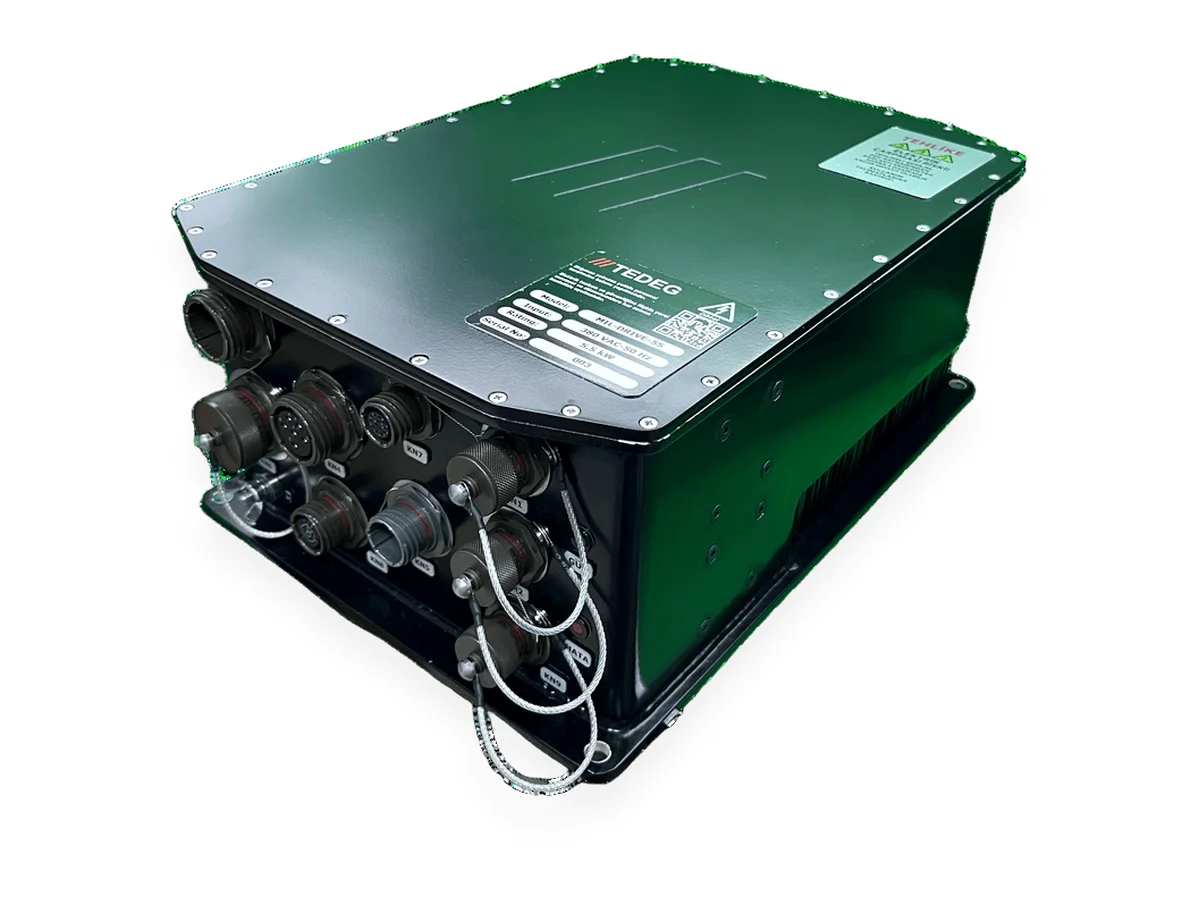
Both can turn the motor. The decision depends on how the drive handles temperature, water, vibration and electromagnetic stress, how it communicates with the platform's control computer, and how its safety functions fit the system. TEDEG's Mil-Drive-55 military induction motor drive provides an example of the custom approach. Our military motor drive guide covers FOC, the servo comparison and STO in detail. The question here is what to specify and purchase.
Where an Industrial VFD Struggles in the Field
Most panel-mount industrial VFDs are designed around factory-panel conditions: controlled temperature, clean air, fixed mounting and mains-quality supply. Most of these assumptions no longer hold on a military platform.
Temperature
Commercial drives typically provide full power over a narrow ambient range, with derating as they approach the upper limit. That range may be insufficient in a closed vehicle compartment in the sun, or on a platform left outdoors on a cold morning. Cabinet air conditioning addresses the environment but adds a failure point, weight and power consumption.
Dust, Water and Humidity
Fan cooling draws dust and moisture in with the air. Panel filters and gaskets need maintenance. On a platform exposed to driving rain or wash-down, sealing must be provided independently of the rest of the system. Our guide to IP ratings explains what each protection rating means.
Vibration and Shock
A drive mounted on a DIN rail with screw terminals and a cooling fan is not designed for vehicle vibration and road shock. Loose terminals and stressed fan bearings are typical causes of field failures.
Electromagnetic Compatibility
PWM switching is a strong emission source. Industrial EMC classes usually do not cover a military environment where radar, radios and sensitive sensors share a platform. Adding filters or shielding late in the project extends the schedule. Our MIL-STD-461 and MIL-STD-810 guide covers the military EMI and environmental test families.
Communication and Integration
An off-the-shelf drive uses its manufacturer's standard data map. The platform control computer expects interlock logic, limit-switch information and fault reports in a defined format. The integrator must translate between them in software or add a gateway.
Safety Functions
Safe torque off, emergency stop and the motor brake form part of the platform's safety chain. Even if an off-the-shelf drive includes these functions, their wiring, interlocks and fault behaviour must subsequently be fitted to the platform's safety analysis.
What Is Designed into a Custom Drive?
For a custom drive, these requirements are design inputs. Each Mil-Drive-55 is designed and built for the customer's application. Inputs, outputs, interfaces, protections and functions are adapted through hardware and firmware. The configuration is agreed with the customer's engineering team and verified in the factory acceptance test.
Environmental protection is built into the drive:
- IP67 sealed aluminium enclosure with fanless passive cooling
- Full rated power up to +55 °C with no derating
- Continued operation if the ambient falls to −40 °C while running; for a cold start, internal heaters pre-condition the unit and the power stage is enabled once the heatsink is above −20 °C (about 10 minutes or longer, depending on conditions)
- All power, signal and communication interfaces on MIL-DTL-38999 series connectors
- Designed to MIL-STD-810G and MIL-STD-461F
The drive communicates over 2 × isolated RS-485 (Modbus RTU). Up to 63 drives can share one line, and the communication data map is adapted to the project. If communication is lost, the motor stops by coasting or on a ramp after the selected watchdog time. The core power ratings are 5.5 kW (optional up to 18 kW), 3 × 400 VAC output and 400 VAC ±10 %, 48–62 Hz input.
The fanless enclosure has no filter or fan to replace. Every fault is latched with a code, reported on the communication line and written to a 1,000-entry event log with a real-time clock. A technician can read when a fault occurred and under what conditions. Firmware can be updated through the serial port without opening the sealed enclosure.
What Is Standard and What Is a Project Option?
Custom configuration does not mean designing every function from scratch. The Mil-Drive-55 includes sensorless FOC speed control, torque limiting and torque-based stop, autotune, two-channel STO, dynamic braking and motor holding-brake control as standard. Modbus RTU, the event log and field firmware updates are also standard. Ramps, limits, stop modes, I/O assignments and the communication data map are configured in software.
Project options require hardware: closed-loop speed and position control with encoder or resolver feedback, CAN/CANopen, Ethernet with an embedded web panel, a hand-held control unit, and multi-axis master/slave systems. The product page lists them under "Standard Functions and Project Options". If the application needs the drive, power distribution and interlock/limit logic in one box, see the Mil-Drive MCU-400 military motor control unit.
When Is an Off-the-Shelf Drive Enough?
Not every motor application needs a custom drive. Use the installation requirements to make the initial comparison:
| Condition | Off-the-shelf VFD | Custom military drive |
|---|---|---|
| Installation | Air-conditioned, fixed cabinet | Vehicle, outdoors, rain-exposed compartment |
| Ambient temperature | Narrow and controlled | Wide; full power needed at the top end |
| Vibration and shock | None or low | Road, terrain, ship motion |
| EMC environment | Industrial | Near radar, radios, sensitive sensors |
| Communication | Manufacturer's standard map is fine | Platform data map and interlocks |
| Safety chain | Simple emergency stop | STO, brake, interlocks and fault reporting together |
If the left column dominates, an industrial VFD is a sensible and economical choice. If even two or three rows in the right column apply, the total cost and risk of adapting an off-the-shelf drive with a cabinet, air conditioning, filters and a gateway should be compared with a custom drive; in many projects the gap narrows or reverses.
What to Include in a Quotation Request
For a Mil-Drive-55 quotation, provide the following application data:
- 1.Motor nameplate data: power, voltage, current, pole count
- 2.Speed range
- 3.Feedback type (sensorless or encoder/resolver)
- 4.Safe-stop requirement: STO, emergency stop
- 5.Communication interface and the data you need
- 6.I/O and interlock list
- 7.Operating environment
Settling this list early also defines the configuration and factory acceptance test scope earlier. The communication data map and interlock list are the items most often missing. Prepare them with the platform's control-software team to shorten the quotation process.
Military Motor Drive Manufacturer in Turkey: TEDEG Defence
TEDEG Defence is based in Ankara and designs and manufactures military power electronics and motor drives.
| Profile | Details |
|---|---|
| Company | TEDEG Savunma Sanayi A.Ş. (brand: TEDEG Defence) |
| Headquarters | Ankara, Türkiye |
| Founded | 2023 |
| Registrations and certificates | ISO 9001, EYDEP |
| Cluster membership | SAHA Istanbul |
The Mil-Drive-55 is supplied to ROKETSAN, ASELSAN and KOLUMAN. Applications in service include the levelling legs of an armoured missile vehicle (the motors that raise and lower the vehicle), an antenna elevating platform and a radar vehicle. For each delivery the drive is configured to that platform's motor, I/O and communication data map.
Frequently Asked Questions
What is the difference between a military motor drive and an industrial VFD?
Both drive an induction motor at variable frequency. A military motor drive is designed for a sealed enclosure, a wide temperature range, military connectors, military EMC and environmental requirements, and the platform's communication and safety chain. Most panel-mount industrial VFDs are designed around a factory-panel environment.
Can an industrial VFD in a sealed cabinet be used on a military platform?
In some fixed installations, yes. In a vehicle or outdoors, the cabinet, air conditioning and filters add failure points and weight. Vibration, EMC and communication compatibility still need to be addressed separately.
What do I need to send for a custom drive quotation?
Send the motor nameplate data, speed range, feedback type, safe-stop requirement, communication interface and data, I/O and interlock list, and operating environment. The configuration is agreed with our engineering team.
Does the Mil-Drive-55 work at −40 °C?
If the temperature falls to −40 °C while the drive is running, it keeps operating. For a cold start, internal heaters pre-condition the unit. The power stage is enabled once the heatsink is above −20 °C, which takes about 10 minutes or longer depending on conditions.
From Requirements to the Quotation
An off-the-shelf VFD is a good choice for a fixed, air-conditioned cabinet. For a vehicle or outdoor installation with demanding EMC conditions, a custom military motor drive with built-in environmental protection and a platform-specific interface reduces integration risk from the start. Compare the requirements with other models in the military motor drives category. The Mil-Drive-55 operating manual and technical overview are available under technical documents on the product page. Send the motor and application data through the quote form to define the configuration.