
Mil-Drive-55 Military Induction Motor Drive — FOC Vector Drive
FOC drive for three-phase asynchronous motors, compliant with MIL-STD-810G and designed to meet MIL-STD-461F — sealed enclosure, passive cooling, Safe Torque Off. Armoured vehicles, EO turrets, radar, missile launch pedestals.
Nominal power
5.5 kW (optional up to 18 kW)
Output
3 × 400 VAC, 0–500 Hz
Motor current
14 A · overload 150% (60 s) / 175% (2.5 s)
Input
400 VAC ±10%, 48–62 Hz
Connectors
MIL-DTL-38999 series
Dimensions
245 × 350 × 145 mm
Weight
12 ± 0.5 kg
Operating temperature
−30 °C to +55 °C
Control
FOC (Field Oriented Control)
Safety
Safe Torque Off (STO)
Company:ITAR-FreeNCAGE: TM885
Overview
Product and Purpose
The Mil-Drive-55 Military Motor Drive and Control Unit is a mil-spec induction motor drive — not a servo drive product category. It delivers precise speed, torque, and direction control for three-phase asynchronous motors on defence platforms. Field Oriented Control (FOC) provides servo-like positioning precision with the durability and cost profile of induction motor technology. Developed by TEDEG Defence R&D, the unit is MIL-STD-810G environmental and MIL-STD-461F EMI/EMC compliant, housed in a sealed enclosure, and passively cooled. Applications include armoured land vehicles, radar antenna drives, electro-optical turrets, missile launch pedestals, mobile mission units, and naval systems. The Mil-Drive-55 is positioned in the military asynchronous motor + FOC niche — a distinct segment versus servo-only premium drives and civilian-grade industrial VFDs.
Engineering Capability and Technology
The engineering foundation of the Mil-Drive-55 is FOC (Field Oriented Control) — an algorithm that monitors motor magnetic flux in real time to achieve torque and speed regulation at maximum efficiency. Compared to conventional drives, this approach yields reduced acoustic noise and significantly higher positioning precision. The system processes platform I/O signals including resolver, incremental and absolute encoder, NTC/PTC temperature sensor, emergency input, and Safe Torque Off (STO). The STO function features dual-channel architecture, immediately interrupting motor torque in emergencies — critical for both operator safety and mission reliability. RS-485 and CAN-Bus communication protocols enable integration with central command systems; operators can remotely access drive status, fault codes, limit switch information, serial number, and device ID. The passively cooled design (no fan) combined with the sealed aluminium enclosure minimises field maintenance and enables continuous operation under rain and harsh outdoor conditions. MIL-STD-461F compliance guarantees EMI/EMC compatibility with radar, communication, and sensor systems sharing the same platform.
Key technical values:
- Nominal power: 5.5 kW (optional up to 18 kW); output 3 × 400 VAC, 0–500 Hz; motor current 14 A
- Overload capacity: 150% (60 s), 175% (2.5 s)
- Input: 400 VAC ±10%, 48–62 Hz; phase imbalance max. 3%
- Start / stop: Ramp-up / ramp-down, configurable 0.1–600 s; PWM frequency 4–32 kHz (selectable)
- Communication: RS-485 (Modbus RTU) and CAN-Bus, adjustable 9600–115200 bps; operating status, fault codes, limit switch information, serial number and device ID are reported
- Mechanical: 245 × 350 × 145 mm, 12 ± 0.5 kg, aluminium 6000 series enclosure; mounting holes 225 × 330 mm, 4 × Ø8.5 mm
- Environmental: −30 °C … +55 °C operating temperature, 95% RH humidity resistance
- Monitoring and maintenance: Built-in operating hour meter, LED status indicators; optional OLED display support and Ethernet
Typical Application Scenarios
The Mil-Drive-55 is deployed in turret rotation (azimuth and elevation) on armoured vehicles, precision positioning in electro-optical gimbal systems, pedestal control on missile launch platforms, antenna positioning in mobile radar systems, and stability systems on naval platforms. The dual-channel STO architecture interrupts motor torque rapidly under emergency conditions. The passive cooling and sealed-enclosure design preserve performance across diverse field conditions — rain exposure, humidity up to 95% RH, vibration, and shock — supporting both indoor and outdoor deployments.
Compliance standards:
- MIL-STD-810G — Environmental durability (vibration, shock, rain exposure)
- MIL-STD-461F — Electromagnetic interference and compatibility (EMI/EMC)
The TEDEG Advantage
The TEDEG Defence R&D team moved the Mil-Drive-55 from concept to series production. Standard configurations are delivered in 8-12 weeks, compared to 20-26 weeks typical of global premium suppliers. Turkish manufacturing infrastructure provides meaningful cost advantage for NATO buyers, with no compromise on FOC software, STO architecture, or MIL-STD compliance. Custom configurations (alternative power levels, additional I/O channels, custom communication protocols) ship within 14-16 weeks thanks to the modular design.
The Mil-Drive-55 sits in a distinctive niche: combining 3-phase asynchronous motor + FOC + mil-spec certification — servo-like positioning precision with the durability and cost advantage of an induction motor.
Validated by Turkish Defence Primes: The system is supplied as an approved vendor of ASELSAN, Roketsan and the Turkish Ministry of National Defence (MSB). Field-proven service record in armoured vehicle, turret, radar, and missile launcher programmes within the Turkish Armed Forces inventory. NATO supplier registration (NCAGE): TM885. ITAR-Free — no US-origin controlled content.
Production Maturity: The Mil-Drive-55 is delivered at day-one production maturity — field-proven FOC vector algorithm, certified component supply chain (power stage, resolver/encoder interface, STO circuit), and rapid serial-production capability. Our team carries more than a decade of R&D and production experience in the defence motor-drive segment.
Specifications
| Nominal power | 5.5 kW (optional up to 18 kW) |
| Output | 3 × 400 VAC, 0–500 Hz |
| Motor current | 14 A · overload 150% (60 s) / 175% (2.5 s) |
| Input | 400 VAC ±10%, 48–62 Hz |
| Connectors | MIL-DTL-38999 series |
| Dimensions | 245 × 350 × 145 mm |
| Weight | 12 ± 0.5 kg |
| Operating temperature | −30 °C to +55 °C |
| Control | FOC (Field Oriented Control) |
| Safety | Safe Torque Off (STO) |
| Comms | RS-485 (Modbus RTU), CAN-Bus |
| Motor type | 3-phase asynchronous |
| Sensors | Resolver, incremental / absolute encoder, NTC/PTC |
| Protection | Sealed aluminium (6000 series) enclosure |
| Cooling | Passive (fanless) |
| Standards | MIL-STD-810G / MIL-STD-461F |
MIL-STD Compliance
MIL-STD-461F
EMI/EMCMIL-STD-810G
EnvironmentalSee Certifications & Quality for our test and validation approach, and our Test & Validation service for programme-specific testing.
Datasheet
Related Products
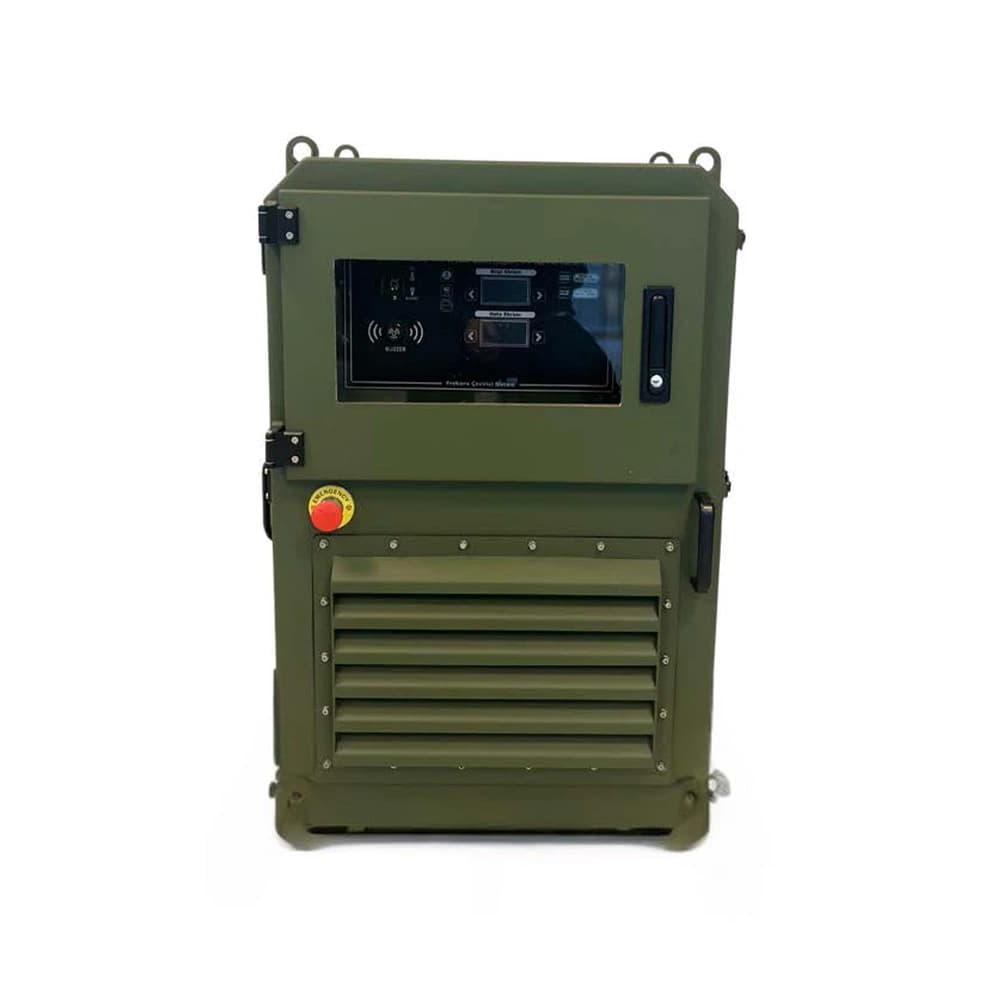
Frequency Converters, Motor Drives & Military UPS Systems
PowerGuard 115/200 VAC 400 Hz Military Static Frequency Converter
Details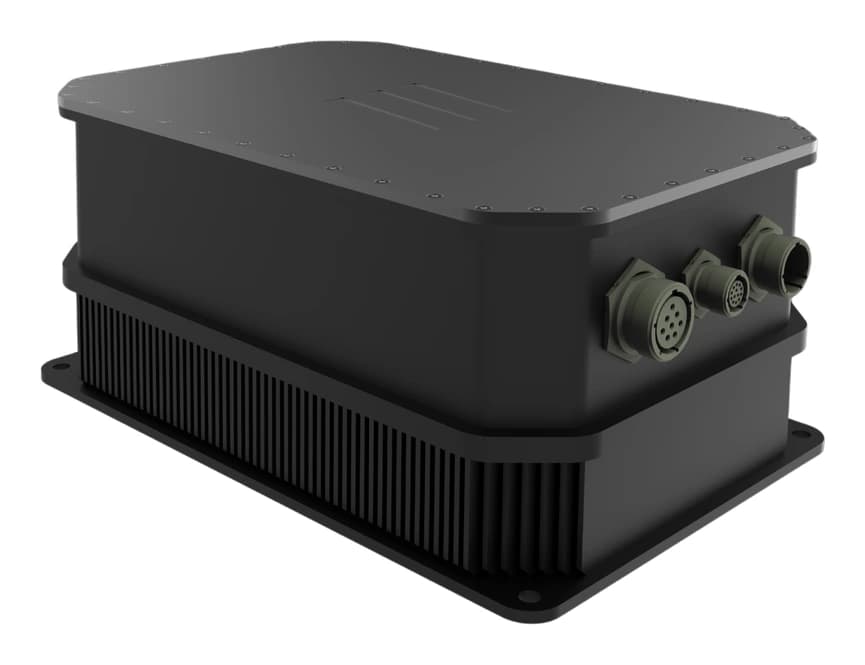
AC-DC & DC-DC Power Converters
PowerGuard-D1000 Mil-Spec DC-DC Converter — 1 kW MIL-STD-1275
Details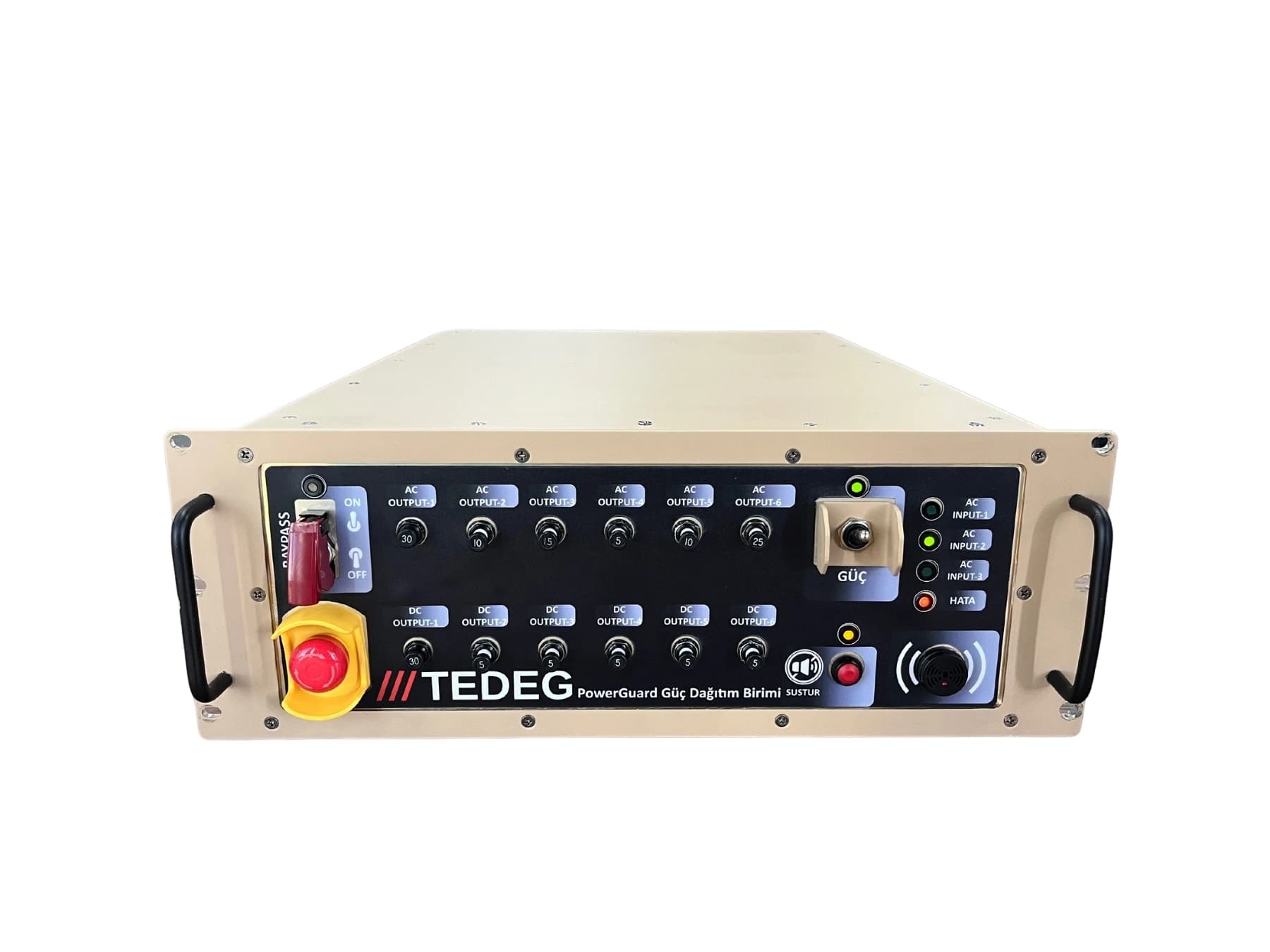
Power Distribution Units (PDU)
PDU-RT5002 Military Power Distribution Unit — Rack-Mount Rugged PDU
DetailsFull category: military frequency converters and 400 Hz power systems
Engineering Support
Our engineering services can adapt this product to your platform, integrate it or test it against your programme requirements.
Related Guides
FAQ
Asynchronous motor + FOC vs servo motor — which is preferred and why?+
Servo motors traditionally offered higher position-control accuracy; however, they are expensive, contain mechanical wear points (brushes/commutators at high speeds), and are harder to maintain in the field. The asynchronous-motor + FOC (Field Oriented Control) combination has reached servo-like positioning accuracy over the last 10-15 years — yet costs 40-60% less, has no mechanical wear thanks to brushless construction, and minimal field maintenance. For mid-precision military applications such as turret positioning, antenna movement, and crane drives, asynchronous + FOC has become the modern choice.
What is Safe Torque Off (STO), which standard does it meet?+
STO is the safety function that instantly and controllably cuts motor torque in an emergency. It electrically disconnects the motor from power — providing a mechanical stop independent of the control system. The STO input circuitry is designed for compliance with international safety standards and works together with dedicated emergency (Emergency Stop) inputs. Dual-channel STO architecture guarantees safe stopping even under a single-point failure.
Which sensors are supported?+
The Mil-Drive-55 standard configuration supports resolver, incremental encoder, absolute encoder, and NTC/PTC temperature sensor inputs: SIN, COS, REF for the resolver; A, B, I channels for the incremental encoder; DATA±, CLOCK± for the absolute encoder; and an NTC/PTC thermistor input for motor winding temperature.
Which platforms can it be mounted on?+
The system is designed for armoured land vehicles (turret motor drive, hydraulic pump, auxiliary motor), radar systems (antenna positioning, cooling fans), electro-optical turrets (positioning), missile launchers (pedestal motion), mobile command vehicles (HVAC, hydraulic), naval platforms (pumps, stabilisation, cranes). The sealed enclosure and passive cooling support both indoor and outdoor deployments.
What is the lead time and serial production capacity?+
Standard configurations have a lead time of 8–12 weeks. Customer-specific configurations (different power levels, additional I/O, custom communication protocols) require an additional 3-6 weeks of engineering. Monthly serial-production capacity scales between 30-80 units.
Which certifications does it hold?+
MIL-STD-810G (environmental — vibration, shock, rain exposure) and MIL-STD-461F (EMI/EMC). TEDEG holds NCAGE code TM885, an ISO 9001 quality management system and EYDEP registration, and is a member of the OSSA and SAHA Istanbul clusters.