
PowerGuard 115/200 VAC 400 Hz Military Static Frequency Converter — 60–400 Hz Variable Output
Input
3-phase, 360–440 VAC, 50–60 Hz
Output
Variable 115–220 VAC, 60–400 Hz
Connection
Star 115 VAC (L-N) · Delta 115 VAC (L-L), 400 Hz
Efficiency
At least 85%
THD
Below 5%
Frequency modulation
Max. 4 Hz
Voltage modulation
Max. 2.5 Vrms
Operating conditions
-30 °C to +50 °C · 3000 m
Weight
210 ± 5 kg
Standards
MIL-STD-1399B · 810G · 461G · 1399-300B
Company:ITAR-FreeNCAGE: TM885
Overview
Product and Purpose
The PowerGuard Military 115/200 VAC 400 Hz Static Frequency Converter is a solid-state frequency conversion system that takes a 3-phase 360–440 VAC, 50–60 Hz supply and converts it to a variable 115–220 VAC, 60–400 Hz output. It was developed by TEDEG engineering to provide the reliable power conversion that defence and industrial applications depend on.
Many military systems are designed to run on 400 Hz power. Shipboard electronics, radar and fire-control subsystems, and some units fitted to land vehicles and mobile field systems fall into this group. At 400 Hz, transformers and motors can be smaller and lighter for the same power. Site and camp grids, however, supply 50–60 Hz. PowerGuard bridges that gap: it takes the grid supply and regenerates it at the voltage and frequency the equipment expects.
Two connection options are available for 400 Hz loads: star connection at 115 VAC (line-to-neutral) and delta connection at 115 VAC (line-to-line). An optional power distribution unit can be added at the output, so that power is distributed to different subsystems in a controlled way.
Conversion is entirely electronic; there is no rotating machine such as a motor-generator set. Steady-state voltage and frequency fluctuations are kept under control, and output quality is defined by harmonic distortion and modulation limits.
Engineering Capability
Electrical performance:
| Feature | Value |
|---|---|
| Input | 3-phase, 360–440 VAC, 50–60 Hz |
| Output | Variable 115–220 VAC, 60–400 Hz |
| Star connection | 115 VAC (line-to-neutral), 400 Hz |
| Delta connection | 115 VAC (line-to-line), 400 Hz |
| Efficiency | At least 85% |
| Output power factor | Star: min. 0.85 · Delta: min. 0.80 |
| Total harmonic distortion (THD) | Below 5% |
| Frequency modulation | 4 Hz maximum |
| Voltage modulation | 2.5 Vrms maximum |
| Time to steady state | 200 ms |
| Output shutdown time | 100–170 ms (on over- or under-voltage) |
Protection:
- Phase-sequence protection
- Overload, short-circuit and over-temperature protection
- Steady-state voltage and frequency fluctuation control
- Output shutdown within 100–170 ms on over- or under-voltage
Monitoring and control:
- BIT (Built-In Test): Continuous status monitoring
- OLED display: Status on the unit itself
- RS-422: Remote control and data monitoring
- Real-time measurement: Live readout of input and output values
- Desktop remote control and monitoring software over Ethernet: Shows per-phase input and output currents, line-to-line voltages, and input and output frequency. It lists over- and under-voltage, overcurrent, frequency deviation, unbalanced load, heat-sink and cabinet temperature, emergency, open panel door, and fuse and contactor faults on the 115 V and 200 V outputs as separate alerts. Voltage selection, inverter start, output on/off, fault reset and silent mode commands are sent from the software.
Environmental and mechanical:
| Feature | Value |
|---|---|
| Operating temperature | −30 °C … +50 °C |
| Operating altitude | 3000 m (under low pressure) |
| Physical durability | Tested to MIL-STD-810G CHG-1: temperature, solar radiation, rain, humidity, salt fog, vibration and shock |
| Weight | 210 ± 5 kg |
Military standards:
- MIL-STD-1399B: Technical standard compliance
- MIL-STD-1399-300B: Output voltage and frequency requirements
- MIL-STD-810G CHG-1: Environmental durability; passed at an ISO/IEC 17025 laboratory (report V 1731 23268 00 01 BE): temperature, solar radiation, rain, humidity, salt fog, vibration, shock
- MIL-STD-461G: EMI/EMC; passed (report A 1731 23268 00 01 BE): CE102, RE102, CS101, CS114, CS115, CS116, RS103
Typical Applications
Defence:
- Naval platforms: Supplying shipboard 400 Hz equipment, with output voltage and frequency requirements defined to MIL-STD-1399-300B
- Radar and fire-control systems: Powering 400 Hz subsystems during maintenance, integration and testing
- Land vehicles and mobile field systems: Workshop and depot testing of vehicle-mounted 400 Hz units, and powering field systems
- Military camps and forward outposts: Power source at temporary bases
- Field operations: Fast power conversion in mobile operations
- Specialised military motors and power-intensive equipment: Mission equipment with high energy demand
Industrial and critical infrastructure:
- Test and calibration laboratories: Test equipment that needs precise power
- Production lines, heavy industry and automation: Large industrial motors and control systems
- Hospitals and data centres: Critical medical devices, servers and storage
- Emergency management: Transportable power source in disaster zones
The TEDEG Advantage
PowerGuard brings a variable 60–400 Hz output, a choice of star or delta connection, BIT, OLED and RS-422 monitoring, and Ethernet-based desktop software together in a single cabinet. Because one unit can supply both 400 Hz equipment and 60 Hz loads, there is less need to carry separate converters for different missions. With the optional power distribution unit, the converter becomes a power platform that distributes energy to subsystems in a controlled way.
If you need an outdoor solution that delivers 60 Hz and 400 Hz on separate channels, see the PowerGuard Outdoor 60/400 Hz Military Frequency Converter. All options are listed under Frequency Converters, Motor Drives & Military UPS Systems.
Corporate assurance: TEDEG Defence is an approved supplier of ASELSAN, Roketsan and the Turkish Ministry of National Defence (MSB), with NATO supplier registration under NCAGE: TM885.
Specifications
| Input | 3-phase, 360–440 VAC, 50–60 Hz |
| Output | Variable 115–220 VAC, 60–400 Hz |
| Connection | Star 115 VAC (L-N) · Delta 115 VAC (L-L), 400 Hz |
| Efficiency | At least 85% |
| THD | Below 5% |
| Frequency modulation | Max. 4 Hz |
| Voltage modulation | Max. 2.5 Vrms |
| Operating conditions | -30 °C to +50 °C · 3000 m |
| Weight | 210 ± 5 kg |
| Standards | MIL-STD-1399B · 810G · 461G · 1399-300B |
MIL-STD Compliance
MIL-STD-810G
EnvironmentalMIL-STD-461G
EMI/EMCMIL-STD-1399B
Shipboard Electrical PowerIndependent Laboratory Test Reports
- Report no.
- V 1731 23268 00 01 BE
- Laboratory
- Consept Europe Kft. · ISO/IEC 17025 · Gebze, Kocaeli
- Report date
- 21 March 2025
- 501.6 · High temperature
- 502.6 · Low temperature
- 505.6 · Solar radiation
- 506.6 · Rain
- 507.6 · Humidity
- 509.6 · Salt fog
- 514.7 · Vibration
- 516.7 · Shock
- Report no.
- A 1731 23268 00 01 BE
- Laboratory
- Consept Europe Kft. · ISO/IEC 17025 · Gebze, Kocaeli
- Report date
- 20 March 2025
- CE102 · Conducted emissions
- RE102 · Radiated emissions, electric field
- CS101 · Conducted susceptibility, power leads
- CS114 · Conducted susceptibility, bulk cable injection
- CS115 · Conducted susceptibility, impulse excitation
- CS116 · Conducted susceptibility, damped sinusoidal transients
- RS103 · Radiated susceptibility, electric field
Reports are shared with customers on request by report number; under the laboratory's terms they are provided only in full. A standard is named on a product page only when it appears in that product's datasheet or test report. Request the report
See Certifications & Quality for our test and validation approach, and our Test & Validation service for programme-specific testing.
Datasheet
Related Products
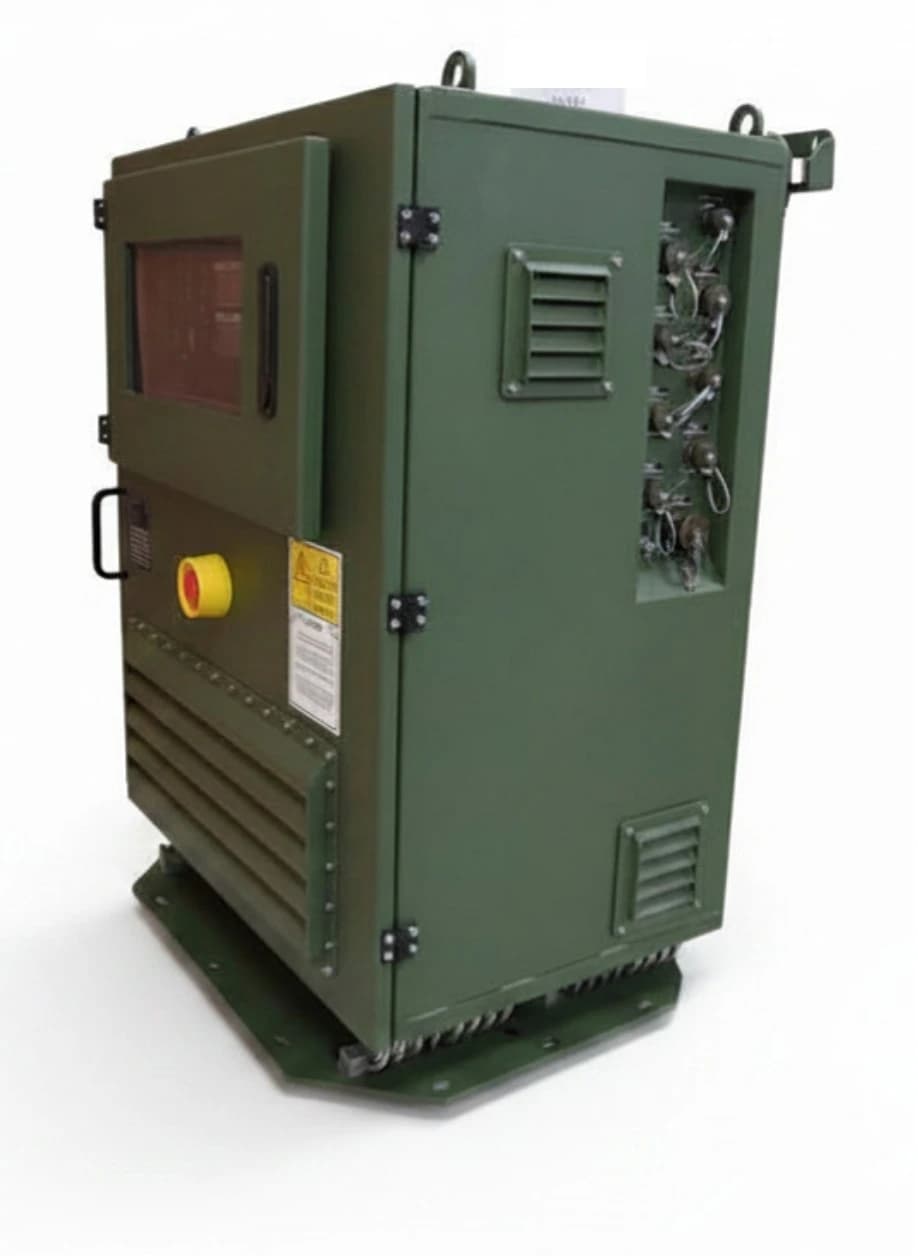
Frequency Converters, Motor Drives & Military UPS Systems
PowerGuard Outdoor 115 VAC 60/400 Hz Military Mobile Frequency Converter
Details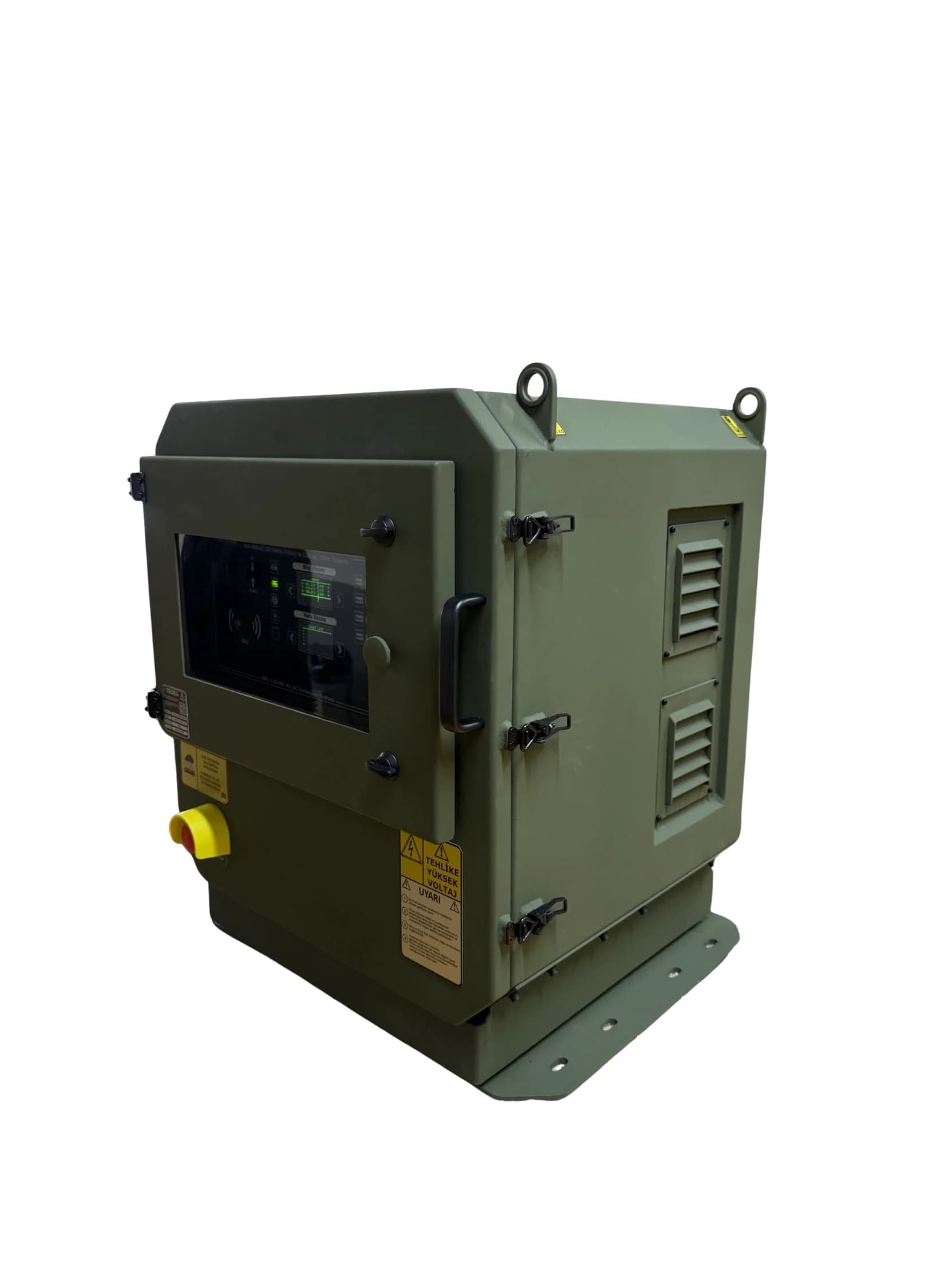
Frequency Converters, Motor Drives & Military UPS Systems
PowerGuard 400/115 VAC AC-AC Military Inverter — 10 kVA, 4 Outputs
Details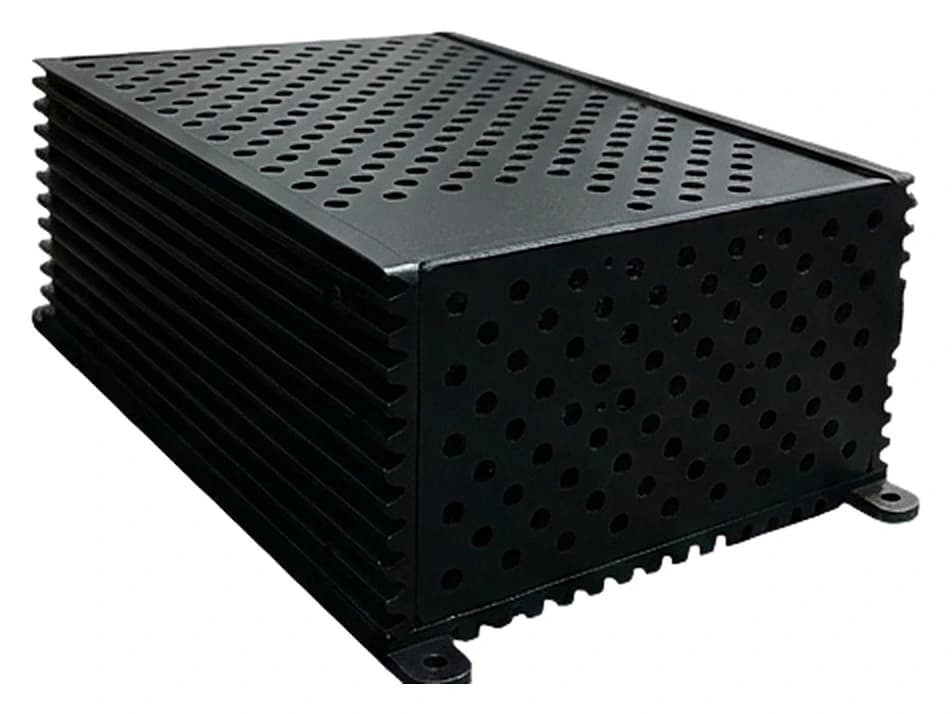
Frequency Converters, Motor Drives & Military UPS Systems
PowerGuard TPS-115 115 VAC / 400 Hz Converter System (400 Hz AC + 28 VDC)
DetailsFull category: military frequency converters and 400 Hz power systems
Engineering Support
Our engineering services can adapt this product to your platform, integrate it or test it against your programme requirements.
Related Guides
FAQ
What is the difference between star and delta connection?+
In star connection, 115 VAC is measured between line and neutral, and a neutral conductor is present; it suits equipment that needs a neutral reference. In delta connection, 115 VAC is measured between two lines. Output power factor is at least 0.85 in star and at least 0.80 in delta. The connection type is chosen to match the design of the load.
Is the output frequency adjustable between 60 and 400 Hz?+
Yes. The system provides a variable 115–220 VAC, 60–400 Hz output. The same unit can therefore supply 400 Hz radar and shipboard equipment as well as 60 Hz loads. The 400 Hz output is taken at 115 VAC in either star or delta connection.
How is output quality maintained?+
Output total harmonic distortion is below 5%, frequency modulation is limited to 4 Hz and voltage modulation to 2.5 Vrms. The system reaches steady state within 200 ms. When over- or under-voltage is detected, the output is shut down within 100–170 ms. Phase-sequence, overload, short-circuit and over-temperature protection are also active.
How does remote monitoring work?+
The on-board BIT monitors status continuously; results are shown on the OLED display and read remotely over the RS-422 link. The desktop remote control and monitoring software over Ethernet gathers per-phase current, voltage and frequency values, faults and alerts on one screen. Voltage selection, inverter start, output on/off, fault reset and silent mode can all be commanded from the software.
Can it be used on naval platforms?+
The system is MIL-STD-1399B compliant, and its output voltage and frequency requirements are defined to MIL-STD-1399-300B. Temperature, solar radiation, rain, humidity, salt fog, vibration and shock were tested to MIL-STD-810G CHG-1 and EMI/EMC to MIL-STD-461G at an ISO/IEC 17025 laboratory; both reports concluded that the product passed all tests in scope. It operates from −30 °C to +50 °C and at altitudes up to 3000 m. Platform-specific mounting and interface requirements are assessed at project stage.