What Is a Static Frequency Converter?
A static frequency converter is a power electronics unit that changes the frequency (and usually the voltage) of an AC supply using semiconductor switches. "Static" means no rotating machine: where an older motor-generator set turns a 400 Hz generator from a mains-fed motor, a static converter does the job electronically with a rectifier, a DC link and an inverter. It is also called a solid-state frequency converter.
In defence work the most common task is producing 115 VAC 400 Hz from a 50 Hz grid. Naval platforms, radar and fire-control subsystems and some land vehicle mission electronics need 400 Hz, while sites, camps and test laboratories supply 50 Hz. Why 400 Hz is used at all is covered in our Mobile Military Frequency Converter Guide. This article looks inside the box: how 400 Hz is generated, how output quality is measured and how to choose a unit.
From 50 Hz to 400 Hz in Four Stages
The input is first converted to DC, and the output is rebuilt from that DC at the required frequency, fully decoupling the two. This is known as double conversion.
1. Rectifier
Single- or three-phase AC from the grid is converted to DC. A diode bridge is the simplest option but draws pulsed current and injects harmonics. An active front end (AFE) uses controlled switches on the input too, drawing near-sinusoidal current. The PowerGuard TPS-115, for example, uses an AFE topology, which its datasheet describes as giving "high power factor, low harmonic distortion, minimal impact on the grid".
2. DC link
The rectifier feeds a capacitor bank known as the DC link. It buffers the two stages, so short input dips and phase imbalance are smoothed out rather than passed to the output.
3. Inverter
The inverter is usually an IGBT bridge. Using pulse-width modulation (PWM), the switches operate at a carrier of several kilohertz or more, with pulse widths set so their average follows a reference sine wave. That reference is defined in software, so the same hardware can produce 60 Hz or 400 Hz.
4. Output filter and isolation transformer
An LC filter removes the carrier content from the PWM pulse train and leaves a clean sine wave. Many designs add an output isolation transformer that matches the voltage, galvanically separates load from grid and can provide a neutral. At 400 Hz it is considerably smaller than a 50 Hz transformer of the same rating.
Static vs Rotary Frequency Converters
| Criterion | Rotary (motor-generator) | Static |
|---|---|---|
| Moving parts | Yes (shaft, bearings, brushes/windings) | None |
| Maintenance | Periodic mechanical servicing | Mainly fans, filters and control electronics |
| Weight and volume | High | Generally lower for the same rating |
| Output frequency | Fixed by machine design | Selectable in software |
| Grid disturbances | Buffered by mechanical inertia | Buffered by the DC link and control loop |
| Noise | Noticeable mechanical noise | Lower |
Rotary units remain in older fixed installations; on mobile and new-build platforms, static architecture is the norm.
How Is Output Quality Defined?
"Clean power" is not a specification. Ask for measurable values:
- Total harmonic distortion (THD): deviation of the output from an ideal sine; high THD makes radar and communications power supplies run hotter and noisier.
- Frequency modulation: steady-state swing of the output frequency, important for synchros and resolvers.
- Voltage modulation: periodic swing of the output voltage in steady state.
- Transient response: how quickly the output settles after a step load or at start-up.
- Protective shutdown: how quickly the output is disconnected on over- or under-voltage.
For naval platforms these limits are typically written against the electric power interface section (Section 300) of the MIL-STD-1399 series. As an example, the datasheet of the PowerGuard 115/200 VAC 400 Hz Static Frequency Converter gives THD below 5%, frequency modulation of 4 Hz maximum, voltage modulation of 2.5 Vrms maximum, 200 ms to steady state and an output shutdown time of 100–170 ms on over- or under-voltage, with output requirements defined to MIL-STD-1399-300B.
Frequency Converter, Motor Drive and AC-AC Inverter Are Not the Same
All three may contain a rectifier and an inverter, but their jobs differ:
- Motor drive (VFD): varies frequency to control motor speed; its output is usually unfiltered PWM smoothed by the motor winding, unsuitable for general equipment. See our Military Motor Drive Guide and the Mil-Drive-55.
- AC-AC inverter: its main job is voltage conversion and isolation, for instance 400 VAC to 115 VAC 50 Hz. See our Military AC-AC Inverter Guide and the PowerGuard 400/115 VAC AC-AC Inverter.
- Frequency converter: delivers a filtered sine wave at a defined frequency and voltage; to the load it behaves like a grid.
6 Parameters for Selecting a Static Frequency Converter
- 1.Input: phases, voltage range and frequency, plus generator tolerances if generator-fed.
- 2.Output connection: whether the 400 Hz load expects star (115 VAC line-to-neutral, with neutral) or delta (115 VAC line-to-line). The wrong choice shifts the voltage seen by the equipment by a factor of √3.
- 3.Power: the kVA rating together with output power factor. Rectifier-input electronics and motors keep kVA above kW.
- 4.Load type and overload: motor starting and capacitor charging draw inrush current that short-term overload capability must cover.
- 5.Environment: indoor or outdoor; temperature, altitude, and vibration, shock, humidity and dust requirements under MIL-STD-810. What MIL-STD-810 asks for is explained in our MIL-STD-461 and MIL-STD-810 guide.
- 6.Monitoring and communications: local display, built-in test and the interface to the platform network (RS-422, RS-485, Ethernet).
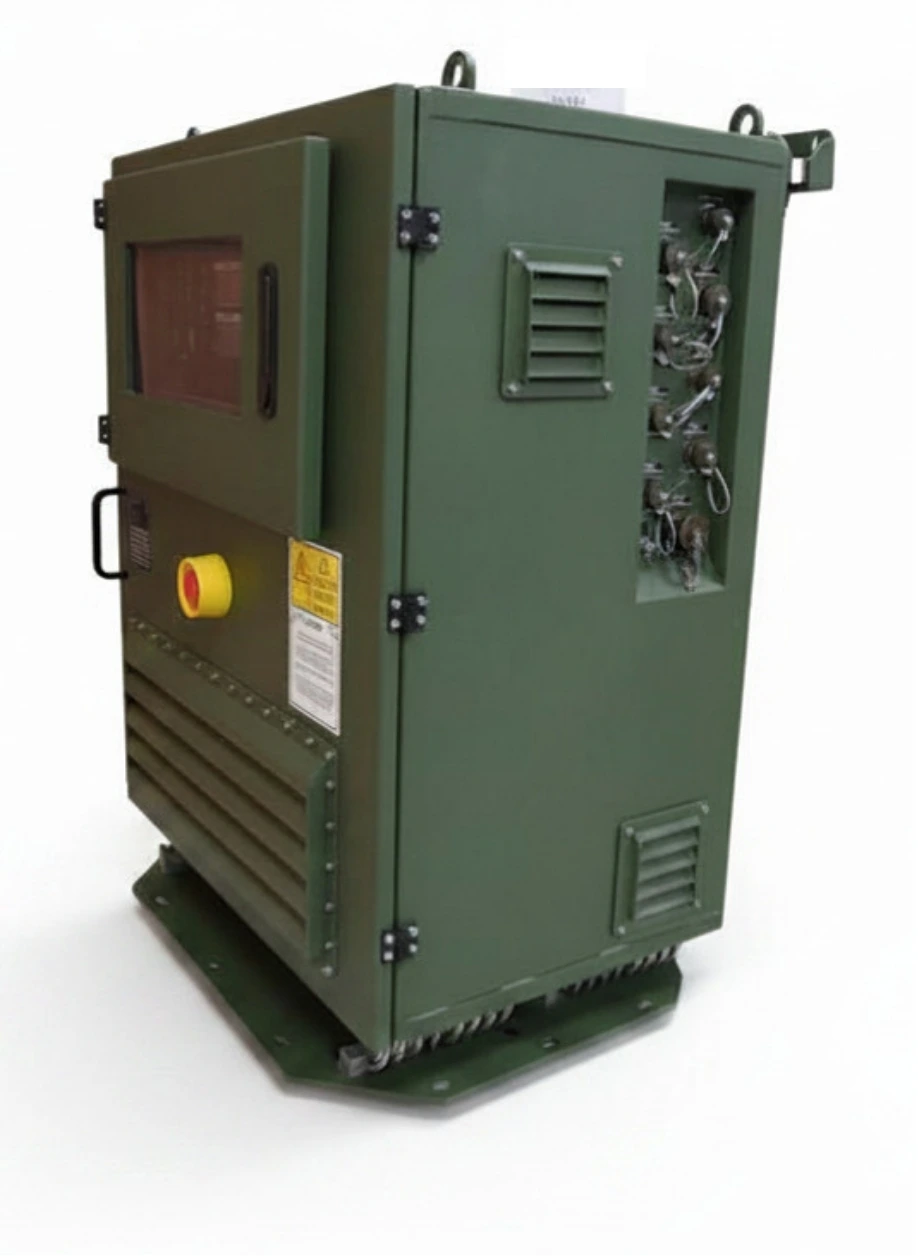
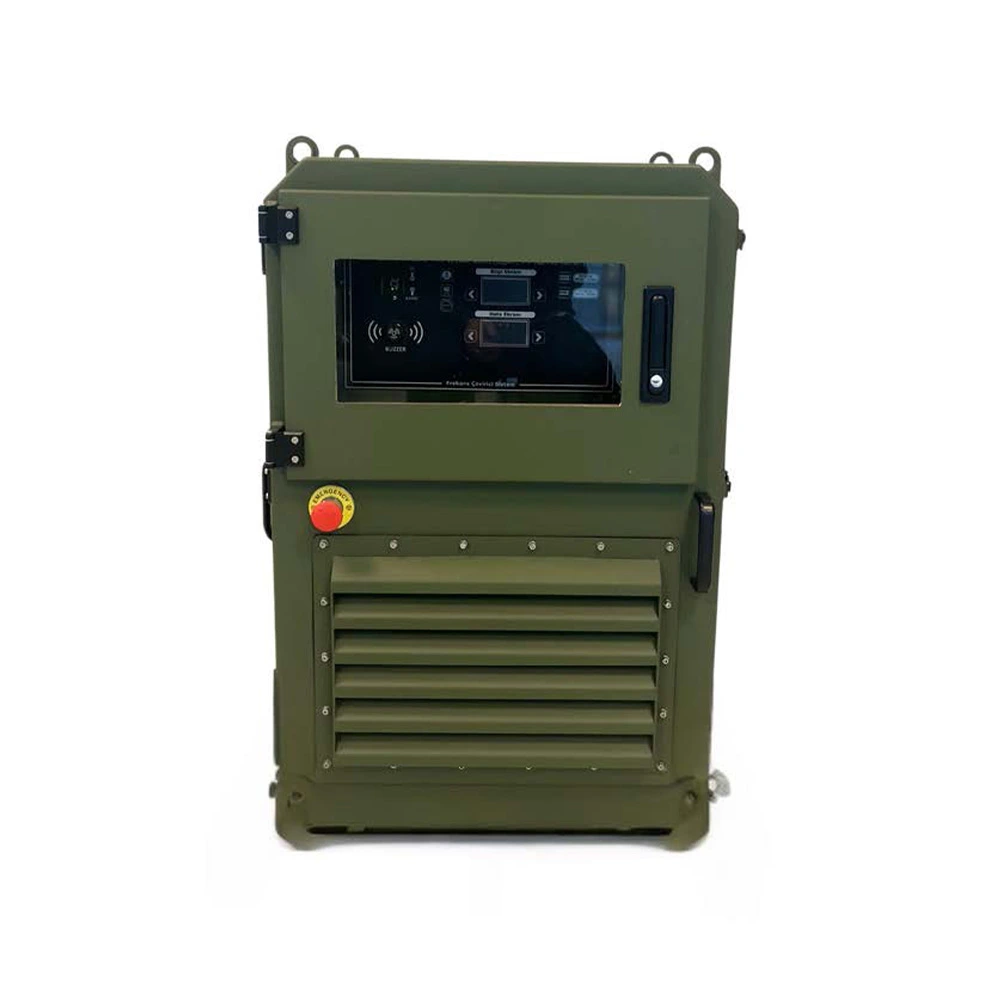
Against these parameters, TEDEG's frequency converter family covers three different needs:
| Product | Input | Output | Highlights |
|---|---|---|---|
| PowerGuard 115/200 VAC 400 Hz Static | 3-phase 360–440 VAC, 50–60 Hz | Variable 115–220 VAC, 60–400 Hz; star or delta 115 VAC 400 Hz | Power factor min. 0.85 star, min. 0.80 delta; RS-422 + Ethernet; MIL-STD-1399B, 810G |
| PowerGuard Outdoor | 3-phase | 12 kVA, 7 isolated outputs (5 × 60 Hz + 2 × 400 Hz) | Static double conversion + IGBT PWM; at 0.8 PF 125% → 5 min, 200% → 5 sec, 250% → 1 sec; −32 to +55 °C |
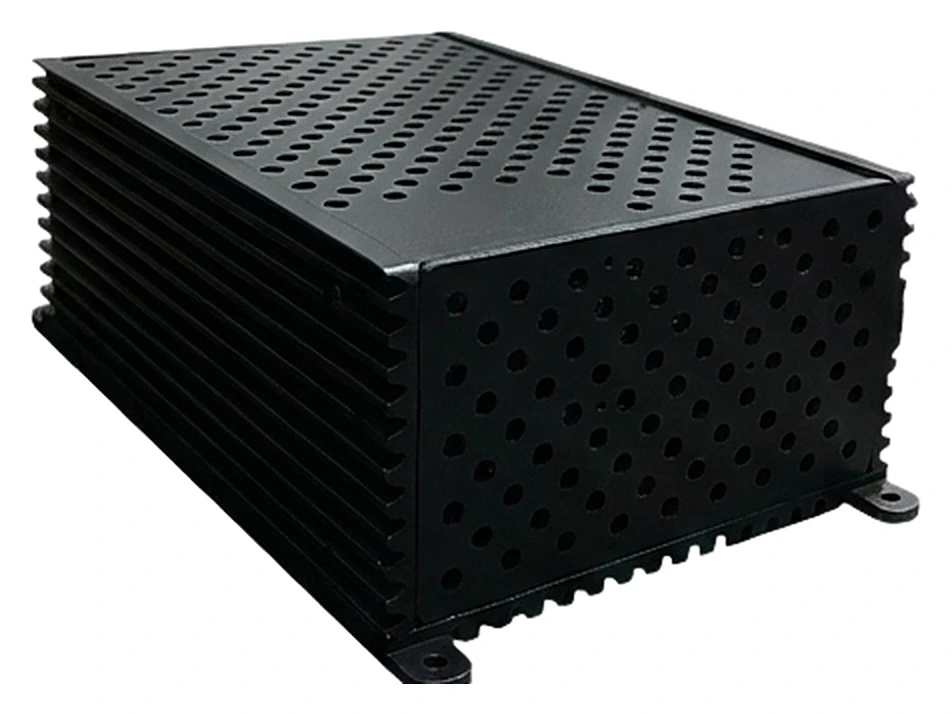
| PowerGuard TPS-115 | 200–240 VAC, 50 Hz | 3-phase 115 VAC 400 Hz, 600 VA + 3 × isolated 28 VDC (600 W total) | AFE, RS-485, passive cooling, −40 to +55 °C |
The decision table in 115 VAC 400 Hz Power Supply Selection shows which one fits land, naval and radar applications.
Frequently Asked Questions
Is a static converter the same as a frequency converter?
Usually, yes: "static converter", "static frequency converter" and "solid-state frequency converter" describe power electronics that convert frequency without a rotating machine. Because "converter" alone also covers DC-DC and AC-DC units, state the output frequency explicitly in the specification.
Does a frequency converter also change the voltage?
Usually, yes: the inverter controls amplitude and the output transformer adapts voltage. The PowerGuard 115/200 VAC static converter produces a variable 115–220 VAC output from a 360–440 VAC input.
Can a 50 Hz grid also supply 60 Hz equipment?
Yes. Output frequency is set in software, so the same architecture can produce 60 Hz. The PowerGuard static converter offers a variable 60–400 Hz output; PowerGuard Outdoor provides 60 Hz and 400 Hz on separate isolated outputs in one chassis.
Why is 400 Hz power generated close to the load?
Cable inductive reactance is proportional to frequency: at 400 Hz it is roughly eight times the 50 Hz value, so voltage drop grows quickly over long runs. The converter is usually placed close to the equipment it supplies.
Conclusion
A static frequency converter uses a rectifier, DC link, PWM inverter and output filter to turn 50 Hz into a clean 400 Hz. For a sound selection, write THD, modulation, transient response, connection type, power factor, overload and environment into the specification as numbers.
If you would like help choosing a converter for your project, fill in the quote form or reach our engineering team through the contact page. The full power range is in the product catalogue.
Field example: for an application in which several power units were consolidated into a single frequency converter, see the Land Rocket Platform case study.