
Why Mobile Power Conversion Matters in Modern Military Operations
Modern military operations rely more and more on rapidly deployed mobile platforms. Field command centres, mobile radars, forward outposts, field hospitals, ships, tactical trucks — every one of these platforms must supply reliable power to military equipment running at different voltage and frequency levels.
Mobile military frequency converters are a critical link in this chain: they convert AC power from a generator or the grid into the stable 115 VAC 60 Hz or 115 VAC 400 Hz formats military equipment requires. The gap between an ordinary industrial converter and a mil-spec conversion system directly affects mission continuity in the field.
Why Is 400 Hz Used?
Grids and generators in Türkiye and Europe are mostly 50 Hz. Even so, many military systems are supplied at 400 Hz. The reason is physics:
- Smaller, lighter transformers: The core cross-section and number of turns a transformer needs to carry a given voltage are inversely proportional to frequency. Moving from 50 Hz to 400 Hz makes transformers and inductors of the same rating markedly smaller and lighter.
- Compact, high-speed motors: Synchronous speed is proportional to frequency (n = 120·f / p). A two-pole motor turns at 3,000 rpm on 50 Hz but 24,000 rpm on 400 Hz. The same power comes from a much smaller motor, and power density rises.
- Smaller filters: The ripple on DC rectified from 400 Hz is at a much higher frequency. Filter capacitors and chokes in the power supplies of radar transmitters and weapon systems become smaller.
- Synchro and resolver reference: The synchros and resolvers that carry angle information in fire-control, weapon turret and navigation systems have traditionally run on a 400 Hz reference.
These advantages come at a price:
- Line losses: Line reactance rises with frequency, so voltage drop grows on long cable runs. 400 Hz power is therefore generated close to the load — in a ship's compartment, inside a vehicle, in a field shelter.
- Core losses: Iron losses increase at higher frequency, so thinner laminations or special core materials are needed.
| Characteristic | 50/60 Hz | 400 Hz |
|---|---|---|
| Transformer and inductor size | Large | Markedly smaller |
| Synchronous speed, two-pole motor | 3,000 / 3,600 rpm | 24,000 rpm |
| Filtering after rectification | Large capacitors and chokes | Smaller filters |
| Voltage drop on long runs | Low | High |
| Typical use | General supply, IT, lighting | Radar, fire control, weapon systems, shipboard combat systems |
Where is it used? Alongside the 60 Hz main network, ships carry separate 400 Hz distribution networks for radar, fire-control and weapon systems. Mobile radar and sensor systems, weapon turrets and stabilisation drives, mission electronics on some military land vehicles, and military equipment test rigs are also typical 400 Hz users.
Why 60 Hz and 400 Hz Together?
Military equipment in the field revolves around two main frequencies:
60 Hz — General-Purpose Military Equipment
- Command centre devices, mission computers, radio systems
- Field hospital medical equipment
- Lighting, heating and air-conditioning systems
- IT infrastructure, servers, network equipment
- Much of the single- and three-phase land equipment of US origin and in common NATO use
Where the 50 Hz grid is standard, 60 Hz equipment also needs frequency conversion.
400 Hz — Specialised Military Systems
- Naval platforms — radar, fire-control and weapon systems
- Mobile radar and sensor systems — compact power supplies
- Weapon turrets and stabilisation drives — high-speed servo motors
- Fire-control and navigation systems — synchro/resolver reference
- Test and calibration laboratories — military equipment verification
A mobile platform needing both frequencies at once is a common scenario. A field command container, for example, may run 60 Hz IT and communications equipment alongside 400 Hz sensor and radar equipment. Getting both frequencies from a single converter is a significant advantage in logistics, weight and mounting space.
Frequency Converter Topologies
The main approaches to frequency conversion are:
1. Rotary Frequency Converter (Motor-Generator)
- Operation: Input motor → mechanical shaft → output generator
- Advantage: Full galvanic isolation, inherent harmonic filtering
- Disadvantage: Moving parts, noise, periodic maintenance, very high weight
- Use: Fixed installations and older shipboard power systems — heavy and maintenance-intensive for mobile platforms
2. Static Double Conversion (Modern Mil-Spec)
- Operation: AC ⇒ DC (rectifier) ⇒ DC link ⇒ AC (IGBT PWM inverter)
- Advantage: High efficiency, low harmonic distortion, no moving parts, lighter, wide input range; grid disturbances do not reach the load
- Disadvantage: Complex electronics, high development cost
- Use: The standard choice for modern mil-spec mobile platforms
3. Integrated Cabinet Systems
- Operation: Power transformer, frequency converter and power distribution unit in one cabinet
- Advantage: Reduces the need for a separate transformer, converter and distribution box; feeds many subsystems from a single point
- Use: Naval and land platforms where 400 Hz and 60 Hz equipment run together
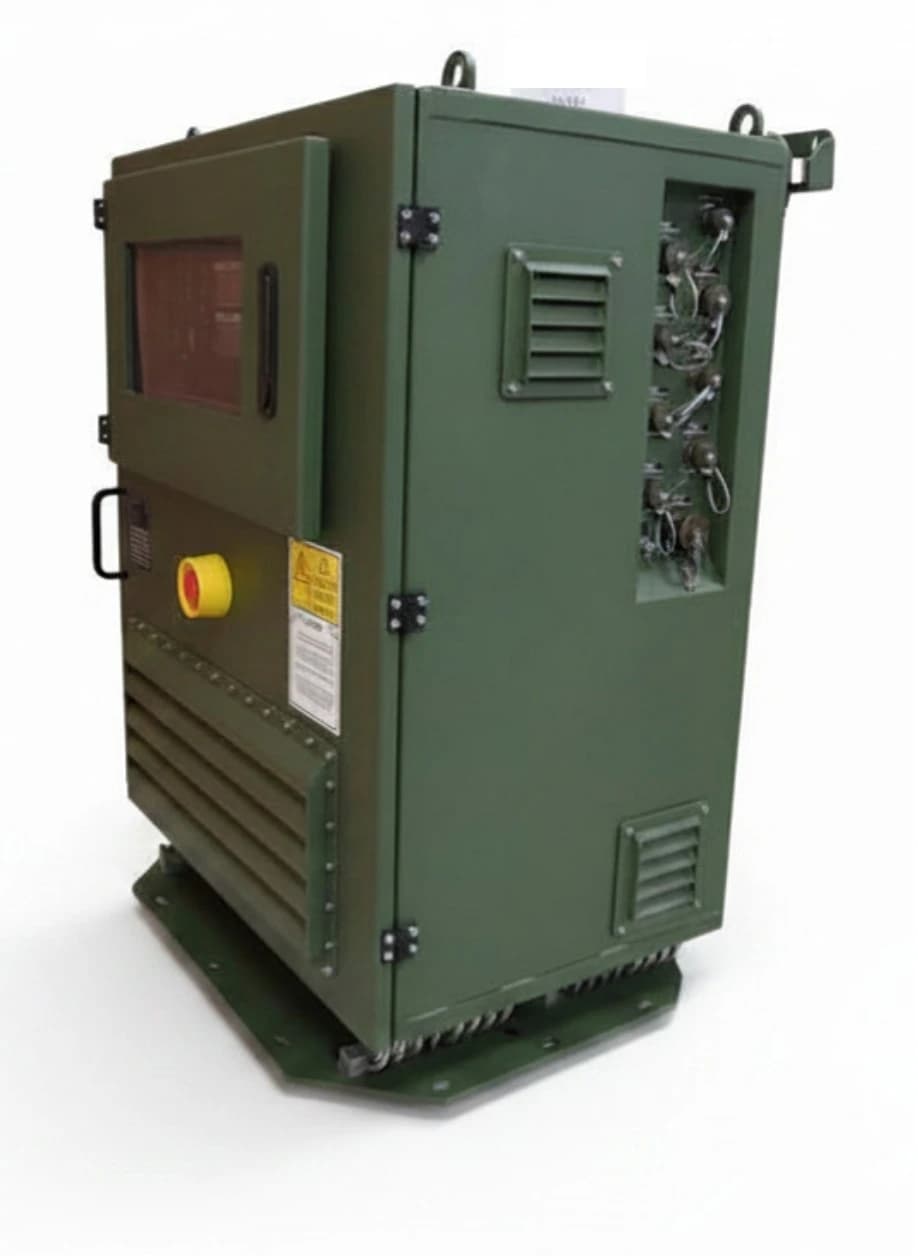
The TEDEG PowerGuard Outdoor uses a static double-conversion + IGBT PWM architecture. The AC-AC Frequency Converter Transformer System is an example of the integrated approach, combining transformer, frequency converter and distribution in one cabinet. The rectifier, DC link, inverter and output filter stages of a static converter are explained step by step in What Is a Static Frequency Converter?
Smart PDU Integration — Multiple Capabilities in One Unit
Older mobile systems used a separate frequency converter + separate PDU. The field drawbacks of this approach are:
- Two separate units = two separate maintenance items
- Cabling complexity and difficult installation
- Greater total weight and volume
- A heavier logistics burden
A smart-PDU-integrated frequency converter offers the following in one chassis:
- Multiple isolated outputs — load groups separated from each other
- Load management — outputs switched according to load conditions
- Independent on/off per output — from the operator panel or remotely
- Per-output monitoring — real-time voltage/current and alarms
- Fault isolation — a fault on one output does not affect the others
The TEDEG PowerGuard Outdoor distributes 12 kVA of total capacity across 7 isolated outputs: 5 × 115 VAC 60 Hz + 2 × 115 VAC 400 Hz. Its built-in smart PDU switches the outputs according to load.
Outdoor Durability — MIL-STD-810F
A civilian-grade converter runs reliably in a controlled office or laboratory. A military system in the field faces very different conditions:
- Wide temperature range — from winter conditions to desert heat
- High humidity — prolonged exposure in coastal and tropical regions
- Dust and sand — fine sand entering the cabinet and connectors
- Vibration — continuous vibration while the vehicle is moving
- Shock — impacts off-road and during loading and unloading
- Rain — direct exposure to precipitation outdoors
MIL-STD-810 verifies these conditions through defined test methods. A converter being MIL-STD-810 compliant shows that it has been tested to these methods. Because the standard exists in several revisions (810F, 810G, 810H), the revision required by the specification should be checked against the product documentation.
The TEDEG PowerGuard Outdoor is designed for outdoor use, with a −32 °C to +55 °C operating temperature, 3000 m altitude capability, and resistance to rain, dust, humidity and vibration. Its compliance standards are MIL-STD-810F, MIL-STD-461E and MIL-STD-1399B.
Ethernet and Web Interface — Remote Monitoring
Older converters were controlled only from front-panel buttons. Modern mil-spec systems have a digital control layer:
- Embedded web server — access from a browser via the IP address, no extra software needed
- SCADA/EMS/NMS integration — connection to central monitoring systems
- Real-time monitoring — voltage, current and frequency for all inputs and outputs
- Alarm history — a record of past faults and warnings
- Remote on/off — an independent command for each output
- Data logging — storage of consumption and performance data
This capability matters particularly for dispersed field units: a technician at the command centre can monitor a remote platform's power status in real time and assess alarms without travelling to site.
On the PowerGuard Outdoor, the built-in web server shows the voltage, current and frequency of all inputs and the 7 outputs, switches each output independently and displays the alarm history. Optional desktop software adds advanced control and data logging. Other members of the family use different interfaces: RS-422 and Ethernet-based desktop software on the static 400 Hz converter, CAN-Bus on the AC-AC Frequency Converter Transformer System, and RS-485 on the TPS-115.
Operator Interface — Designed for the Field
In mil-spec equipment it is not only the technical data but also the operator interface that must be designed for field use. An operator who has to make quick decisions in difficult conditions cannot afford to get lost in complex menus.
A field-ready frequency converter interface should offer:
- Separate info and fault screens — so status and faults are never confused
- Physical buttons per output — one-touch control of each output
- All-on/all-off and reset — fast recovery after an alarm
- Silent mode and blackout mode — for missions requiring light and noise discipline
- Clear alarm indication — audible and visual warnings
The PowerGuard Outdoor has a dual OLED display (Info + Fault) and colour-coded physical buttons. The panel of the AC-AC Frequency Converter Transformer System provides an OLED display, an audible alarm, a separate on/off button for each output, all-on/all-off and reset buttons, and blackout and silent modes.
Overload Performance — Stability Under Field Loads
The loads a frequency converter meets in the field are not always at nominal value:
- Motor starting currents — typically several times nominal current
- Capacitive loads — peak current at switch-on
- Loads switched on together — several devices powered up at the same moment
If a converter trips in these situations, every connected load loses power. A mil-spec converter should therefore offer overload capability for defined periods.
TEDEG PowerGuard Outdoor (at 0.8 power factor):
- 125% load → 5 minutes
- 200% load → 5 seconds
- 250% load → 1 second
This capability keeps the system from tripping during motor starts, capacitive load connection and transient peak loads.
Typical Platform Applications
PowerGuard Outdoor class mobile military frequency converters serve the following platforms:
- Mobile command-and-control vehicles — field C2 containers, mobile operations centres
- Field communications vehicles — tactical truck power distribution
- Naval platforms — ship auxiliary power systems
- Forward outposts and mobile military camps — continuous 60 Hz supply
- Field hospitals and surgical containers — critical medical equipment
- Temporary military base infrastructure — uninterrupted mobile power
- Test and calibration laboratories — combined 60 Hz and 400 Hz requirements
- Special military motor and servo drives — land and naval equipment requiring 400 Hz
The TEDEG Frequency Converter Family — Which One When?
| Product | Input | Output | Power | Highlights |
|---|---|---|---|---|
| PowerGuard Outdoor | 3-phase, 50/60 Hz | 5 × 115 VAC 60 Hz + 2 × 115 VAC 400 Hz, isolated | 12 kVA | Outdoor, smart PDU, web interface, −32 to +55 °C |
| 115/200 VAC 400 Hz Static Converter | 3-phase 360–440 VAC, 50–60 Hz | Variable 115–220 VAC, 60–400 Hz | — | Star/delta 400 Hz connection, RS-422, MIL-STD-1399B |
| AC-AC Frequency Converter Transformer System | Various input options | 2 × 400 Hz + 5 × 60 Hz, 115 VAC | 12 kVA | > 90% efficiency, CAN-Bus, blackout and silent modes |
| PowerGuard TPS-115 | 200–240 VAC, 50 Hz | 3-phase 115 VAC 400 Hz + 3 × 28 VDC | 600 VA + 600 W | Compact, passive cooling, RS-485, −40 to +55 °C |
If you only need voltage conversion and an isolated 115 VAC 50 Hz output, see our Military AC-AC Inverter Guide and the PowerGuard 400/115 VAC AC-AC Inverter. All products are listed in the Frequency Converters, Motor Drives & Military UPS Systems category.
The TEDEG PowerGuard Outdoor Advantage
The TEDEG PowerGuard Outdoor answers the need for a mobile military frequency converter with the following combination:
- 60 Hz + 400 Hz dual frequency in one chassis
- 12 kVA, 7 isolated outputs (5 × 60 Hz + 2 × 400 Hz), built-in smart PDU
- Static double conversion + IGBT PWM — THD < 5%, efficiency ≥ 85%
- Ethernet web server + optional desktop software; SCADA/EMS/NMS integration
- Dual OLED + colour-coded physical buttons
- Overload capability: 125% (5 min) · 200% (5 s) · 250% (1 s) at 0.8 power factor
- MIL-DTL-38999 military connectors
- MIL-STD-810F · MIL-STD-461E · MIL-STD-1399B compliance standards
- −32 °C to +55 °C operating temperature, 3000 m altitude
- 270 ± 5 kg weight, 687 × 786 × 1016 mm dimensions
Corporate assurance: TEDEG Defence is an approved supplier of ASELSAN, Roketsan and the Turkish Ministry of National Defence (MSB), with NATO supplier registration under NCAGE: TM885.
Conclusion
The mobile military frequency converter is critical power infrastructure for field operations. Thanks to smaller transformers and motors, higher power density and compact power supplies, 400 Hz keeps its place in radar, shipboard combat systems, fire control and weapon systems. 60/400 Hz dual frequency, smart PDU integration, static double conversion, outdoor durability, MIL-STD-1399B naval compatibility and Ethernet remote control are the main features to look for in a serious mobile mil-spec frequency converter.
The TEDEG PowerGuard Outdoor delivers these features in one chassis. For datasheet and technical documentation requests, visit the PowerGuard Outdoor product page; for an engineering conversation with our team, use the contact page.