Lighting Tower vs Searchlight: The Short Answer
The short answer to "lighting tower vs searchlight" lies in the task. A lighting tower illuminates an area from height: a deployment site, a maintenance point, a recovery scene. A searchlight carries a narrow beam to a distant point: search, tracking, target recognition. One is judged by lumens and mast height, the other by candela and range.
This article compares the two by task, metric, power draw, deployment and specification. For searchlight mounting classes, infrared and night-vision compatibility, see our military searchlight guide.
Two Different Tasks: Lighting an Area and Reaching Far
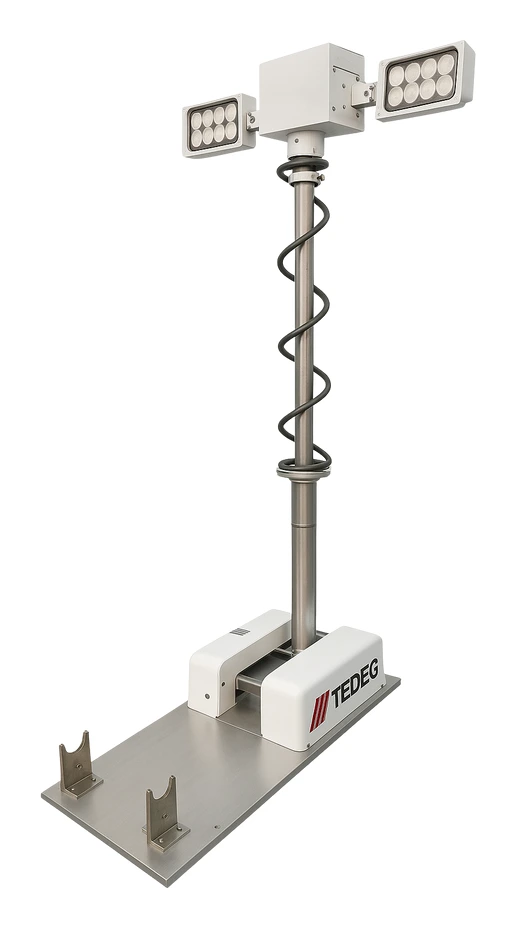
A lighting tower creates a working area without shadows. The higher the source, the wider the lit ground and the shorter the shadows of vehicles and equipment. What matters is total luminous flux (lumens), mast height and how freely the head can be aimed.
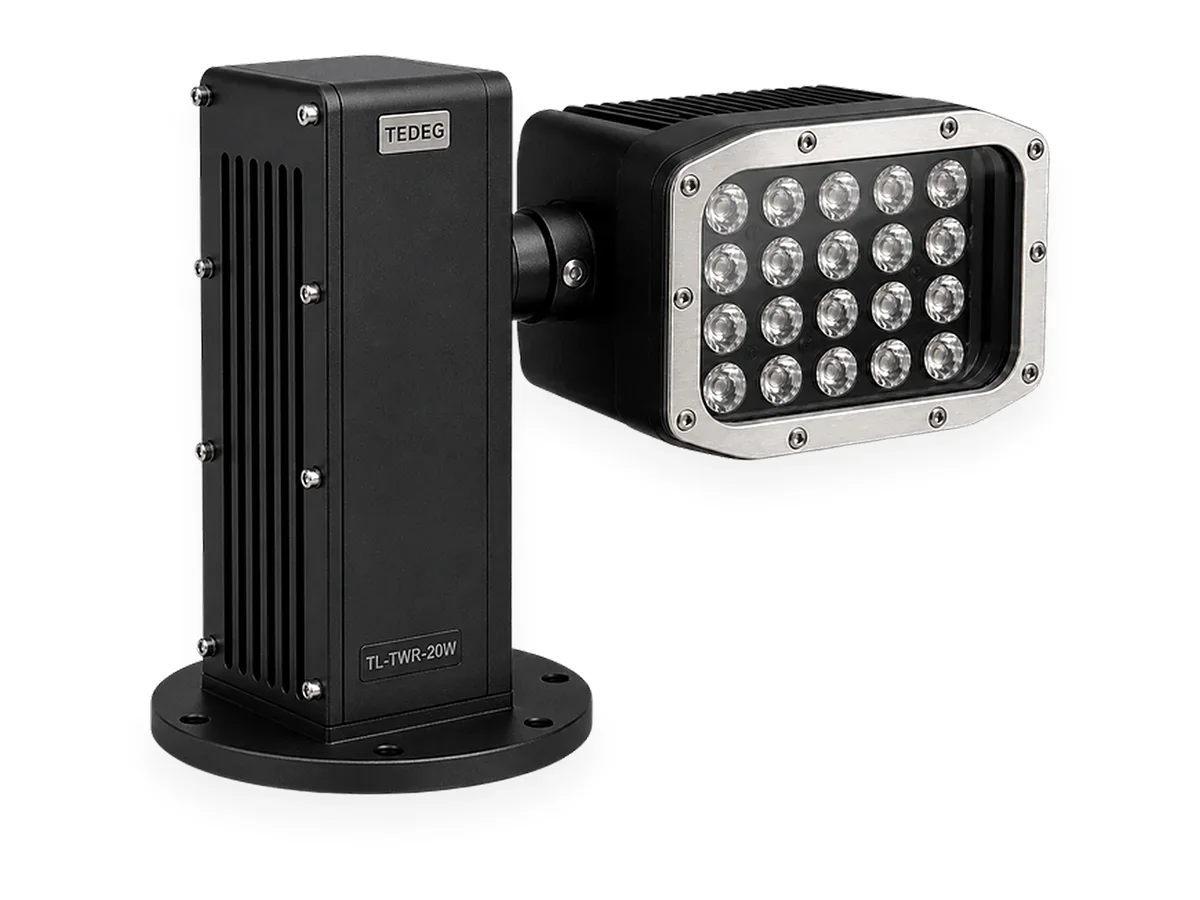
A searchlight does the opposite. A narrow lens squeezes the flux into a small angle, so usable illuminance still reaches a target hundreds of metres away. What matters is peak intensity (candela), beam angle and illuminance (lux) at the target.
Neither replaces the other.
Lumens or Candela? Reading the Right Number
Lumens measure total light output, not where it goes. Candela is intensity in one direction. Lux is illuminance on a surface. Illuminance follows the inverse-square law, E = I / d²: double the distance, a quarter of the light.
This is the quickest check of a searchlight datasheet. The 10° version of the T-Light Turret military searchlight has a peak intensity of 191,900 cd; 191,900 / 440² ≈ 1 lux, which matches the datasheet's effective search range of ~440 m (1 lux). The datasheet uses a 5 lux reference for recognition: ~195 m with the 10° lens and ~130 m with the 15° lens.
For a lighting tower, "range" is the wrong question. What matters is the illuminance over a given ground area from a given height, which depends on the head's beam distribution and mast height, not on lumens alone. Ask the supplier for illuminance distribution (isolux) data when quoting.
Side by Side: T-Light Tower and T-Light Turret
The values below are taken from the two products' datasheets.
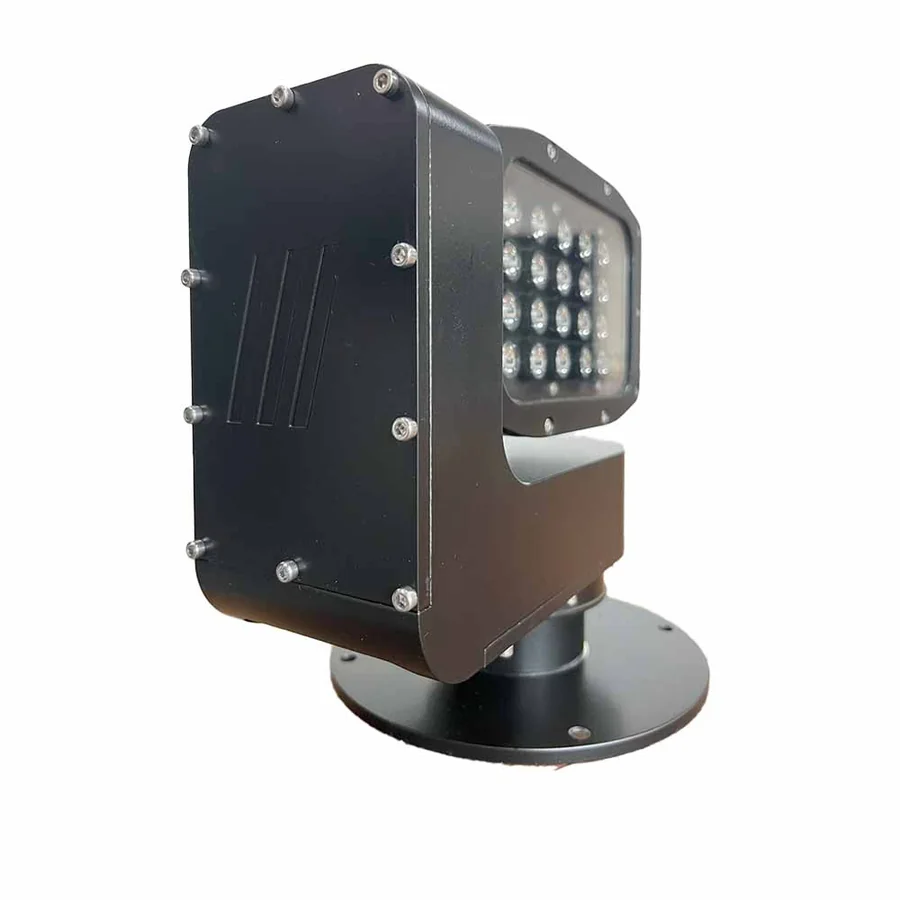
| Feature | T-Light Mobile Lighting Tower (TDK-LT2000-2LED) | T-Light Turret (TL-TWR-20W) |
|---|---|---|
| Task | Area lighting | Search, tracking, target recognition |
| Light source | 2 × 600 W LED (1200 W total) | 20 × 3 W white LEDs |
| Luminous flux | 112,000 lm | 4,590 lm (±10%) |
| Intensity / range | Not stated in the datasheet | 191,900 cd · ~440 m (10°, 1 lux) |
| Height / mounting | Vehicle roof, telescopic mast, 2 m max. (1.0–3.5 m options) | Integrated into a weapon turret, Ø 156.8 mm flange |
| Movement | Pan 360° / tilt 330°, 4 rpm | Unlimited 360° horizontal with the turret, 135° vertical |
| Supply | DC 12 V / DC 24 V or AC 220 V | 16–33 VDC |
| Consumption | 2 × 600 W LED | 50 W typical / 60 W max. |
| Control | RS-485, Pelco-D/P, wired and wireless | TDG-LX-10001 control unit, BIT and fault LED |
| Protection class | IP67 | IP69K projector / IP65 controller |
| Weight | 60 kg (tower) | ~3.7 kg (system) |
The difference is one of scale: the tower produces about twenty-four times more flux; the searchlight carries a fraction of it far in a narrow beam.
Power Draw and the Vehicle Electrical System
The power budget is often the first filter. The T-Light mobile lighting tower carries two 600 W LED modules. As a general calculation, a 1200 W load on 24 VDC draws in the order of 50 A before conversion losses (I = P / V). The tower runs directly from the vehicle battery on DC 12 V / 24 V, or from AC 220 V; the lamp voltage is AC 220 V. For extended use, battery capacity, charging and cable cross-section must be assessed together; see military vehicle electrical architecture.
The T-Light Turret draws 50 W typical and 60 W maximum, and its 16–33 VDC input covers 24/28 VDC vehicle networks: a small item on the budget, whereas the tower is a load to plan for.
Deployment, Control and Light Discipline
Set-up time: a tower has to be raised first. The T-Light tower combines a pneumatic telescopic mast with a worm-and-gear drive; a built-in air compressor removes the need for external air, extension and retraction are one-touch, and the head returns home automatically. A turret-integrated searchlight has no mast to raise.
Environment: an extended mast is exposed to wind; the T-Light tower is rated for wind up to 66 km/h. The T-Light Turret housing is IP69K, operating at −32 °C to +60 °C. For what the ratings mean, see IP ratings.
Control: the tower uses RS-485 with the Pelco-D/P protocol and wired or wireless remote control; the datasheet describes this as well suited to mobile video surveillance. The searchlight uses its control unit's vertical movement and on/off buttons; BIT reports faults through the fault LED.
Light discipline: a powerful light on a raised mast gives a position away. Define when each light may be used together with the vehicle's blackout behaviour; see what is blackout mode.
Which Task, Which Solution?
- Deployment and maintenance areas, night repairs, recovery scenes: a lighting tower.
- Search and target recognition wherever the weapon turret points: a turret-integrated searchlight.
- Search and infrared illumination independent of the turret: the T-Light Searchlight, with its own pan-tilt base and white + 940 nm IR dual mode.
- Static and mobile mission phases: both; the tower for the area, the searchlight for range.
6 Questions for the Specification
- 1.Is the task area lighting or a distant target? What is the target distance and the required lux level?
- 2.For a searchlight, are peak intensity (cd), beam angle and the lux reference behind the stated range written down?
- 3.For a tower, can the supplier provide mast height and illuminance distribution data?
- 4.What are the supply range and typical/maximum consumption, and can the battery and charging system carry it?
- 5.Which control protocol is used, and how does it connect to the vehicle network or cameras?
- 6.Do the IP rating, temperature range and wind rating match the mission environment?
Military Lighting Manufacturer in Turkey: TEDEG Defence
| Company | Details |
|---|---|
| Registered name | TEDEG Savunma Sanayi A.Ş. (TEDEG Defence) |
| Headquarters | Ankara |
| Founded | 2023 |
| Registrations and certificates | ISO 9001, EYDEP |
| Cluster membership | SAHA Istanbul |
- T-Light Mobile Lighting Tower: 2 × 600 W LED, 112,000 lm, roof-mounted pneumatic telescopic mast, IP67.
- T-Light Turret: 20 LEDs, 4,590 lm, 191,900 cd and ~440 m search range with the 10° lens, IP69K.
All of these solutions are listed in the Tactical Systems category. Field example: how the T-Light searchlight replaced a unit that kept failing in service.
Frequently Asked Questions
Can a lighting tower replace a searchlight?
No. A tower lights a wide area; it lacks the narrow beam and high candela needed to reach a distant point.
How is searchlight range calculated?
Divide peak intensity (cd) by the distance squared to get lux at that distance. Range is quoted against a lux threshold, which the datasheet should state.
Can a lighting tower run from the vehicle battery?
The T-Light tower runs from the vehicle battery on DC 12 V / 24 V, or from AC 220 V. With a 1200 W LED load, battery and charging capacity need their own calculation.
Can both systems be used on the same vehicle?
Yes. Their tasks differ, so they complement each other: the tower on the roof, the searchlight on the turret, each with its own control.
Conclusion
The choice starts with where the light must go: across an area or to a distant point. Then come the right metric, power budget, set-up time and light discipline. To discuss a lighting configuration for your platform, request a quote or reach our team through the contact page.