What Does a Military Warning Unit Do?
A military vehicle warning unit tells the crew and the people around a vehicle or fixed installation that something needs attention: a ramp that is not closed, an unfastened seat belt, high temperature, low battery voltage or an alarm raised by the mission computer. A military audible visual alarm combines both channels in one housing. Selection is often reduced to "how many dB?", yet on a military vehicle the protocol, blackout behaviour, environmental ratings and diagnostics matter just as much as sound level.
Below are eight criteria for writing a specification or comparing quotes. For the warning unit's place in vehicle electronics, see what is vetronics.
8 Selection Criteria
1. Sound level and measuring distance
A dB figure means little without the distance at which it was measured. In a free field, sound pressure level falls by roughly 6 dB each time distance doubles: about 6 dB lower at 2 m than at 1 m, about 12 dB lower at 4 m. Danger-signal standards such as ISO 7731 require the signal to exceed ambient noise at the listener by a clear margin (typically more than 15 dB A-weighted). A running armoured vehicle cabin is loud, so verify at the mounting point under real noise.
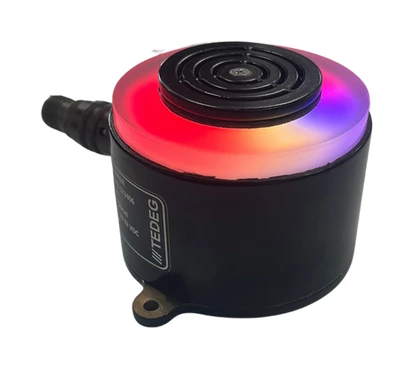
The audible alert of the T-Light programmable warning unit reaches a maximum of 110 dB in three levels (low, medium, high); its datasheet gives no measuring distance, so ask for one when quoting.
2. Colour code and visibility
Indicator standards such as IEC 60073 use red for emergency, yellow for abnormal, green for normal and blue for a mandatory action. On T-Light, green means normal operation, yellow a condition needing attention and red a critical alarm; blue and purple (optional) are extra colours, each steady or flashing. A per-alarm table of colour and flash behaviour in the specification stops subsystem warnings being confused.
3. Control path: hard-wired, RS-485 or CAN-Bus
A simple device switches from one hard-wired input; choosing colour, level and scenario needs a data bus. RS-485 is typically a multi-drop line polled by one master; CAN-Bus is multi-master with priority arbitration and error checking, and common on vehicle networks (see CAN bus and SAE J1939 in military vehicles).
T-Light comes as two models, RS-485 or CAN-Bus, specified at order and not changeable in the field, so settle the vehicle's interface control document (ICD) first.
4. Blackout and silent mode
At night the unit must not give the vehicle away. In silent mode only sound is off; in blackout both light and sound are off. T-Light can run on visual warnings only, and its blackout mode switches off LEDs and audible alerts completely. System-level design is in what is blackout mode.
5. Sealing and temperature
An external unit sees rain, wash-down, dust and short immersion. IP68 is defined per product by the manufacturer; for T-Light it is 60 minutes at 1 m (IP ratings compares the classes). Check temperature against the platform too: −32 °C … +55 °C operating, −40 °C … +70 °C storage.
6. Vibration, shock and impact
"MIL-STD-810H" alone is not a specification; state method, category and level, since the category within 514.8 defines the test profile. The T-Light datasheet gives 5–2000 Hz, 7.7 grms, MIL-STD-810H 514.8 Cat. 24 vibration; MIL-STD-810H 516.8, Method I, 40 g / 11 ms shock; and ≥ 20 J impact (IEC 60068-2-75). Compare these with the platform's vibration profile.
7. Supply, current and connector
T-Light runs from 16–32 VDC, drawing a nominal 50 mA at 24 VDC and 400 mA in the warning state; budget the warning current times the number of units. Also state whether spike and surge protection on the 28 VDC supply sits in the unit or in the feeding distribution (see what is MIL-STD-1275).
T-Light uses an O-ring sealed PT02E-10-6P military connector with one pinout for both models (pin F is scenario input/output), M4-bolted surface or flange mounting with an optional clamp adapter, and a Ø110 × 65 mm, 480 g ± 50 g housing.
8. Test and diagnostics
A faulty unit is often found only when the alarm is needed, so remote test and status reporting matter. On T-Light, bus test commands verify audible and visual functions, and connection status and the last received command can be queried.
Comparison Table: What to Put in the Specification
| Criterion | Question to ask | T-Light datasheet value |
|---|---|---|
| Sound | How many dB, at what distance, how many levels? | Max. 110 dB, 3 levels (ask for distance) |
| Colour | Which colours, steady or flashing? | Red, yellow, green, blue, purple (opt.); steady or flashing |
| Protocol | Hard-wired, RS-485 or CAN-Bus? | RS-485 or CAN-Bus, chosen at order |
| Blackout | Silent mode and full blackout? | Sound off + blackout mode |
| Sealing | IP rating and its definition? | IP68, 60 min at 1 m |
| Temperature | Operating and storage range? | −32 … +55 °C / −40 … +70 °C |
| Vibration / shock | Method, category, level? | 810H 514.8 Cat. 24 · 516.8 Method I |
| Supply | Input range, warning current? | 16–32 VDC, 400 mA @ 24 VDC |
| Diagnostics | Remote test and status query? | Test commands, connection status, last command |
Integration Example: From Seat-Belt Alert to Cabin Warning
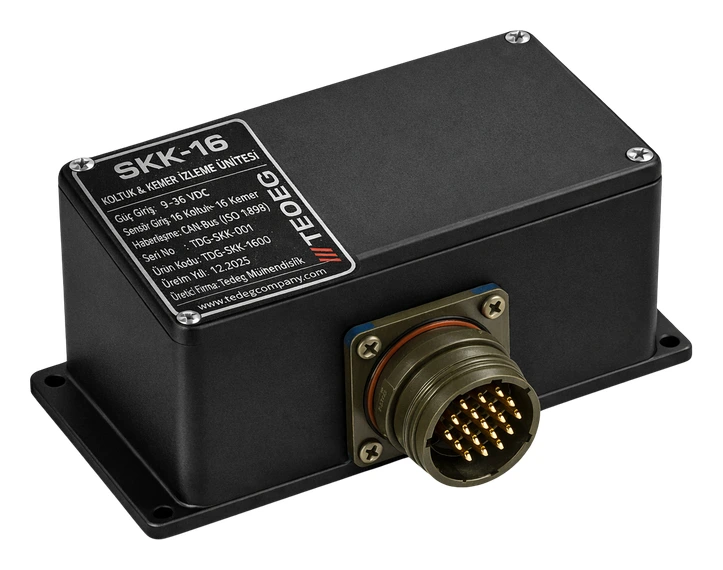
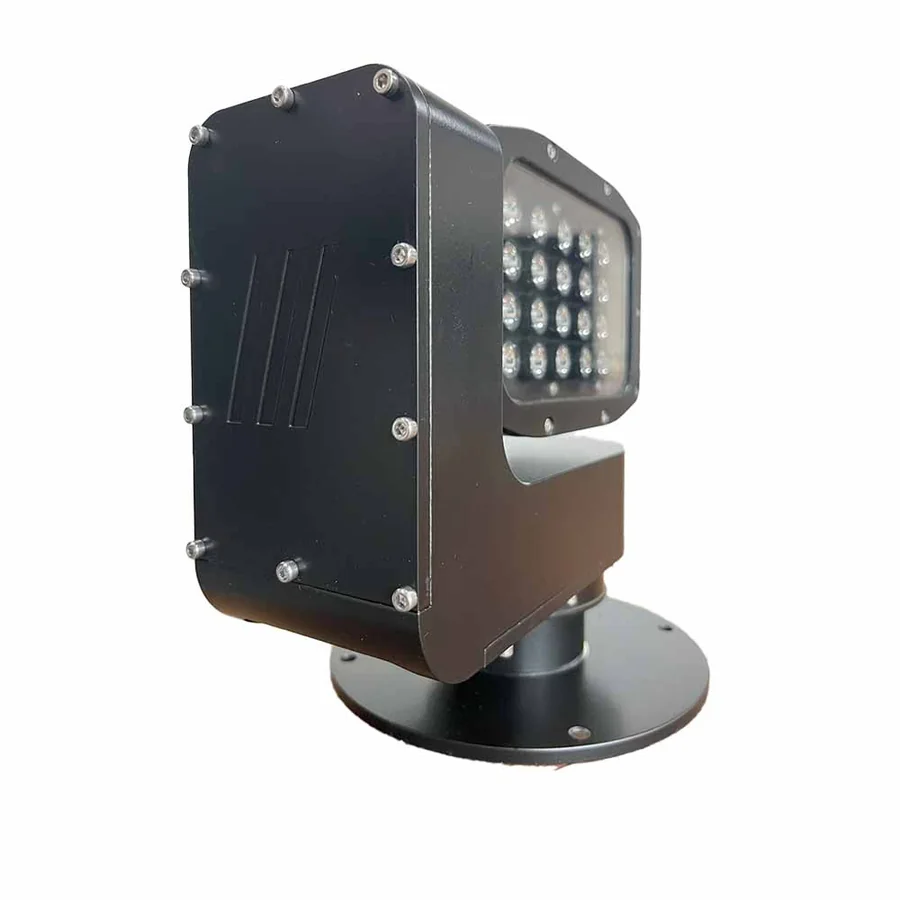
Say the vehicle is about to move with one belt unfastened. The SENTRA-16 seat and seat-belt monitoring system reads 16 seats and 16 belts over 32 channels and sends the data over CAN-Bus (ISO 11898, 500 kbps) to the mission computer, and can also pass it to safety and warning systems. The computer can command flashing yellow with a low tone; under blackout the external warning stays off and the alert goes to the cabin display (see seat and seat-belt monitoring in military vehicles). For night surveillance on the same vehicle, the vehicle-mounted military searchlight switches between white light and 940 nm infrared.
Military Warning Unit Manufacturer in Turkey: TEDEG Defence
The T-Light programmable warning unit is part of the tactical systems product family of Ankara-based TEDEG Defence.
| Company profile | Details |
|---|---|
| Company | TEDEG Savunma Sanayi A.Ş. (TEDEG Defence) |
| Location | Ankara, Turkey |
| Founded | 2023 |
| Registrations and certificates | ISO 9001, EYDEP |
| Cluster membership | SAHA Istanbul |
- Sound and light: max. 110 dB in 3 levels; red, yellow, green, blue and purple (optional) LEDs.
- Communication: RS-485 or CAN-Bus; colour, flashing and sound change on command.
- Environment: IP68, MIL-STD-810H 514.8 vibration and 516.8 shock values, passive cooling with no fan.
Further products are in the Tactical Systems and Vetronics (Vehicle Electronics) categories, and certificates are on the Certifications & Quality page.
Frequently Asked Questions
How far can a 110 dB warning unit be heard?
It depends on measuring distance and ambient noise. The level falls about 6 dB per doubling of distance in a free field and must clearly exceed ambient noise at the listener, so verify by measurement on site.
Should a warning unit use CAN-Bus or RS-485?
It depends on the vehicle's bus and ICD. On a CAN-Bus network the CAN-Bus model avoids an extra gateway; RS-485 is common in fixed, PLC-based installations. T-Light's protocol is fixed at order.
Can the audible alarm be switched off and the unit run on light only?
On T-Light, yes: sound can be switched off so the unit runs on visual warnings only. Blackout mode switches off both the LEDs and the sound.
What IP rating does an externally mounted warning unit need?
Where wash-down, rain and short immersion are expected, IP67 or IP68 is typically specified; the duration and depth behind IP68 should be written in the datasheet.
Conclusion
A warning unit is a system decision, not just a dB figure: measuring distance, colour table, protocol, blackout, environment and diagnostics belong in one specification. To discuss a warning scenario for your platform and the right T-Light configuration, request a quote or reach our team through the contact page.