What Is Seat and Seat-Belt Monitoring in a Military Vehicle?
Military vehicle seat belt monitoring is the electronic function that keeps answering two questions for every crew position: is the seat occupied, and is the belt fastened? Unlike in a passenger car, the driver and commander of an armoured vehicle sit in front of a troop compartment they often cannot see, with many seats in it. The monitoring system gathers the status of those seats on one screen and puts it on the vehicle network as data.
This guide covers sensing, warning logic, network integration and specification questions. It expands the crew safety layer of our what is vetronics guide; the related products are in the military vetronics category.
Why It Is Needed
In armoured and tactical vehicles the seat belt is not only about road accidents. In a rollover, under hard braking, in severe jolts over rough terrain and under blast effects, the seat and the belt work as one protection system: an energy-absorbing seat does its job only if the occupant is strapped into it. Yet belts stay unfastened in the field for many reasons. Body armour and equipment make buckling up awkward, frequent dismounting breaks the habit, and the troop compartment is out of the driver's sight.
How Seat Occupancy and Belt Status Are Sensed
Seat Occupancy Sensing Methods
| Method | Principle | Point to watch |
|---|---|---|
| Pressure switch or membrane pad | A pad in the cushion closes a contact above a set load | A bag or kit left on the seat can read as "occupied" |
| Force-sensing resistor or load cell | Analogue signal that varies with load | Calibration and drift with temperature |
| Capacitive sensing | Measures the effect of the human body on an electric field | Needs tuning for wet fabric, thick clothing and body armour |
Sensor placement differs between folding, suspended and fixed seats, so the sensor is chosen together with the seat manufacturer.
Belt Status Sensing
Belt status is read by a switch inside the buckle: a mechanical microswitch or a contactless Hall-effect or reed sensor that changes state when the tongue latches. Four-point and five-point harnesses are common on military seats; which buckle is monitored, usually the central one, is settled as part of the seat design.
Signal Architecture: Chassis-Referenced or Two-Wire
In a chassis-referenced architecture a single wire runs from each sensor to the unit and the return path is the vehicle chassis. The harness is lighter, but chassis noise can couple into the measurement, so the input needs filtering and signal conditioning. A two-wire architecture needs more conductors and is less sensitive to noise. Either way, vibration causes contact bounce, so a change of state is accepted only after a filter and a time threshold. Resistors are typically added to the switch so that an open circuit and a short circuit can be told apart from the "fastened" and "unfastened" states.
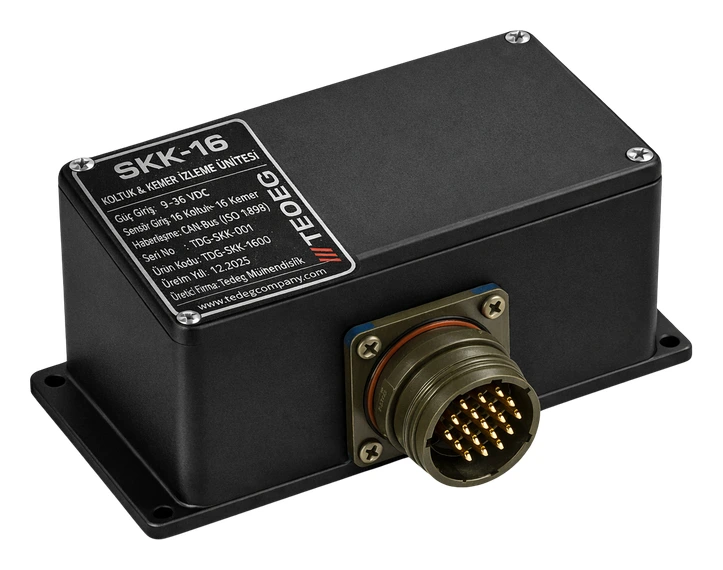
One example is the military seat and belt monitoring system SENTRA-16. According to its datasheet it is designed for a chassis-referenced sensor architecture; it reads 32 channels (16 seats + 16 belts) continuously and at the same time, and passes the analogue signals through RC filtering, op-amp buffering and a multiplexer structure before converting them into digital data.
Warning Logic: What the Driver and Commander See
Two pieces of information per seat give four states:
| Seat | Belt | Meaning | Typical behaviour |
|---|---|---|---|
| Empty | Unfastened | Empty seat | No warning |
| Occupied | Fastened | Normal state | Confirmation shown |
| Occupied | Unfastened | Unrestrained occupant | Visual warning; audible warning if the vehicle is moving |
| Empty | Fastened | Belt buckled behind the occupant, or a faulty sensor | Check warning |
The fourth row is often overlooked: a system that monitors only the buckle sees an occupant who has buckled the belt behind their back as "restrained".
Four decisions shape the logic: a speed condition (display only while stationary, warning when moving, with speed taken from the vehicle data bus); escalation from a visual to an audible warning; who sees what (a summary for the driver, a seat map for the commander); and blackout, where the warning stays on the screen and the blackout command must also reach the warning unit.
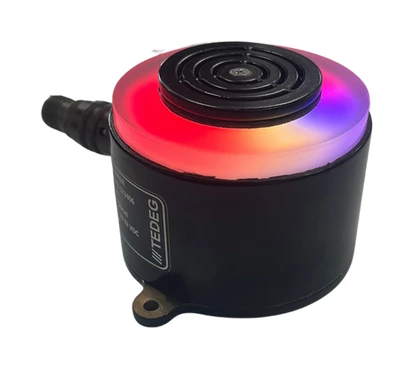
According to the datasheet of the T-Light programmable warning unit, colour, flashing and audible behaviour change with commands from the control system; the audible alert is a maximum of 110 dB in three levels, blackout mode switches off the LEDs and the audible alert completely, and communication is RS-485 or CAN-Bus, specified at order. In a typical architecture the monitoring unit reports status, while the mission computer or vehicle control software decides which warning is raised.
Integration into the Vehicle Network
Data. SENTRA-16 sends seat and belt status to the vehicle mission computer over CAN-Bus (ISO 11898, 500 kbps); according to the datasheet the same data can also be passed to safety and warning systems. The higher-layer protocol, message identifiers, transmission period and bit layout are fixed in the interface control document (ICD) before ordering.
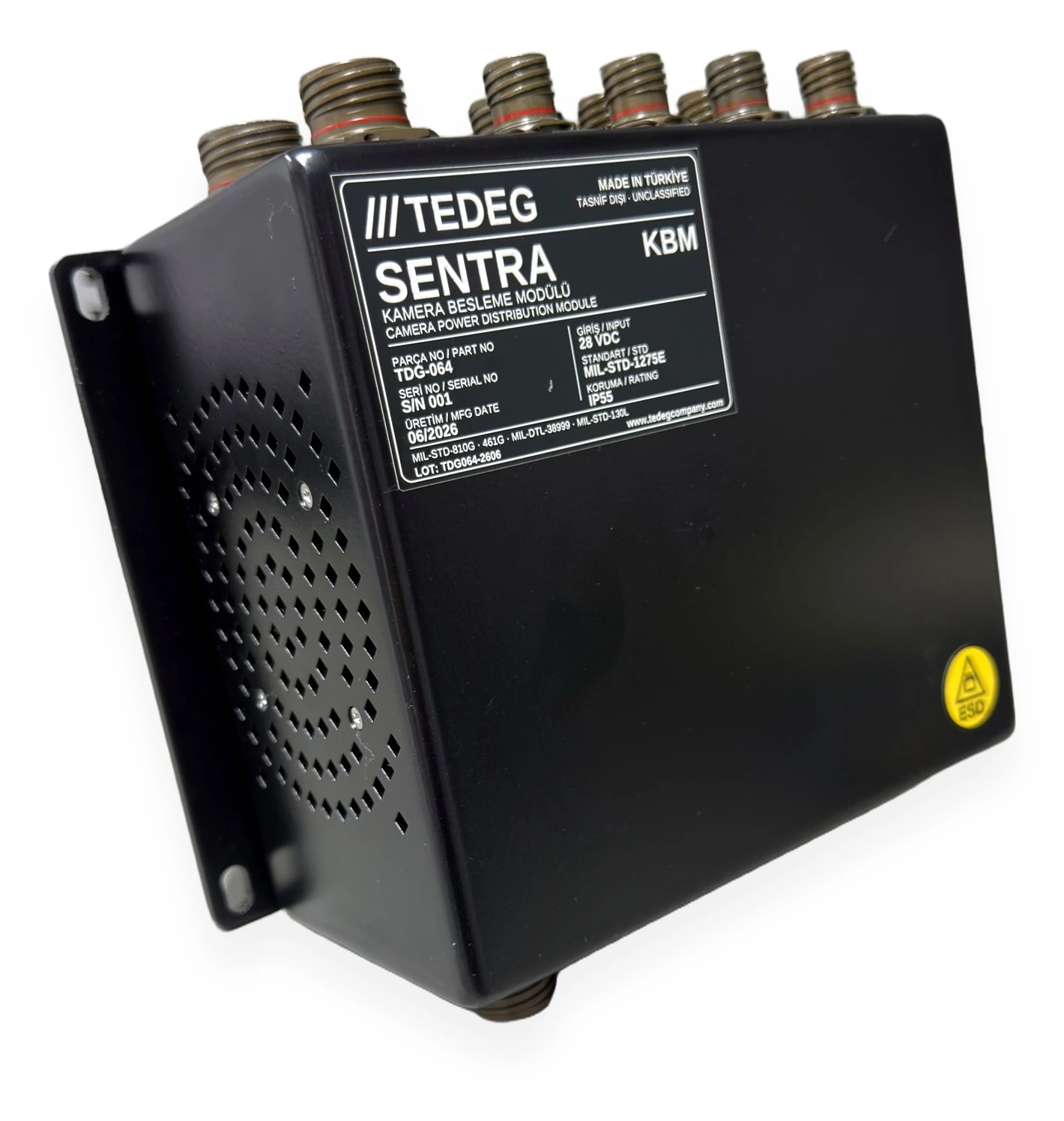
Power. The unit runs from 18–32 VDC (24 VDC nominal) and draws less than 15 W. The transients of a 28 VDC vehicle supply are defined by MIL-STD-1275; because they can go beyond the supply range of most electronic units, low-power units are typically fed from a protected distribution output. For example, the SENTRA KBM camera power distribution module provides a separate, isolated 24 VDC ±0.2 V seat module output from a MIL-STD-1275E compliant 28 VDC input. See the military vehicle electrical architecture guide for the distribution layers.
Harness and environment. SENTRA-16 uses a MIL-DTL-38999 connector and bolts to the chassis on its flanged base; its datasheet gives an IP65 enclosure and −32 °C … +55 °C operation. What IP65 covers is explained in our IP ratings guide.
Questions to Put in the Specification
| Topic | Question |
|---|---|
| Signal architecture | Chassis-referenced or two-wire? Is open-circuit and short-circuit diagnosis required? |
| Data interface | CAN bit rate, higher-layer protocol, message list, transmission period |
| Warning logic | Speed condition, escalation, blackout behaviour; which unit runs the logic? |
| Environmental and EMI | Temperature range, IP rating, vibration; which MIL-STD methods and what level of evidence? |
The specification should state whether it requires "designed to comply" or "tested" evidence; see our MIL-STD-461 and MIL-STD-810 guide.
Seat and Belt Monitoring System Manufacturer in Turkey: TEDEG Defence
TEDEG Defence is a military power electronics and vehicle electronics manufacturer based in Ankara.
| Company profile | |
|---|---|
| Company | TEDEG Savunma Sanayi A.Ş. (brand: TEDEG Defence) |
| Headquarters | Ankara |
| Founded | 2023 |
| Registrations and certificates | ISO 9001, EYDEP |
| Cluster membership | SAHA İstanbul |
SENTRA-16 (P/N TDG-SKK-1600) is its seat and belt monitoring unit. Pin assignments, the message list and harness interfaces are fixed for each platform in an ICD before ordering. Certificates are on the Certifications and Quality page.
Frequently Asked Questions
What does it mean if a belt reads fastened on an empty seat?
Either the belt has been buckled behind the occupant or a sensor is faulty. Well-built warning logic shows this state as a check warning, not as normal.
Can equipment left on a seat cause a false warning?
With pressure-based sensing it can. A threshold chosen for the seat, a speed condition on the warning and, where needed, a different sensing method reduce false warnings.
How many seats can one unit monitor?
SENTRA-16 monitors the occupancy of 16 seats and the status of 16 belts over 32 channels. According to the datasheet its modular architecture adapts to different vehicle platforms.
Conclusion
Getting seat and seat-belt monitoring right depends on three things: a sensor that suits the seat, warning logic that handles all four states, and an interface with the vehicle network that is frozen in writing. Share your seat count, sensor type and CAN-Bus details through the quote form, or reach our engineering team through the contact page for technical questions.