What the "Mil-Spec" Label Does and Does Not Tell You
Two units do the same job: both turn 230 VAC mains into 24 VDC at 1 kW. One is a commercial power supply from an industrial catalogue; the other is a mil-spec AC-DC converter. The price can differ several times over, and comparing quotes without knowing why is as risky as writing "MIL-STD compliant" into a mil spec power supply specification and moving on.
"Mil-spec" is not a certificate. It means the product was designed to the requirements of military standards and that the claim can be documented. We explained the standards themselves in our MIL-STD-461 and MIL-STD-810 guide. This article turns the military power supply vs commercial question into seven concrete differences. The examples come from the PowerGuard-A Series in our mil-spec AC-DC and DC-DC converters category.
Difference 1 — Operating Temperature and Cooling Method
A commercial 1 kW power supply is typically fan-cooled and derates from around +50 °C. A fan is a moving part: it draws in dust, wears under vibration, and when it fails the unit shuts down or overheats.
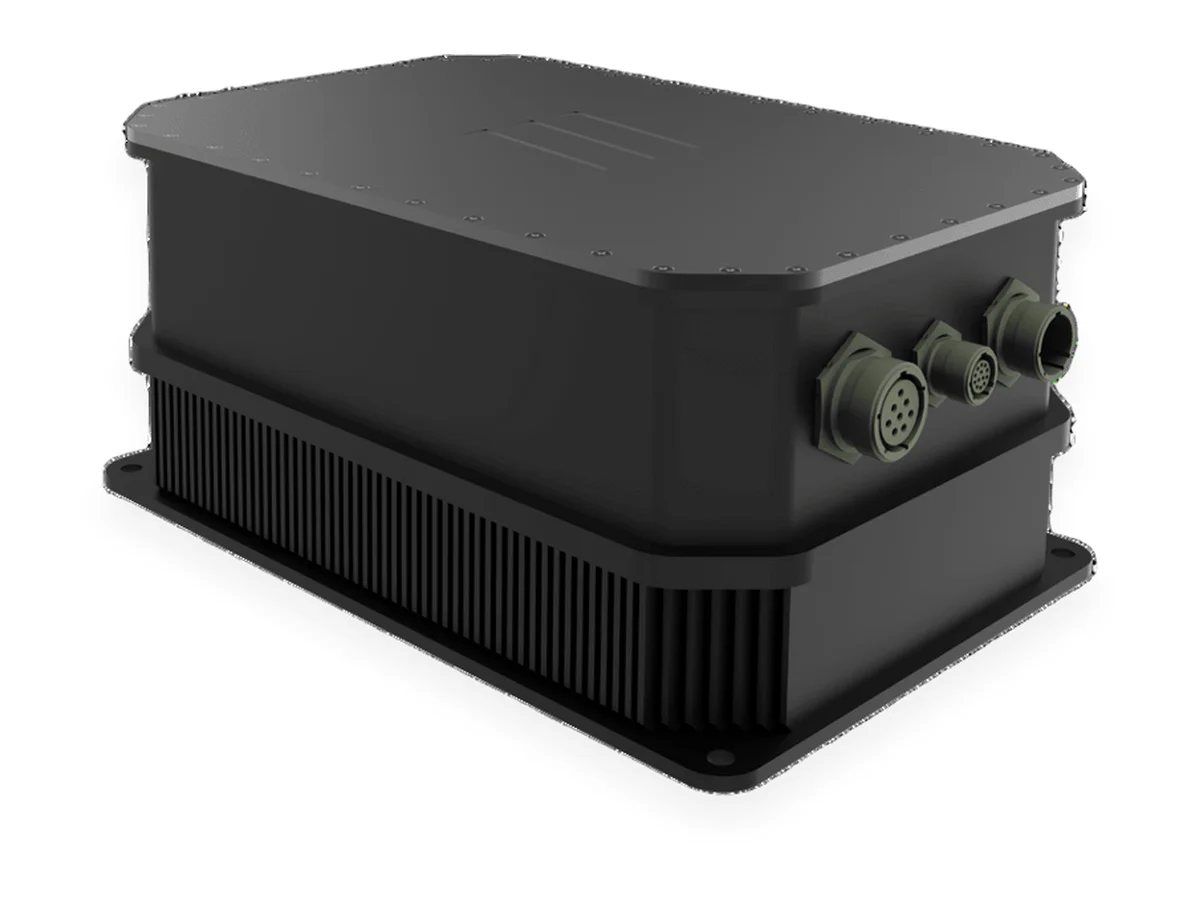
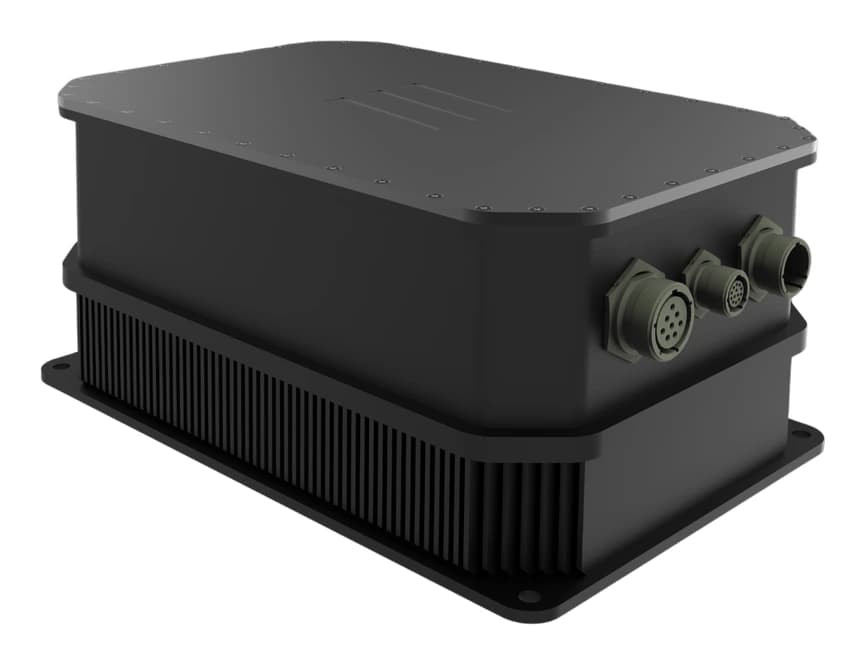
A mil-spec design removes heat by conduction: the power components are bonded to the aluminium housing and baseplate, and the heat passes into the chassis. The PowerGuard-A1000 is an example: fanless and conduction-cooled; −40 °C to +55 °C operating range; 1000 W continuous output with no derating up to +55 °C; 1200 W peak for up to 30 minutes. Over-temperature protection is staged: derating above +75 °C, shutdown above +95 °C, recovery below +85 °C.
Difference 2 — Enclosure and Sealing
Most commercial power supplies are open-frame or ventilated metal cases meant for mounting inside a cabinet, with no dust or water protection of their own. In military use the unit is often outside the cabinet: on a vehicle chassis, under a turret or on deck.
A mil-spec AC-DC converter therefore comes in a fully sealed housing. The PowerGuard-A1000 enclosure is IP67-rated, fully sealed aluminium, and the connectors are part of the seal. What an IP rating does and does not say, and how to read it at sub-unit level, is covered in our IP ratings guide; temperature, vibration and salt fog belong to MIL-STD-810 and are assessed separately.
Difference 3 — EMI/EMC: Civil Standards versus MIL-STD-461
Every switch-mode power supply generates noise; the question is which limit it is measured against. Commercial products are designed to civil EMC standards, which typically measure conducted emissions from 150 kHz upwards with quasi-peak and average detectors. The CE102 test in MIL-STD-461 starts at 10 kHz and uses a peak detector. On the immunity side, CS101, CS114 and CS116 inject the ripple and transients of a 28 VDC vehicle network straight into the unit's cables.
Adding external filters and shielding to a commercial supply afterwards usually creates a weight, volume and heat problem. A mil-spec design treats input filter, board layout, chassis bonding and 360°-terminated connectors together from day one. The PowerGuard-A1000 datasheet puts it this way: the enclosure is designed to meet MIL-STD-810 (environmental) and MIL-STD-461 (EMC) requirements. That is a "designed to" statement; if your programme needs a test report, say so at the quotation stage.
Difference 4 — Tolerance to the Input Source
Commercial power supplies are built for 50/60 Hz mains. On a military platform the source may be a generator, a ship's network or the 400 Hz supply used by radar systems. Input frequency and voltage range are the first lines to check.
The PowerGuard-A1000 runs from a single-phase 90–265 VAC input across 45–420 Hz, covering both 50/60 Hz mains and 400 Hz systems. The datasheet is candid: active power factor correction gives PF ≥ 0.99 at 50/60 Hz, while at 400 Hz the power factor drops to ≈0.75–0.8 and must be allowed for when sizing fuses, cabling and EMI filters. A 20 ms hold-up time (full load, 230 VAC) keeps short interruptions away from the load, and an inrush current of ≤ 16 A (cold start at 220 VAC) simplifies generator and breaker selection. See also our 115 VAC 400 Hz power supply selection article.
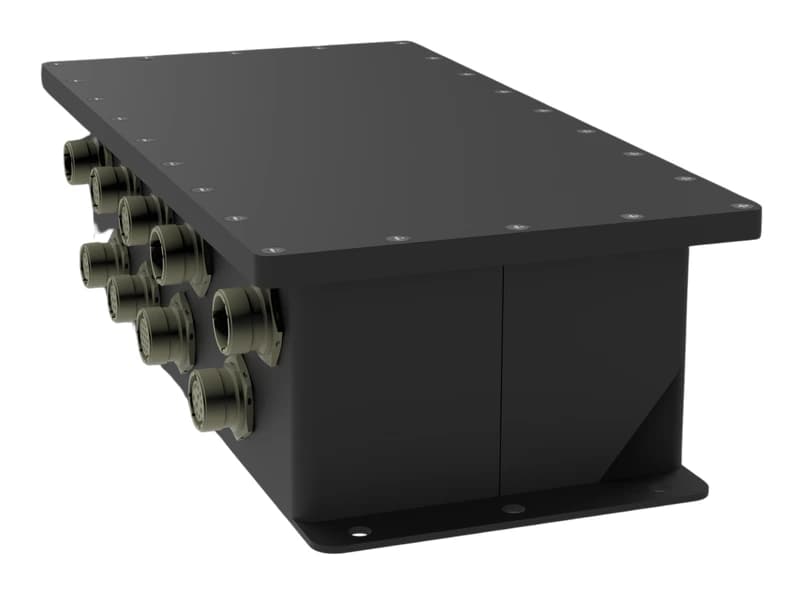
For a three-phase source, the PowerGuard-A 380 from the same family takes 360–440 VAC, 47–63 Hz and delivers 28 VDC nominal (12–48 VDC configurable) in 1 / 2 / 3 / 4 kW classes.
Difference 5 — Connectors and Cabling
The commercial standard is an IEC appliance inlet or a screw terminal block. Under vibration terminals loosen and plugs work their way out; even with shielded cable, how the shield is bonded to the housing stays undefined.
A mil-spec AC-DC converter uses MIL-DTL-38999 Series III connectors for power input and output. On the PowerGuard-A1000 the input is D38999/24WE6PN and the output D38999/24WE6SN, with a PT02E10-6P connector specified for optional communication. These connectors are keyed, lock in place, and provide 360° EMI shielding, vibration resistance and environmental sealing.
Difference 6 — Protection, Monitoring and Remote Control
Both units carry over-voltage, over-current and short-circuit protection; the difference is how it behaves and whether the system can see it. On a commercial supply it is often "shuts down, restarts after a power cycle" and reports nothing.
On the PowerGuard-A1000 the OVP, OCP, SCP and OTP functions recover automatically, and the input has surge, reverse polarity and fuse protection. It provides an opto-isolated Remote ON/OFF input, a Power-Good (DC-OK) signal active while the output is within ±5% of nominal, and a fault/alarm signal active during OCP, OTP and SCP. Optional Ethernet, CAN-Bus or RS-485 interfaces give remote monitoring; the optional Remote Commander Control Box adds remote ON/OFF, fault reset, a Blackout button that disables all outputs, status LEDs and a voltage/current display. The PowerGuard-A 380 comes with 4 independent outputs with monitoring and control.
Difference 7 — Proof, Documentation and Configuration Control
A commercial power supply is documented by a datasheet and a CE declaration. Defence procurement asks which revision of which standard, which tests, and what level of evidence. "Tested", "designed to the requirements" and "designed to the principles" say different things; the level must match what your programme needs.
The second layer is configuration control. A commercial manufacturer may change a board revision, a capacitor brand or a connector supplier without notice, so the tested configuration quietly changes. In mil-spec supply, part number, revision and change notification belong to the quality system. For the PowerGuard-A1000 the part number ACDC-1000-220-24, the main dimensions of 220 × 330 × 150 mm and the input-to-output isolation of 2000 VAC, 1-minute factory test are fixed on the datasheet. See our Certifications & Quality and test and validation services pages.
When Is a Commercial Power Supply Enough?
Not every defence project needs a mil-spec product. In a climate-controlled cabinet, inside a panel, on 50 Hz mains and behind a system-level EMI filter, a commercial unit is cheaper and easier to source. The question is whether the seven differences apply on your platform:
| Difference | Commercial may be enough | Mil-spec is needed |
|---|---|---|
| Temperature and cooling | Climate-controlled cabinet, free airflow | Closed vehicle compartment, direct sun, −40 °C cold start |
| Enclosure | Inside a panel or IP-rated cabinet | Open mounting, rain, dust, temporary immersion |
| EMI/EMC | System-level filtering and shielding in place | MIL-STD-461 test list in the specification |
| Input source | Stable 50/60 Hz mains | Generator, ship's network, 400 Hz, wide voltage range |
| Connectors | Fixed installation, no vibration | Vehicle, turret, transportable system |
| Protection and monitoring | Local ON/OFF is sufficient | Remote control, DC-OK and alarm signals, Blackout |
| Proof and documents | CE declaration is sufficient | Test list with revisions, configuration control |
Two or more rows on the right usually mean starting from a mil-spec product is cheaper than hardening a commercial one.
Mil-Spec AC-DC Converter Manufacturer in Turkey: TEDEG Defence
| Company profile | |
|---|---|
| Company | TEDEG Defence Industry A.Ş. |
| Location | Ankara, Türkiye |
| Founded | 2023 |
| Registrations and certificates | NCAGE TM885, ISO 9001, EYDEP |
| Cluster memberships | OSSA, SAHA İstanbul |
- PowerGuard-A1000: single-phase 90–265 VAC, 45–420 Hz input; 24 VDC / 1 kW continuous, 1200 W peak; 91% efficiency (230 VAC); IP67 fanless enclosure; MIL-DTL-38999 Series III connectors.
- PowerGuard-A 380: three-phase 360–440 VAC, 47–63 Hz input; 28 VDC nominal, 12–48 VDC configurable; 1–4 kW; 4 independent, monitored outputs; Ethernet / CAN-Bus / RS-485.
- Mil-Spec AC/DC Converter family: fully isolated output, conduction cooling, IP67; custom input/output configurations can be adapted to project requirements.
See the full range in the product catalogue.
Frequently Asked Questions
What does "mil-spec power supply" mean?
A power supply designed to the requirements of military standards (MIL-STD-461 EMI/EMC, MIL-STD-810 environmental, MIL-STD-1275 vehicle input) whose claim can be documented. It is a design and evidence level, not a certificate; check which standard, revision and wording the datasheet uses.
Can a commercial power supply pass MIL-STD-461?
It may pass some tests, but the measurement bands, detectors and immunity levels of civil EMC standards and MIL-STD-461 differ. Filters and shielding added afterwards usually turn into a weight, volume and heat problem, so products with compliance built into the design are preferred.
Why are military power supplies designed without fans?
A fan draws in dust, wears under vibration and, when it fails, leaves the unit to overheat. Conduction cooling moves heat through the housing and baseplate into the chassis; the unit stays fully sealed, runs silently and needs no maintenance.
Does a mil-spec AC-DC converter work on a 400 Hz supply?
It depends on the product; check the input frequency on the datasheet. The PowerGuard-A1000 accepts 45–420 Hz, including 400 Hz military power systems; allow for the ≈0.75–0.8 power factor at 400 Hz when sizing fuses and cabling. The PowerGuard-A 380 is specified for 47–63 Hz.
Conclusion
The difference between a mil-spec AC-DC converter and a commercial power supply is not in the label but in seven design decisions: cooling, enclosure, EMI approach, input tolerance, connectors, protection and monitoring, proof and configuration control. Specify against these seven headings and quotes become comparable.
Send us your input source, output voltage and power, environmental conditions and test report requirement through the quote form, or contact our engineering team.