Why Auxiliary Power Is Critical in Modern Armoured Vehicles
A modern armoured vehicle is no longer just a mobility and firepower platform — it is also a dense cluster of electronic systems. Electro-optical surveillance, communications terminals, mission computers, turret positioning systems, protection sensors and climate control all require continuous, stable electrical power.
The problem: running the vehicle's main diesel engine to power these electronic loads creates three serious operational disadvantages:
- 1.High fuel consumption — depending on the engine type, an idling tank engine can typically burn 15–30 litres per hour
- 2.High acoustic signature — a running engine can be heard from long distances
- 3.High thermal signature — the engine and exhaust are clearly detectable by thermal cameras
The Auxiliary Power Unit (APU) solves this: with the main engine off, it supplies critical electronic loads from its own smaller, quieter, low-thermal-signature power unit. This capability is known as Silent Watch, and it directly affects survivability on the modern battlefield.
Silent Watch — Operational Value
Silent Watch is the foundation of surveillance and ambush missions. Consider a scenario:
An armoured reconnaissance vehicle begins an 8-hour surveillance watch at the mouth of a valley at night. Its mission is to monitor and report enemy movement. Throughout this time:
- The main engine must be off — it must not be heard or picked up by thermal cameras
- The electro-optical system must be active — continuous imaging
- Communications must be live — data flow to the command centre
- The mission computer must run — target detection and recording
Without adequate auxiliary power, this scenario cannot be sustained. Running the main engine exposes the vehicle, and covering an 8-hour load from batteries alone is not possible on most platforms. With the main engine off, the APU supplies the critical loads quietly and covertly, allowing the mission to be completed.
Three Signatures, Three Risks
| Signature Type | Main Engine On | APU Silent Watch |
|---|---|---|
| Acoustic | High (audible at distance) | Low |
| Thermal | High (engine and exhaust stand out) | Low (small, thermally managed unit) |
| Fuel | Typically 15–30 L/hour (idle) | Markedly lower than the main engine |
The Physics of Acoustic and Thermal Signatures
Acoustic Signature
An engine produces sound waves through mechanical vibration and exhaust pulses. These waves travel long distances in open terrain. An adversary can detect this sound with acoustic sensor arrays and locate the vehicle by triangulation.
The APU advantage: a smaller engine, fan noise reduced by water cooling, and a sound-insulated enclosure. The result: an acoustic signature far lower than the main engine's.
Thermal Signature
As an object heats up, it emits infrared (IR) radiation. Thermal cameras turn this radiation into an image. A running tank engine and its exhaust appear as a bright target on a thermal camera, even at night.
The APU advantage: water cooling carries engine heat away in a controlled way, and a lower-power unit produces less heat. The result: a reduced thermal signature — the vehicle appears much colder on a thermal camera.
APU vs Battery-Only Silent Watch
Some platforms try to achieve Silent Watch with batteries only. A comparison of the two approaches:
Battery Only
- Advantage: Completely silent, no moving parts, practically no thermal signature
- Disadvantage: Limited duration (typically 1–3 hours), heavy battery pack, still needs the main engine to recharge
- Use: Short-duration silent watch, light platforms
APU
- Advantage: No time limit as long as fuel lasts; charges the battery and supplies the load
- Disadvantage: Low (but not zero) acoustic and thermal signature, engine maintenance
- Use: Extended silent watch (typically 4–12 hours and beyond), medium and large platforms
Hybrid Approach
Modern platforms often use an APU + energy storage buffer: the APU charges the battery and supplies the load; at critical moments when absolute silence is required, the APU is shut down and the load runs from stored energy. This delivers a long duration + instant total silence combination.
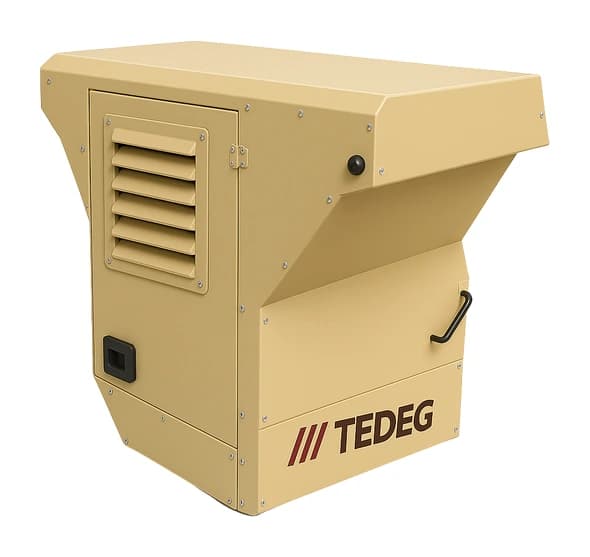
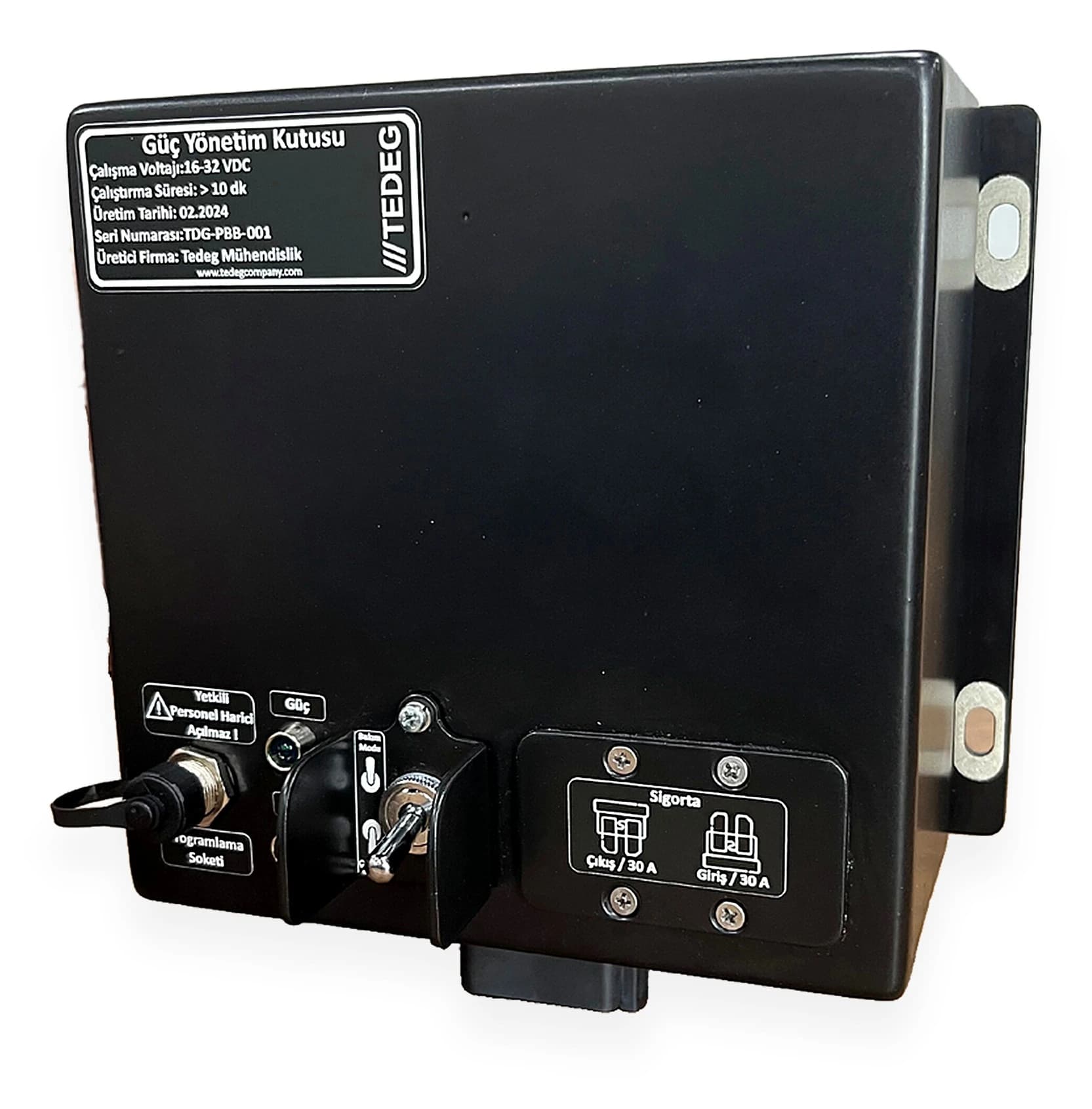
In the TEDEG portfolio, these two layers are covered by separate products. On the APU side, the PowerGuard YGG-DS11 supplies critical loads at 28 VDC / 10 kW with the main engine off, and keeps them powered without interruption during engine maintenance and refuelling. On the energy storage side, the PowerGuard EBB Auxiliary Battery Unit, with 3600 F supercapacitor cells, keeps supplying power for 3 hours after the vehicle ignition is switched off and charges from 0% to 90% in 30 minutes at 22 ± 5 °C.
Water-Cooled vs Air-Cooled APU
One of the most critical engineering decisions in APU design is the cooling method:
Air-Cooled
- Advantage: Simple, lightweight, low cost
- Disadvantage: Fan noise (acoustic signature), performance drops at high ambient temperatures, heat radiates directly into the surroundings (thermal signature)
- Silent Watch suitability: Low — fan noise compromises stealth
Water-Cooled
- Advantage: Quieter (minimal fan), heat removed in a controlled way (low thermal signature), performance preserved at high ambient temperatures
- Disadvantage: More complex, slightly heavier, coolant maintenance
- Silent Watch suitability: High — acoustic and thermal signatures are minimised
Since acoustic and thermal signatures are critical in Silent Watch missions, water cooling is the right engineering choice. The PowerGuard YGG-DS11 follows this approach, with an integrated water-cooling system and a water-cooled Kubota D1105 vertical diesel engine.
28 VDC Vehicle Power Architecture
The dominant power standard on military ground vehicles is 28 VDC, and the characteristics of this bus are defined by MIL-STD-1275E. Why 28 VDC?
- Widespread across NATO — compatibility with allied vehicle equipment
- Low-voltage safety — reduced electrical risk for the operator
- Wide equipment ecosystem — most radios, sensors and computers are designed for this bus
- Battery compatibility — 24 V battery groups operate at around 28 V under alternator charging
MIL-STD-1275E defines how a vehicle's 28 VDC bus may behave and what equipment connected to it must withstand:
- Nominal voltage: 28 VDC
- Steady-state voltage limits
- Surges: e.g. pulses of up to 100 V lasting on the order of 50 ms
- Spikes, ripple and voltage dips during engine starting
An APU must deliver clean 28 VDC to this bus and withstand transient conditions.
APU Power Class Selection Guide
APU power class is selected according to the platform and load profile. A typical approach:
| Power Class | Typical Platform | Load Profile |
|---|---|---|
| 2–5 kW | Light reconnaissance vehicle, command vehicle | Radio + basic electronics |
| 5–10 kW | APC, MRAP, medium armour | Surveillance + communications + climate control |
| 10–25 kW | Main battle tank, heavy infantry fighting vehicle | Full silent watch + turret + climate control |
| 25–50 kW | Mobile command centre, radar vehicle | Multiple electronic systems + IT infrastructure |
| 50–100 kW | Large logistics platform, mobile field facility | Full container supply |
The reference model in TEDEG's APU family is the PowerGuard YGG-DS11 (TDG-10), delivering 10 kW at 28 VDC. Its key specifications:
| Feature | Value |
|---|---|
| Output | 28 VDC, 10 kW |
| Engine | Kubota D1105, water-cooled vertical diesel |
| Cooling | Integrated water-cooling system |
| System weight | 375 ± 10 kg |
| Dimensions | 1000 × 591 mm (L × W), engine height 435 mm |
| Temperature | Max. operating +49 °C; storage −40 °C … +60 °C |
| Control panel | IP67, last 500 log records |
On the same architecture, power output can be customised between 2 kW and 100 kW to suit the platform.
MIL-STD Compliance — Field Durability
An APU faces the following conditions in the field, and its design must be verified against them:
MIL-STD-810G — Environmental Durability
- High and low temperature (desert and winter conditions)
- Vibration (vehicle in motion)
- Shock (cross-country driving, impact)
- Sand and dust (desert operation)
- Humidity
MIL-STD-461F — EMI/EMC
- The APU's generator and power electronics must not interfere with the vehicle's radar, communications and positioning systems
- It must not be affected by external electromagnetic fields
MIL-STD-1275E — Power Interface
- Compatibility with the 28 VDC vehicle bus
- Resistance to transients and surges
IP67 — Dust and Water Protection
- Dust-tight; withstands immersion at 1 m for 30 minutes
- Safe operation in rain and dust
On the PowerGuard YGG-DS11, military standard compliance is defined for the control units: the control panel and remote control comply with MIL-STD-810G and MIL-STD-461E/F. The control panel is designed to IP67, and the remote control also has IP67 dust and water protection and operates from −40 °C to +85 °C.
Monitoring, Control and Diagnostics
An APU's reliability in the field depends not only on the engine and generator but also on how much information it gives the operator and the maintenance team. On the PowerGuard YGG-DS11, this information comes through two interfaces:
- Control panel — monitoring and diagnostics: Real-time display of current fault states; LED indicators for APU status, fuel level, pressure, DC current and battery voltage; fault code display; access to the last 500 detailed log records
- Control panel — operation: Start/Stop, Auto/Manual and Reset buttons; manual override if a problem arises during automatic start; adjustable alarm sound and night mode
- Remote control: Switching the APU and the air-conditioning system on and off remotely, monitoring APU data on the information display, CIT test and emergency stop
Typical Platform Applications
Military APUs are used on the following platforms:
- Main battle tanks — silent watch surveillance, turret system supply
- Armoured fighting vehicles and APCs — uninterrupted electronic loads
- Command-and-control vehicles — field C2, sustained communications
- Border surveillance vehicles — extended ambush and surveillance watch
- Mobile radar platforms — continuous radar and processor supply
- Logistics and support vehicles — field camp power supply
- Military trucks — 28 VDC for on-board systems, independent of the main engine
Total Cost of Ownership
An APU's purchase price is only part of its life-cycle cost. The evaluation should also account for:
- Installation — vehicle integration and mounting interface
- Maintenance — engine servicing, coolant, filters (the APU engine runs far less than the main engine)
- Spare parts — generator, controller card, sensors
- Fuel — supplying the load from the APU rather than the main engine during silent watch
Supplying the load from the APU during Silent Watch reduces the hours the main engine spends idling, together with the associated fuel consumption and engine wear. Log records and fault codes help maintenance move from unplanned downtime to data-driven planning.
Conclusion
The military Auxiliary Power Unit (APU) is the foundation of an armoured vehicle's Silent Watch capability and operational survivability. Acoustic and thermal signature reduction, 28 VDC power architecture, water cooling, MIL-STD-1275E compliance and the right power-class selection are the core criteria to look at when evaluating a military APU.
TEDEG's APU solution, the PowerGuard YGG-DS11, offers 28 VDC / 10 kW output, integrated water cooling, a water-cooled diesel engine, and an IP67 control panel and remote control. On the same architecture, power output can be customised between 2 and 100 kW to suit the platform. For short-term backup power with the main engine off, the portfolio also includes the PowerGuard EBB Auxiliary Battery Unit.
Corporate assurance: TEDEG Defence is an approved supplier of ASELSAN, Roketsan and the Turkish Ministry of National Defence (MSB), with NATO supplier registration under NCAGE: TM885.
For technical documentation, see the PowerGuard YGG-DS11 and PowerGuard EBB supercapacitor power backup unit product pages, or browse the Auxiliary Power Units (APU) category. For on-board power distribution, read our military PDU guide; for an engineering conversation with our team, use the contact page.