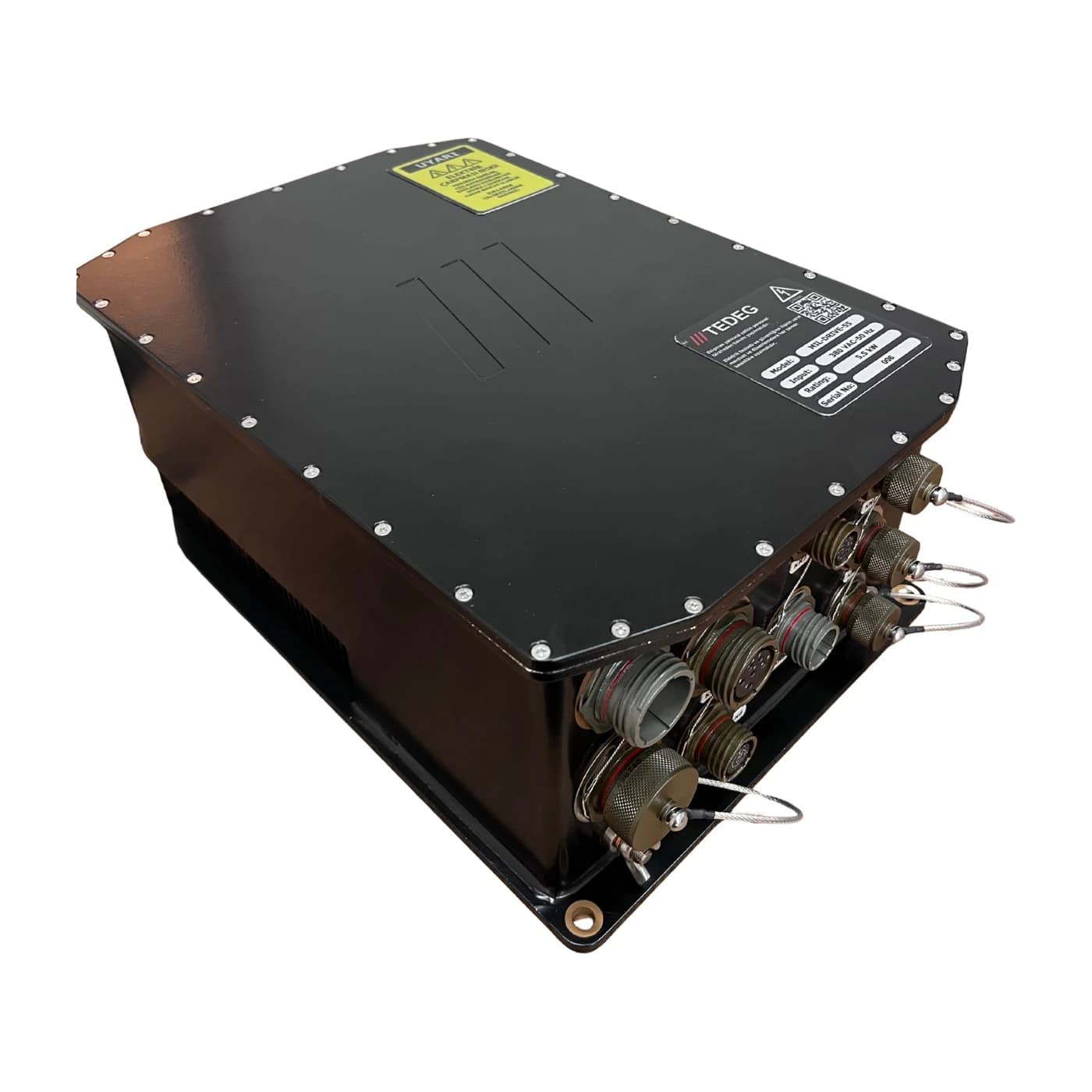
The Role of Motor Drives in Modern Military Systems
Modern military platforms host many motion-critical subsystems: tank turrets, radar antenna positioning, missile launcher pedestal motion, electro-optical gimbals, ship cranes, hydraulic pumps, cooling fans. All of these motions are delivered by a motor and the drive that controls it.
Motor drives for civilian industrial use differ fundamentally from those in military field service. Military field conditions (vibration, shock, temperature, humidity, EMI/EMC, dust and water) and operational requirements (remote monitoring, safe torque removal, fault tolerance) demand a more comprehensive engineering approach for military drives.
This guide covers the technical foundations, FOC vector control logic, the Safe Torque Off safety function, MIL-STD compliance and platform-specific selection criteria for modern military motor drives.
Motor Drive Topologies — Scalar, Vector and Servo
Military motor drives fall into three fundamental control approaches:
1. V/f Scalar Control (Classic VFD)
- Operation: Varies voltage and frequency at a constant ratio (V/f constant)
- Advantage: Simple, low cost, widely available
- Disadvantage: Weak position control, torque drops at low speed, can become unstable under sudden load changes
- Use: Pumps, fans, simple conveyors — limited for tasks that need precise position and torque
2. FOC Vector Control (Modern Choice)
- Operation: Splits motor current into magnetic flux and torque components (d-q transformation) and controls flux and torque independently
- Advantage: Servo-like dynamic performance, high torque at low speed, fast load response
- Disadvantage: Complex algorithm, needs more processing power
- Use: Turrets, radar, gimbals, cranes — a widespread choice on modern platforms
3. Servo Drive (Permanent-Magnet Motor)
- Operation: Controls a permanent-magnet synchronous motor (PMSM / brushless servo) with high-resolution feedback
- Advantage: Highest position accuracy and dynamic response, high power density
- Disadvantage: High cost, dependence on rare-earth magnets, risk of magnet weakening at high temperature, need for precise feedback
- Use: Applications requiring very high precision — fire-control servos, precision measurement rigs
In many modern military applications, induction motor + FOC stands out: it combines servo-like performance with the ruggedness and cost advantage of an induction motor. The TEDEG Mil-Drive-55 sits in this category.
What Is FOC (Field Oriented Control), and Why Is It Critical?
The FOC algorithm mathematically separates the magnetic flux and torque components of an induction motor. Unlike traditional V/f control, it does not treat the motor as a "black box" — it controls it by modelling what happens inside in real time.
Operating Principle
- 1.Three-phase current measurement (phases a, b, c)
- 2.Clarke transform (a-b-c → α-β two-axis system)
- 3.Park transform (α-β → d-q rotor reference frame)
- 4.Independent PI control: d-axis (magnetic flux), q-axis (torque)
- 5.Inverse transforms (d-q → α-β → a-b-c)
- 6.PWM applied to the motor windings through power semiconductors (e.g. IGBTs)
This structure lets the motor:
- Produce high torque at low speed (critical for fine turret adjustment)
- Respond quickly to load changes
- Run more quietly
- Run more efficiently than under V/f control
Sensored and Sensorless FOC
Sensored FOC reads rotor position and speed from a feedback device such as a resolver or encoder; it is preferred at very low speeds and for precise positioning. Sensorless FOC estimates rotor position from motor currents and voltages; it is an advantage where a sensor cannot be fitted or where the number of cables and connections should be kept down.
The TEDEG Mil-Drive-55 supports both sensored and sensorless FOC operation. It processes the power and input/output signals coming from the platform with embedded control algorithms and real-time control loops.
Induction Motor + FOC vs Servo — Comparison
One of the most critical decisions for platform designers: servo, or induction motor + FOC?
| Criterion | Servo (PMSM) | Induction + FOC |
|---|---|---|
| Position accuracy | Very high | High (with a feedback sensor) |
| Cost | High | Generally lower |
| Power density | High, compact | Motor slightly larger |
| Rotor design | Permanent magnet | Magnet-free, rugged squirrel-cage rotor |
| Temperature and overload tolerance | Magnet limits need attention | High |
| Dynamic response | Fastest | Fast |
| Drive side | High-resolution feedback | FOC computational load |
Conclusion: Servo stands out in applications requiring very high precision (e.g. fire-control servos). Induction + FOC is a strong option where medium-to-high precision must be combined with ruggedness (turrets, radar, cranes, hydraulic pumps).
The TEDEG Mil-Drive-55 is designed for speed, torque and direction control of three-phase induction motors. Typical uses include turret motion, hydraulic pumps and auxiliary motors on armoured ground vehicles, radar and antenna positioning, electro-optical turrets, missile launch platforms, mobile mission platforms and naval systems.
Safe Torque Off (STO) — Safe Torque Removal
One of the core safety features of modern military motor drives is the Safe Torque Off (STO) function.
What STO Does
STO is the electrical safety function that safely prevents the motor from producing torque when the operator presses an emergency button or the system detects an anomaly. No energy capable of producing rotation reaches the motor, and the motor coasts to a stop; this corresponds to stop category 0 in IEC 60204-1. Where controlled deceleration is needed, STO is combined with the SS1 function, which first performs a ramped stop.
Operating Principle
- 1.As long as the STO inputs (typically 24 V) are energised, the drive can produce torque
- 2.When the inputs are removed, the gate signals of the power semiconductors are blocked at hardware level
- 3.No torque-producing energy reaches the motor windings
- 4.The function is independent of the control software — STO works even if the software locks up
Single-Channel vs Dual-Channel STO
| Criterion | Single-Channel STO | Dual-Channel STO |
|---|---|---|
| Single-fault tolerance | No | Yes — if one channel fails, the other still removes torque |
| Achievable safety level | More limited | With suitable diagnostics, an architecture typically suited to ISO 13849-1 Category 3 / PL d and SIL 2 targets |
| Military use | Limited | Preferred |
Dual-channel STO is preferred in mission-critical military applications. On the Mil-Drive-55, the STO function is implemented with a dual-channel architecture, and the drive also has a separate emergency input.
The IEC 61800-5-2 Standard
IEC 61800-5-2 addresses the functional safety of adjustable-speed electrical power drive systems. The standard:
- Defines safety functions such as STO, SS1 and SLS
- Sets safety integrity level (SIL) requirements within the IEC 61508 framework
- Covers requirements for diagnostic coverage (DC) and failure rates
- Is assessed together with ISO 13849-1 on the machinery side
The Passive Cooling (Fanless) Advantage
Cooling strategy is a critical engineering decision for military motor drives:
Active Cooling (Fan)
- Advantage: Smaller heat sink, higher power density
- Disadvantage: A fan is a mechanical part that can fail under vibration; air inlets make dust and water protection harder; fan noise creates an acoustic signature
- Maintenance: Fans and filters need periodic cleaning
Passive Cooling (Fanless)
- Advantage: No moving parts, no acoustic signature, a high IP rating is easier to achieve, lower maintenance need
- Disadvantage: Needs a larger heat sink, limited power density
- Military application: Preferred — quiet and durable in the field
The TEDEG Mil-Drive-55 has a passively cooled, fanless architecture: no mechanical wear points and no fan-related acoustic signature, aimed at long, maintenance-free service.
MIL-STD-810G and MIL-STD-461F — Military Field Durability
A civilian motor drive usually operates in a controlled environment. A drive that goes into military service faces much harsher conditions.
MIL-STD-810G Environmental Test Methods
MIL-STD-810G defines more than twenty environmental test methods. Those most relevant to motor drives include:
- High temperature (Method 501) and low temperature (Method 502) — desert summer and Eastern Anatolian winter
- Temperature shock (Method 503)
- Rain (Method 506) and humidity (Method 507)
- Salt fog (Method 509) — corrosion in a marine environment
- Sand and dust (Method 510) — desert operation
- Vibration (Method 514) — vehicle in motion
- Shock (Method 516) — cross-country driving and impact
Which methods are applied, and at what levels, depends on the platform and mission profile — so the test scope should always be checked during procurement.
MIL-STD-461F EMI/EMC Requirements
- CE102 — Conducted emissions on power leads
- CS101, CS114, CS115, CS116 — Conducted susceptibility
- RE102 — Radiated emissions
- RS103 — Radiated susceptibility
If a motor drive emits electromagnetic noise, it can affect the radar, positioning receivers, communications and fire-control systems on the same platform. The MIL-STD-461F requirements are defined to keep this risk under control.
The TEDEG Mil-Drive-55 is designed for compliance with MIL-STD-810G environmental durability and MIL-STD-461F EMI/EMC.
IP Rating — What Does IP67 Mean?
IP67 = dust-tight (6) + withstands immersion at 1 m for 30 minutes (7)
In military applications, this level of protection allows both indoor and outdoor use:
- No dust or sand ingress (desert operation)
- The outdoor enclosure is safe in rain
- Withstands salt fog and splashing water on a ship's deck
- Also suitable for indoor use in field command containers
During procurement, it is also worth checking whether the declared IP rating applies with the connectors mated.
Resolver, Encoder, NTC — Sensor Interfaces
A modern military motor drive must measure the motor's actual position, speed and temperature through sensors.
Resolver
- Works on a magnetic principle — analogue signal
- Withstands high vibration and temperature (well suited to military use)
- Provides absolute angle within one revolution
- Typical use: tank turrets, heavy turret orientation
Incremental Encoder
- Works on an optical or magnetic principle — digital signal
- High resolution (thousands of pulses per revolution)
- Typical use: radar antennas, cranes
Absolute Encoder
- Optical or magnetic — absolute position
- Retains position after a power interruption
- Typical use: missile launcher initial position
NTC Temperature Sensor
- Monitors motor winding temperature
- Triggers over-temperature protection
- Widely used in military drives
The TEDEG Mil-Drive-55 supports resolver, incremental or absolute encoder and NTC temperature sensor inputs.
RS-485 vs CAN-Bus — Communication Protocol Selection
| Criterion | RS-485 / Modbus | CAN-Bus / J1939 |
|---|---|---|
| Message length | Flexible | Fixed (8 data bytes in classic CAN) |
| Speed | Depends on distance; up to 10 Mbps on short runs | Up to 1 Mbps (classic CAN) |
| Distance | Up to 1.2 km at low speed | About 40 m at 1 Mbps |
| Topology | Master-slave | Multi-master |
| Fault tolerance | Medium | High (CRC, automatic retransmission) |
| Typical military use | Fixed command centres, communications shelters | In-vehicle networks (J1939 — heavy vehicles) |
The TEDEG Mil-Drive-55 has RS-485 and CAN-Bus communication interfaces. Through them it exchanges data with central control systems, and the operator gets remote monitoring, fault reporting and telemetry. The integrator chooses the interface that suits the platform architecture.
Typical Platform Applications
Military motor drives are used in the following applications:
- Tank turret motion — azimuth and elevation positioning
- Electro-optical gimbals — precision target tracking
- Missile launcher pedestals — launch platform position adjustment
- Radar antenna positioning — fixed and mobile radars
- Ship cranes and stabilisation — naval platforms
- Hydraulic pump drives — turret rotation, loading and hatch mechanisms
- HVAC fans and compressors — mobile command container climate control
- Auxiliary motor control — cooling, valve open/close, conveyor belts
Pre-Procurement Selection Checklist
When selecting a military motor drive, the following points should be clarified:
- Motor type and power: Induction or permanent magnet; nominal power and overload needs
- Control mode: Sensored or sensorless FOC
- Feedback: Resolver, encoder type and temperature sensor
- Safety: STO (single or dual channel) and emergency input
- Communication: RS-485 or CAN-Bus; which status and fault data will be shared
- Environmental and EMC compliance: MIL-STD-810G methods, MIL-STD-461F requirements, IP rating
- Cooling: Fan or passive
- Maintenance and diagnostics: Fault codes and remote monitoring
How the TEDEG Mil-Drive-55 answers these points:
| Point | Mil-Drive-55 |
|---|---|
| Motor type | Three-phase induction (asynchronous) |
| Nominal power | 5.5 kW |
| Control | Sensored and sensorless FOC |
| Feedback | Resolver, incremental / absolute encoder, NTC |
| Safety | Dual-channel Safe Torque Off (STO), emergency input |
| Communication | RS-485, CAN-Bus |
| Monitoring | Remote monitoring, fault reporting, telemetry |
| Cooling | Passive, fanless |
| Standards | MIL-STD-810G, MIL-STD-461F |
Corporate assurance: TEDEG Defence is an approved supplier of ASELSAN, Roketsan and the Turkish Ministry of National Defence (MSB), with NATO supplier registration under NCAGE: TM885.
Life-Cycle Cost
A military motor drive's purchase price is only part of its life-cycle cost. Installation (integration engineering, cable harness fit), periodic maintenance and checks, spare parts (power module, controller card, sensor interface) and operator training should also be taken into account. A fanless design removes fan and filter maintenance, while remote monitoring and fault reporting shorten the time needed to find the cause of a fault and make maintenance easier.
Conclusion
The military motor drive is the foundation of the motion capability of modern combat platforms. FOC vector control, dual-channel Safe Torque Off, a sealed and passively cooled design, MIL-STD-810G/461F compliance, resolver/encoder sensor interfaces and modern communication protocols are the core criteria to look at when evaluating a drive.
The TEDEG Mil-Drive-55 was developed along these criteria, with sensored and sensorless FOC for three-phase induction motors, dual-channel STO, passive cooling, RS-485 and CAN-Bus communication, and a design compliant with MIL-STD-810G/461F.
For the datasheet and technical documentation, visit the Mil-Drive-55 product page; for other solutions, browse the Frequency Converters and Motor Drives category. For an engineering conversation with our team, use the contact page.