
Defence Systems — Launch Platforms
Armoured Launcher — Running the Levelling Leg Motors from a Single Sealed Drive
The levelling leg system's industrial drive needed a separate cabinet, filter and brake control hardware. The Mil-Drive-55 induction motor drive brought drive, protection and brake management together in one IP67 unit, with fault codes reported to the platform computer.
- Platform
- Armoured launcher vehicle — levelling legs, three-phase induction motors, platform computer
- Customer
- Leading Turkish Defence Systems Manufacturer
- Sector
- Land · armoured launcher vehicle
- Year
- 2025
Customer & Context
A leading Turkish defence systems manufacturer was developing the levelling system for an armoured launcher vehicle. At the firing position, the legs deploy, lift the vehicle and bring it level. After the mission, they retract and the vehicle moves off again. Three-phase induction motors drive the legs.
The initial design used an industrial frequency inverter to drive the motors. It was not built for outdoor use, so installation on the vehicle required a separate cabinet and filter. Another control box managed the motor's holding brake. The drive's fault status was also unavailable to the platform computer.
The manufacturer sent TEDEG Defence its technical requirements for a drive that could run the leg motors, withstand the outdoor environment and connect to the platform's communication line. It wanted drive, protection and brake management in a single sealed unit, replacing the arrangement that split these functions between separate devices.
Challenge
The manufacturer's requirements document set out the problems with the industrial drive arrangement:
- Separate cabinet and filter: using the industrial drive on the vehicle required its own cabinet and filter. The cabinet occupied vehicle space and added to the installation and wiring work.
- Separate holding brake control: a control box independent of the drive switched the leg motor's holding brake. Brake and drive sequencing was therefore split between two devices.
- Safe stop: the legs carry the weight of the vehicle. In an emergency, motor torque had to be removed safely.
- No fault reporting: the cause of a drive trip did not reach the platform computer. Diagnosis required a visit to the drive itself.
- Cold and wet sites: the unit had to work at cold, wet positions, exposed to rain and dust.
The manufacturer wanted these requirements met by a single military drive.
TEDEG Solution
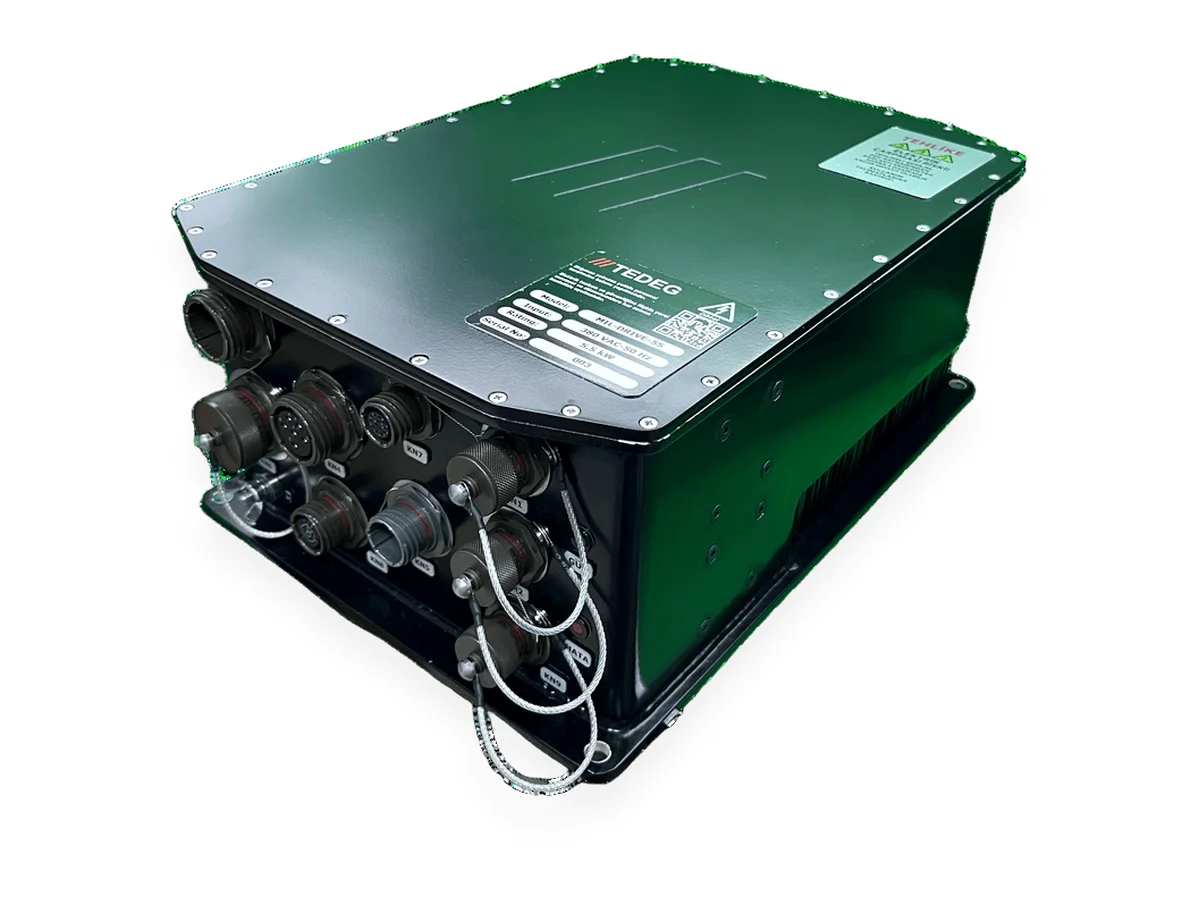
TEDEG Defence configured and delivered the Mil-Drive-55 Military Induction Motor Drive for the levelling leg motors. The Mil-Drive-55 is not an off-the-shelf product: its motor data, I/O assignments, protection thresholds and communication data map were defined for this application with the manufacturer's engineering team.
Drive and Brake Management in One Unit
The drive takes a 400 VAC ±10%, 48–62 Hz input and delivers a 3 × 400 VAC output, with a nominal power of 5.5 kW. The induction motors run under sensorless FOC speed control. Two independent ramp sets (0.1–600 s) allow the lifting and lowering movements to be tuned separately, so the legs start and stop smoothly. The drive now manages the leg motor's holding brake itself: a current-monitored 24 VDC motor holding brake output is switched directly by the drive. An internal brake chopper with a 25 Ω / 200 W internal brake resistor handles dynamic braking. The separate brake control box is no longer needed.
Safe Stop and Reporting to the Platform Computer
A dual-channel STO input and an emergency stop input remove motor torque safely. Every fault latches: PWM is cut, the motor brake engages and a fault code is reported on the communication line. Over two isolated serial ports, the drive reports speed, running status and fault code to the platform computer using Modbus RTU. A real-time-clock event log of 1,000 entries lets faults in the field be investigated afterwards. The firmware is updated in the field over the serial port through the built-in bootloader, without opening the sealed enclosure.
A Sealed Enclosure That Works Without a Cabinet
The enclosure is IP67-sealed aluminium with fanless cooling, so the unit works on the vehicle without a separate cabinet or filter. It delivers full nominal power with no derating up to +55 °C. If the ambient temperature drops to −40 °C while the drive is running, it keeps running. For a cold start, internal heater pads prepare the drive: the heater switches on below −10 °C, and the power stage is enabled once the heatsink rises above −20 °C. An input EMI filter and an output filter are standard. All power, signal and communication connections are on nine MIL-DTL-38999 series connectors (KN1–KN9).
Outcome
Drive, protection and brake management for the levelling leg motors were brought together in a single sealed unit.
- The separate drive cabinet, filter and brake control box are no longer needed.
- The leg motor's holding brake is managed from the drive's own output.
- The dual-channel STO and emergency stop input remove motor torque safely.
- Fault codes and running status are visible on the platform computer over Modbus RTU.
- During field service, the firmware is updated over the serial port without opening the enclosure.
Technical Scope
Values are taken from each product's own technical data; full specifications are on the product page.
- Nominal power
- 5.5 kW (optional up to 18 kW)
- Output
- 3 × 400 VAC, 0–500 Hz
- Motor current
- 14 A · overload 150% (60 s) / 175% (2.5 s)
- Input
- 400 VAC ±10%, 48–62 Hz
- Connectors
- MIL-DTL-38999 series
- Dimensions
- 245 × 350 × 145 mm
StandardsMIL-STD-461FMIL-STD-810GView product: Mil-Drive-55 Military Induction Motor Drive — FOC Vector Drive- Input
- 3-phase 400 VAC + N + PE, 50–60 Hz, 10 A rms
- Output
- 3-phase induction motor; FOC vector control; 0–50.0 Hz, ±1500 rpm
- Output current
- 10 A rms continuous (≈ 6.9 kVA); induction motors up to 4 kW (400 V, 4-pole)
- Speed feedback
- Incremental encoder input (1024 PPR), closed-loop speed control
- Ramps
- Acceleration / deceleration 1.0–30.0 s, adjustable
- Communication
- RS-485 (4-wire, 115200 bps) · Ethernet 10/100 TCP/IP · embedded web interface
StandardsMIL-STD-810HMIL-STD-461FView product: Mil-Drive MCU-400 Military Motor Control Unit
More case studies
Air Defence · 2025
Mobile Air Defence Platform — Pedestal Motor Control & Radar Frequency Feed
A motor drive and a frequency converter sourced from separate foreign suppliers were replaced by a matched TEDEG pair, designed together so that neither interferes with the other.
Read case study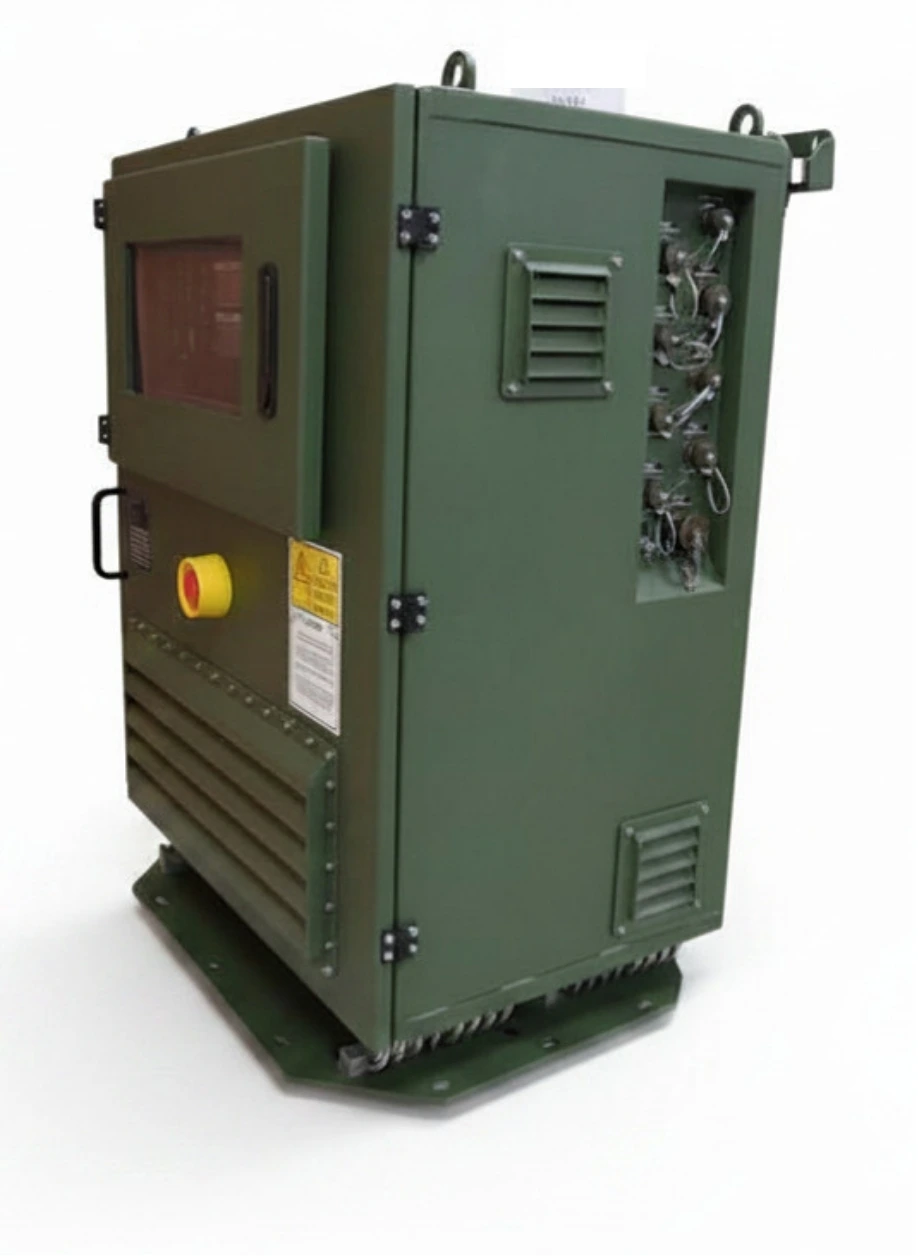
Land — Rocket / Missile Platforms · 2025
Land Rocket Platform — From Three Separate Systems to One Integrated Solution
The outdoor-rated military 60 Hz and 400 Hz solution the manufacturer could not find on the market: a single PowerGuard Outdoor replaced three systems combined in an industrial enclosure.
Read case study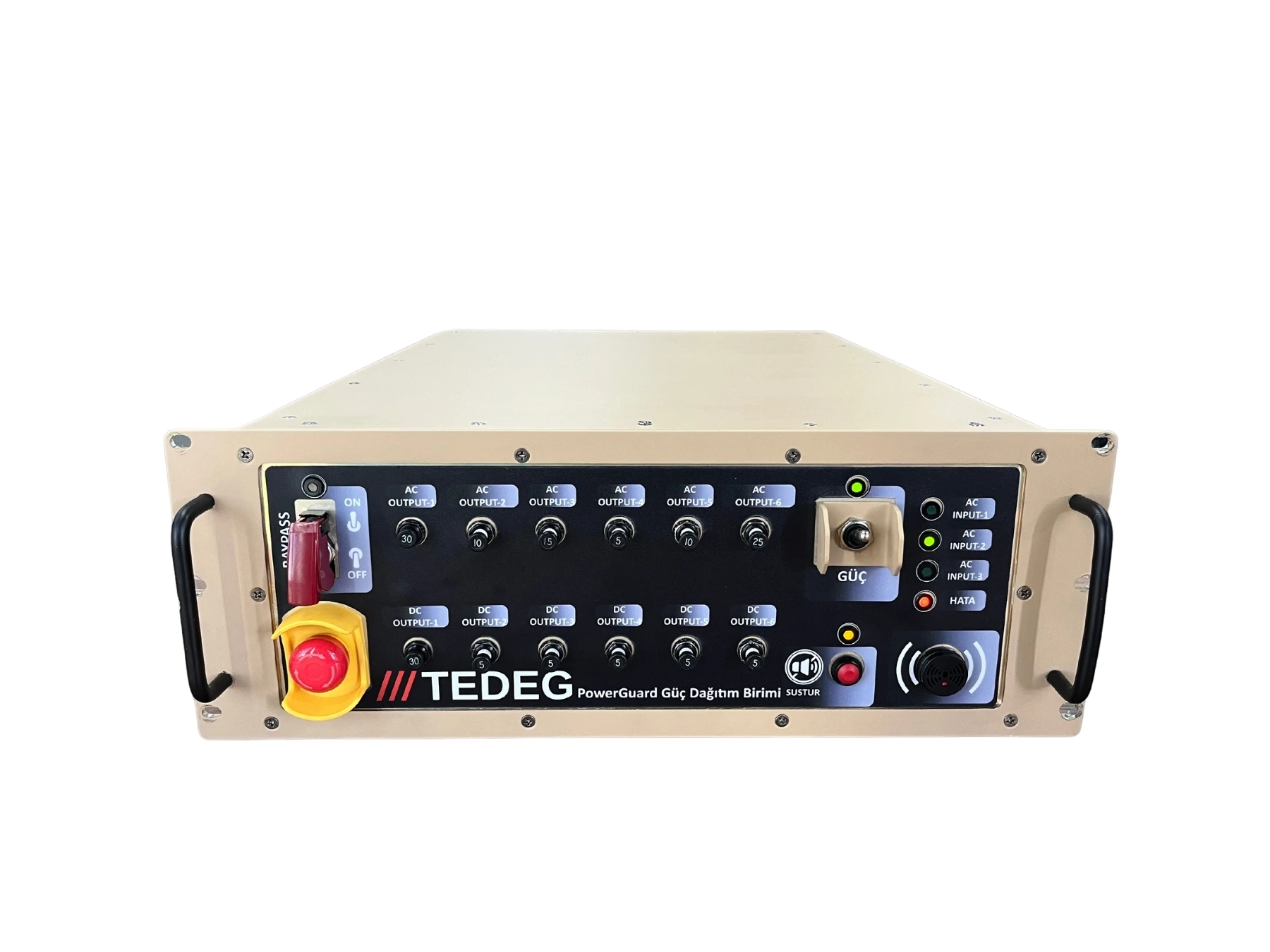
Land Platforms · 2024
Tactical Truck Power Architecture Modernisation
An ageing PDU that could no longer keep pace with growing mission loads was replaced by a remotely monitored power distribution architecture built on the PDU-RT5002 and designed to MIL-STD requirements.
Read case study