
Radar and Communication Systems
Mobile Radar Node — A 28 VDC Power System That Loads the Generator on Three Phases and Starts Outputs in Sequence
For a mobile radar node where single-phase commercial supplies loaded the generator unevenly, every load started at once and fans failed in the dust, a three-phase, fanless, remotely monitored 28 VDC converter and distribution system: the PowerGuard-A 380.
- Platform
- Mobile radar and communication node — 3-phase 380 VAC generator, 28 VDC radar processor, radios and router
- Customer
- Leading Turkish Radar Systems Manufacturer
- Sector
- Land · mobile radar and communications
- Year
- 2025
Customer & Context
A leading Turkish radar systems manufacturer builds mobile radar and communication nodes that are deployed in the field. Each node draws its energy from a three-phase 380 VAC field generator, while the radar processor, radios and network routers run on 28 VDC.
On the existing nodes, that conversion was done with single-phase commercial power supplies, one for each load group. The manufacturer's field teams reported that the generator was loaded unevenly across its phases, that every load started at the same moment when the node was energised, and that fan-cooled supplies were failing at dusty sites. The node's own system had no view of what was happening on the power side either.
Based on these field reports, the manufacturer sent TEDEG Defence its technical requirements: an AC-DC converter and distribution system fed directly from the generator on three phases, fanless and fully sealed, able to bring its outputs on in sequence and monitored remotely. The power class had to be selectable to match the load profile of each node.
Challenge
The manufacturer's requirements document set out the problems with the existing power arrangement:
- Phase imbalance: single-phase supplies could not be spread evenly across the generator's phases. One phase carried more load while the others sat lightly loaded, so the generator's full capacity could not be used.
- Overlapping inrush: when the node was energised, the radar processor, radios and routers all switched on together. The stacked inrush currents put strain on the generator.
- Fan failures in dust and humidity: the fans and vents of commercial supplies clogged at dusty, humid sites, and filter cleaning and fan replacement added to the field maintenance load.
- No monitoring: voltage, current, temperature and fault data never reached the node's command software. A power problem was only noticed when a load stopped working.
- Power needs varying by configuration: node configurations carried different load profiles, and choosing a separate supply model for each one widened the range of parts to buy and keep in spares.
The manufacturer wanted these problems solved in a single sealed unit.
TEDEG Solution
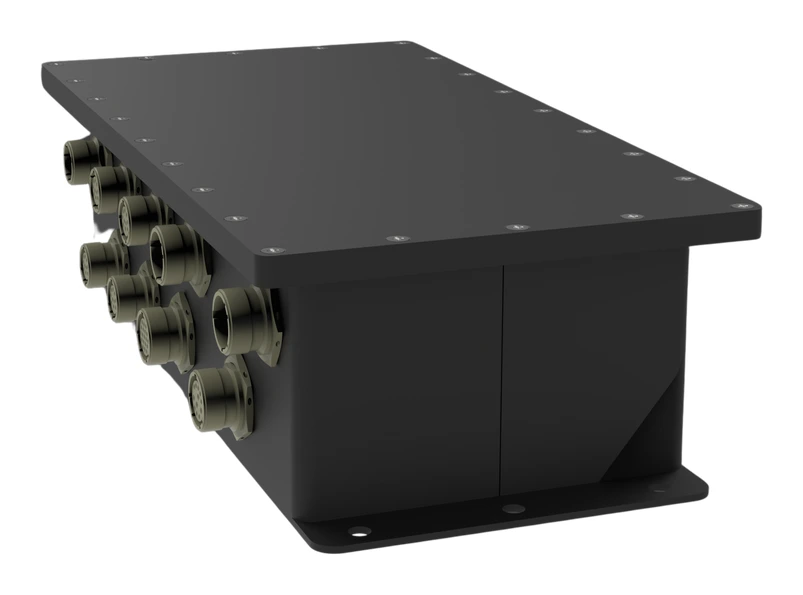
Against these requirements, TEDEG Defence delivered the node's power system as the PowerGuard-A 380 VAC to 28 VDC Military AC-DC Converter & Distribution System. The unit combines three-phase AC-DC conversion, multi-channel DC distribution and remote management in a single IP67 enclosure.
Three-Phase Input Straight from the Generator
PowerGuard-A runs from a 360–440 VAC three-phase (line-to-line) input over 47–63 Hz, with a nominal input of 380 / 400 VAC. The generator is now loaded across all three phases together instead of through single-phase supplies. The unit first rectifies the input into a stable high-voltage DC bus of 500–800 VDC, then converts that bus into a regulated 28 VDC output. Output accuracy is ±1% typical (±2% max.); in a transient, deviation stays below 5% with 2 ms recovery. Power factor is ≥ 0.95 typical and efficiency is 92–95% depending on the model. The input is protected by overcurrent protection, undervoltage lockout (UVLO) and phase-loss detection. The power class is selected as 1, 2, 3 or 4 kW, so nodes with different load profiles are covered by the same product family.
Sequenced Start-Up and Remote Monitoring
The 28 VDC is distributed to the loads through four output channels (KN2–KN5) on D38999 connectors. Outputs can be sequenced, soft-started, time-delayed and current-limited. The radar processor, radios and routers no longer start all at once but in a defined order, so their inrush currents do not stack up. Short circuits are handled by an electronic current limit with auto-recovery, overvoltage by programmable OVP and overtemperature by thermal shutdown. Optional Ethernet (TCP/UDP), RS-485 (Modbus) and CAN-Bus (J1939 / CANopen-style) interfaces report voltage, current, temperature, DC bus and fault data in real time. Output ON/OFF, fault reset, sequencing and channel enable are carried out remotely over the same interfaces.
Fanless, Sealed IP67 Enclosure
The enclosure is a monolithic, IP67-sealed aluminium chassis with no air or moisture ingress, protected against mud, dust, rain and salt fog. Cooling is fanless and by conduction: there are no fans, vents or moving parts, and heat passes through the enclosure directly into the platform structure. On a dusty site there is no filter left to clog and no fan to replace. Shock and vibration design follows MIL-STD-810H profiles, and EMI/EMC design follows MIL-STD-461 principles. Main dimensions are 205 × 440 × 109 mm.
Outcome
The mobile radar node's 28 VDC supply moved to a single sealed unit fed directly from the generator on three phases.
- The generator is loaded across all three phases instead of through single-phase supplies.
- The radar processor, radios and routers start in a defined order, so their inrush currents no longer overlap.
- With a fanless, sealed enclosure, no filter cleaning or fan replacement is needed in the field.
- Voltage, current, temperature and fault data reach the node's software in real time.
- 1–4 kW power options and 12 / 24 / 28 / 36 / 48 VDC configurations on the same platform bring different node configurations into one product family.
Technical Scope
Values are taken from each product's own technical data; full specifications are on the product page.
- Input
- 360–440 VAC, 3-phase (L-L), 47–63 Hz
- Nominal input
- 380 / 400 VAC
- Output
- 28 VDC, ±1% typ. (±2% max.)
- Power options
- 1 / 2 / 3 / 4 kW
- Efficiency
- 92–95% (model-dependent)
- Power factor
- ≥ 0.95 (typ.)
StandardsMIL-STD-461MIL-STD-810HView product: PowerGuard-A 380 VAC to 28 VDC Military AC-DC Converter & Distribution System- Input
- 230 VAC ±10%, 50 Hz (universal 90–264 VAC)
- Output
- Isolated 28 VDC, 3 independent converter modules
- Switched outputs
- M1: 4 × 10 A + 1 × 50 A · M2/M3: 4 × 2 A + 1 × 10 A
- Total output power
- ≈1.7 kW
- Ripple and noise
- Max. 150 mVp-p
- Communication
- 1 × RS-485 HD, 4.2 Mbps; MCU-based control
StandardsMIL-STD-461MIL-STD-810GView product: PowerGuard TPS-28 Military Power Management Module (28 VDC Output)- Input
- Single-phase universal AC, 90–265 VAC (220 VAC nominal)
- Input frequency
- 45–420 Hz (including 400 Hz)
- Output
- 24 VDC (23.8–24.5 V), ±1% regulation
- Power
- 1000 W continuous · 1200 W peak (up to 30 minutes)
- Efficiency
- 91% (230 VAC input)
- Power factor
- ≥ 0.99 @ 50/60 Hz · ≈0.75–0.8 @ 400 Hz
StandardsMIL-STD-461MIL-STD-810View product: PowerGuard-A1000 Mil-Spec AC-DC Converter — 1 kW Fanless
More case studies
Air Defence · 2025
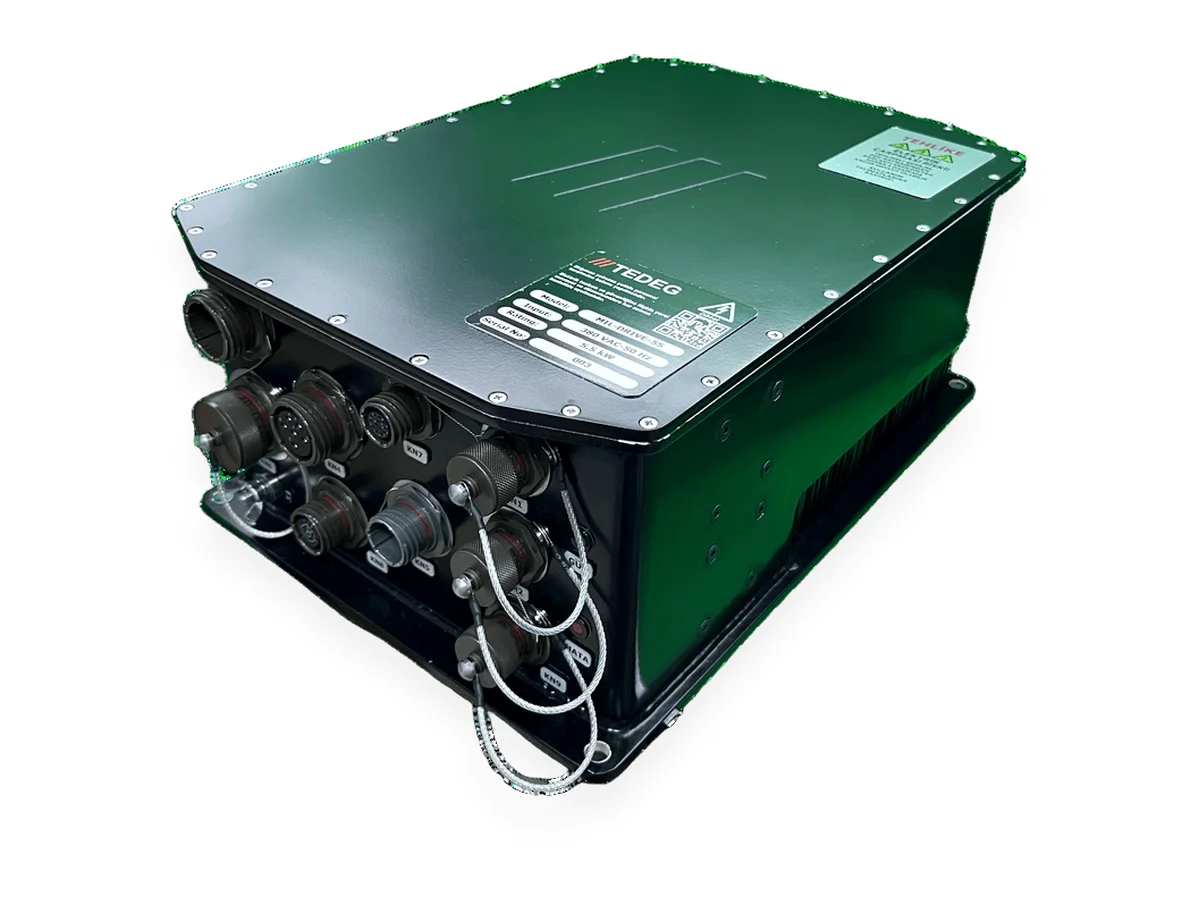
Mobile Air Defence Platform — Pedestal Motor Control & Radar Frequency Feed
A motor drive and a frequency converter sourced from separate foreign suppliers were replaced by a matched TEDEG pair, designed together so that neither interferes with the other.
Read case study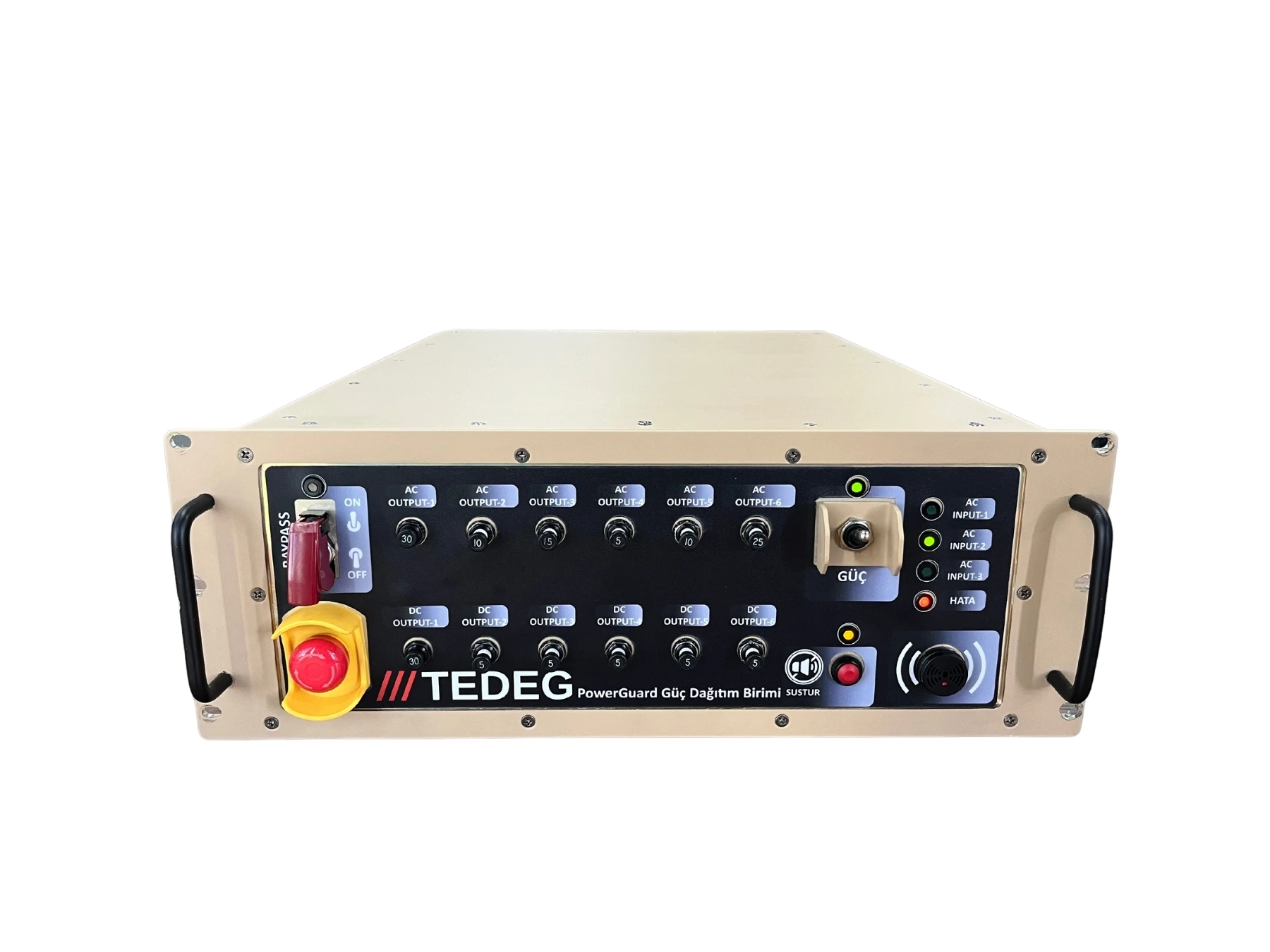
Land Platforms · 2024
Tactical Truck Power Architecture Modernisation
An ageing PDU that could no longer keep pace with growing mission loads was replaced by a remotely monitored power distribution architecture built on the PDU-RT5002 and designed to MIL-STD requirements.
Read case study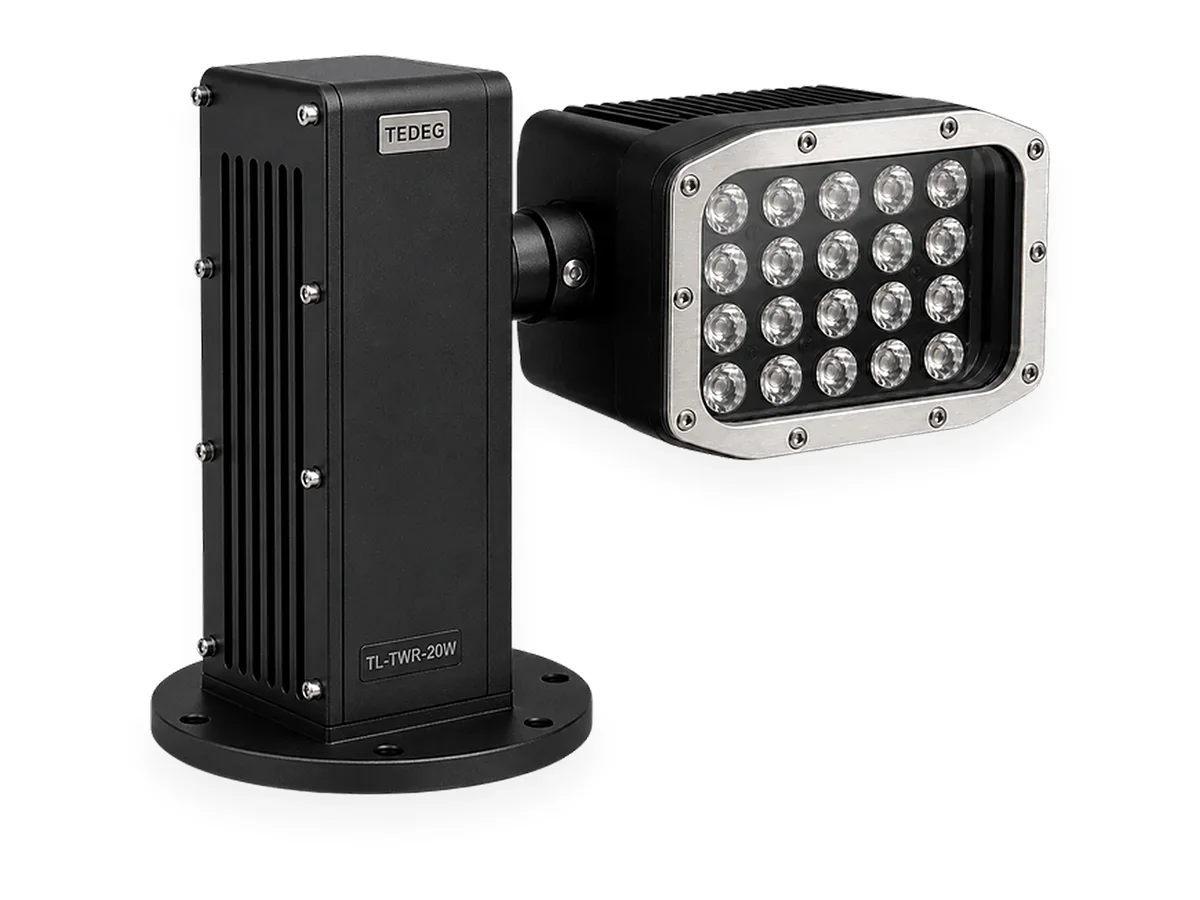
Lighting Systems · 2024
Supplier transitionMilitary Spotlight System — A Domestic LED Solution to Recurring Field Failures
A competitor's spotlight that kept failing in the field was replaced by a domestic design with a sealed enclosure, a reworked motion system and LED electronics.
Read case study