
Military Land Vehicles
Military Truck — Two Batteries, Alternator and Charger on One 400 A Busbar
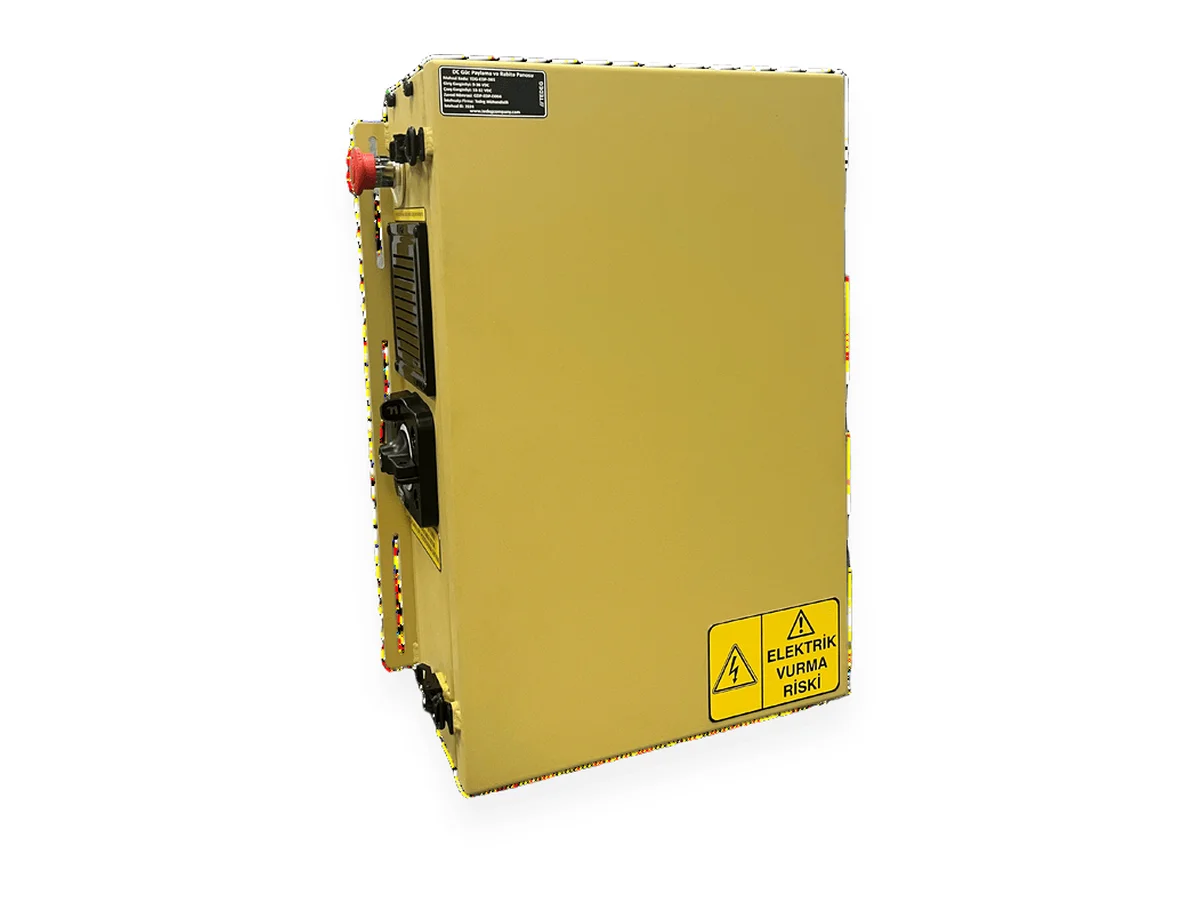
In place of scattered fuse boxes and battery wiring that changed from truck to truck on dual-battery 6×6 military trucks, a sealed distribution panel that brings four DC sources onto one busbar: the TDG-EDP-D0X.
- Platform
- 6×6 military truck — dual battery bank, 28 VDC mission loads, 12 VDC auxiliary source
- Customer
- Leading Turkish Military Truck Body Builder
- Sector
- Land · military trucks
- Year
- 2024
Customer & Context
A leading Turkish military truck body builder fits mission equipment, cabins and shelter bodies to 6×6 military trucks. The electrical system on these vehicles was fed from four sources: two battery banks, the alternator and a battery charger. Most of the mission loads run on 28 VDC, while some body equipment drew its power from an auxiliary 12 VDC source.
The builder's quality and maintenance teams reported the same picture across delivered vehicles: fuse boxes and busbar points were spread over different parts of the truck, the battery wiring layout changed from one vehicle to the next, and one of the distribution points sat at a mounting position exposed to rain. Based on these field reports, the builder prepared a technical requirements document and sent it to TEDEG Defence. The request was clear: a single DC distribution panel that brings the four sources onto one busbar, with adjustable thresholds for connecting and disconnecting the batteries, a 12 VDC to 28 VDC conversion stage, and an enclosure that stands up to rain.
Challenge
The builder's requirements document and field reports identified these problems with the existing distribution layout:
- Scattered distribution: fuse boxes and busbar points were in different areas of the vehicle. During a fault, a technician had to open several points just to find out where a given line was fed from.
- Battery layout varying by vehicle: the battery connections were not built the same way on every truck, so the maintenance instructions and harness drawings did not match each vehicle exactly.
- Undefined thresholds: nothing defined when the batteries should be connected to the system or when they should drop out as voltage fell. When a vehicle stood for a long time, the batteries kept draining through the loads.
- No emergency cut-off: there was no emergency stop arrangement to cut distribution in one action during maintenance or a short circuit.
- Rain-exposed mounting: one of the distribution points was in a location exposed to rain and wash water, and the existing boxes had not been tested for that condition.
- No bridge between 12 VDC and 28 VDC: power from the auxiliary 12 VDC source could not be passed to the 28 VDC mission loads.
The builder wanted these problems solved in one panel rather than with separate patches.
TEDEG Solution
TEDEG Defence designed the TDG-EDP-D0X DC Power Distribution Unit against the requirements document and delivered it to the body builder. Busbars, fuses, contactors and voltage conversion share one aluminium enclosure, so the vehicle now has a single point for connection, protection and switching.
Four Sources, One 400 A Busbar
Battery 1, Battery 2, the alternator and the battery charger come together on positive and negative 400 A busbars. The lines feeding the mission loads are protected by MIDI-type fuses rated 30, 60 and 100 A @28 VDC. The panel holds three spare MIDI fuses in each of the 30, 60, 100 and 200 A ratings, so a fuse change in the field does not depend on a separate stock. Wiring uses AWG military cables sized to the power requirement, and cable entries use IP67 PG glands matched to cable diameter. The built-in 12 VDC → 28 VDC, 500 W converter carries power from the auxiliary 12 VDC source onto the 28 VDC lines; it starts above 12.5 VDC and stops below 12 VDC.
Adjustable Thresholds and Emergency Stop
The input and load contactors decide when the batteries are connected to the system and when they are disconnected. The input contactor closes above 21.5 VDC and opens below 21 VDC, disconnecting the batteries and the load contactor from the system. The control unit's switch-on voltages (11.5 VDC or 21 VDC) are fixed; every other threshold can be adjusted. That allowed the same panel to be adapted to the body builder's vehicle architectures with different battery and load layouts. A bypass switch inside the panel overrides the threshold values when needed. Pressing the emergency stop disconnects both the input and the load contactor, and the battery isolator gives a separate cut-off point for taking the batteries out of circuit during maintenance.
Rain-Tight Enclosure and Staged Cooling
The enclosure is made from 5000-series aluminium and is watertight to the 30-minute rain test of MIL-STD-810G Method 506.5 Procedure I, so the rain-exposed mounting point needs no separate protective box. The cover has an EMI gasket and torque hinges. Two thermostat-controlled axial fans come in gradually above 30 °C while the input contactor and converter are active, run at 100% at 45 °C and stop below 25 °C. The unit operates from −32 °C to +52 °C, weighs 14 ± 2 kg and measures 421 × 632 × 190 mm overall. The enclosure is delivered in one of four military paint options to match the vehicle.
Outcome
On the builder's 6×6 military trucks, the four DC sources were brought together in a single sealed panel.
- Connection, protection and switching are managed from one point; the scattered fuse boxes and busbar points are gone.
- On every vehicle the batteries connect to the same panel in the same layout.
- Adjustable thresholds let the panel be adapted to different vehicle electrical architectures.
- The emergency stop and battery isolator cut distribution in one action.
- The auxiliary 12 VDC source also feeds the 28 VDC lines through the built-in 500 W converter.
- Fuse changes in the field are made from the spares held inside the panel.
Technical Scope
Values are taken from each product's own technical data; full specifications are on the product page.
- Inputs
- 4 (Battery 1, Battery 2, Alternator, Battery charger)
- Busbar
- (+) and (−) 400 A
- Output fuses
- MIDI type, 30 / 60 / 100 A @28 VDC
- DC-DC converter
- 12 VDC → 28 VDC, 500 W
- Sealing
- MIL-STD-810G, Method 506.5, Procedure I
- Cable entries
- IP67 PG cable glands
- Operating voltage
- 12 V / 24 V DC
- Maximum current
- Up to 500 A
- Time control
- Alternator shut-off 8 s after excite drops
- Protection technology
- Internal diode
- Ingress protection
- IP67
- Operating temperature
- -40 °C to +120 °C
- Input voltage
- 400 VAC
- Output voltage
- 400 VAC / 230 VAC
- Remote on/off signal
- 28 VDC / 230 VAC
- Output protection
- Individual breaker per output
- Phase indicator lamps
- 3
- Operating temperature
- −32 °C to +50 °C
More case studies
Land Platforms · 2024
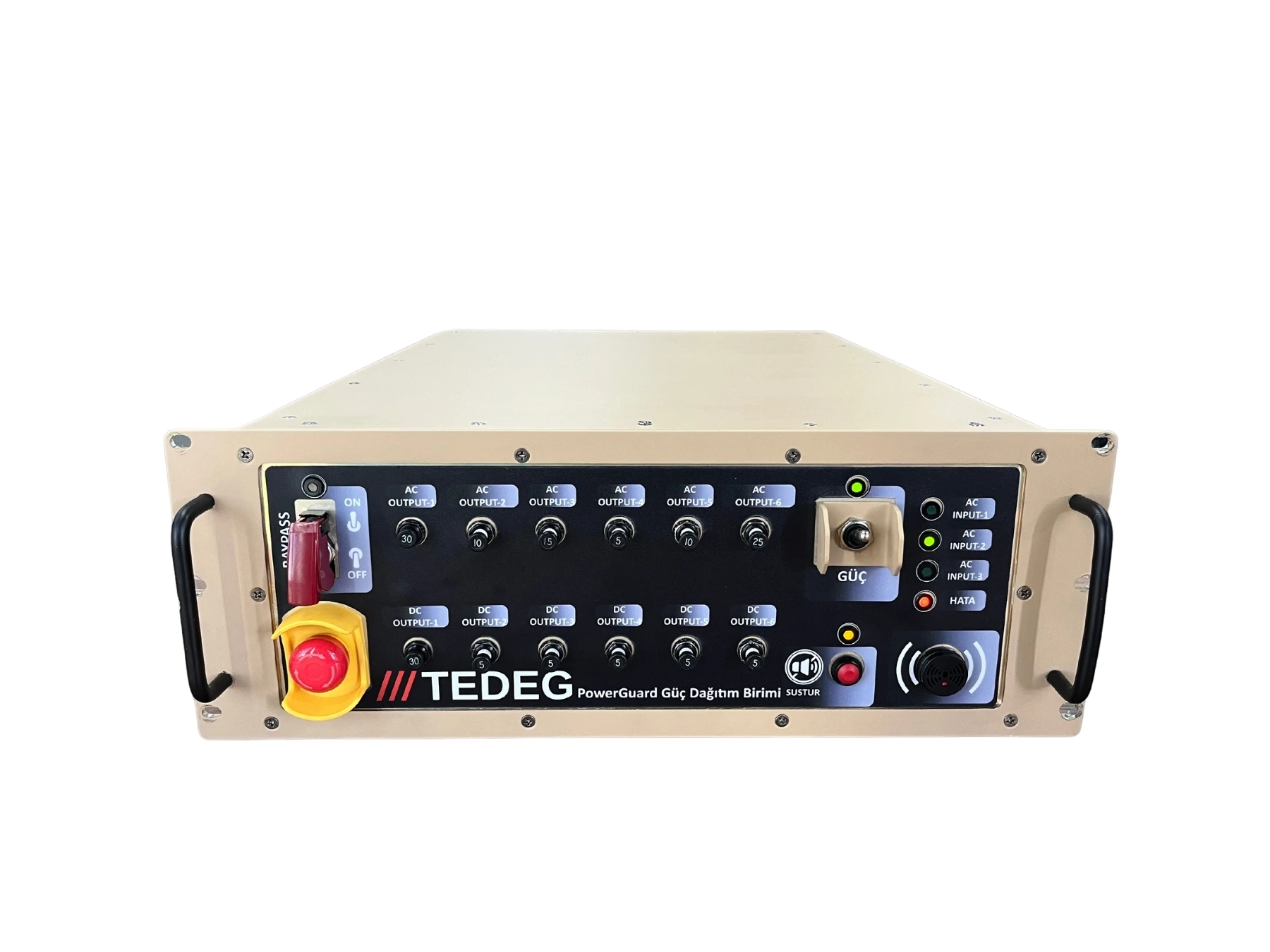
Tactical Truck Power Architecture Modernisation
An ageing PDU that could no longer keep pace with growing mission loads was replaced by a remotely monitored power distribution architecture built on the PDU-RT5002 and designed to MIL-STD requirements.
Read case study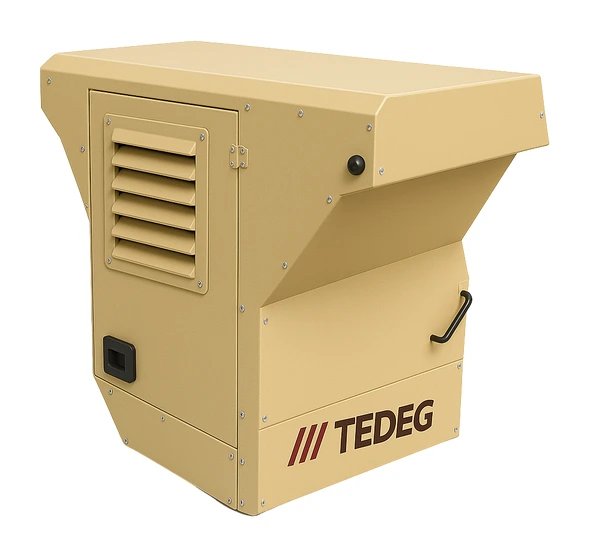
Armoured Land Platforms · 2025
Main Battle Tank — Main Engine Off, Systems On During Silent Watch
For a tank modernisation programme that ran the main engine at idle on watch just to power weapon systems, communications and climate control, a 28 VDC / 10 kW APU integrated into the vehicle: the PowerGuard YGG-DS11.
Read case study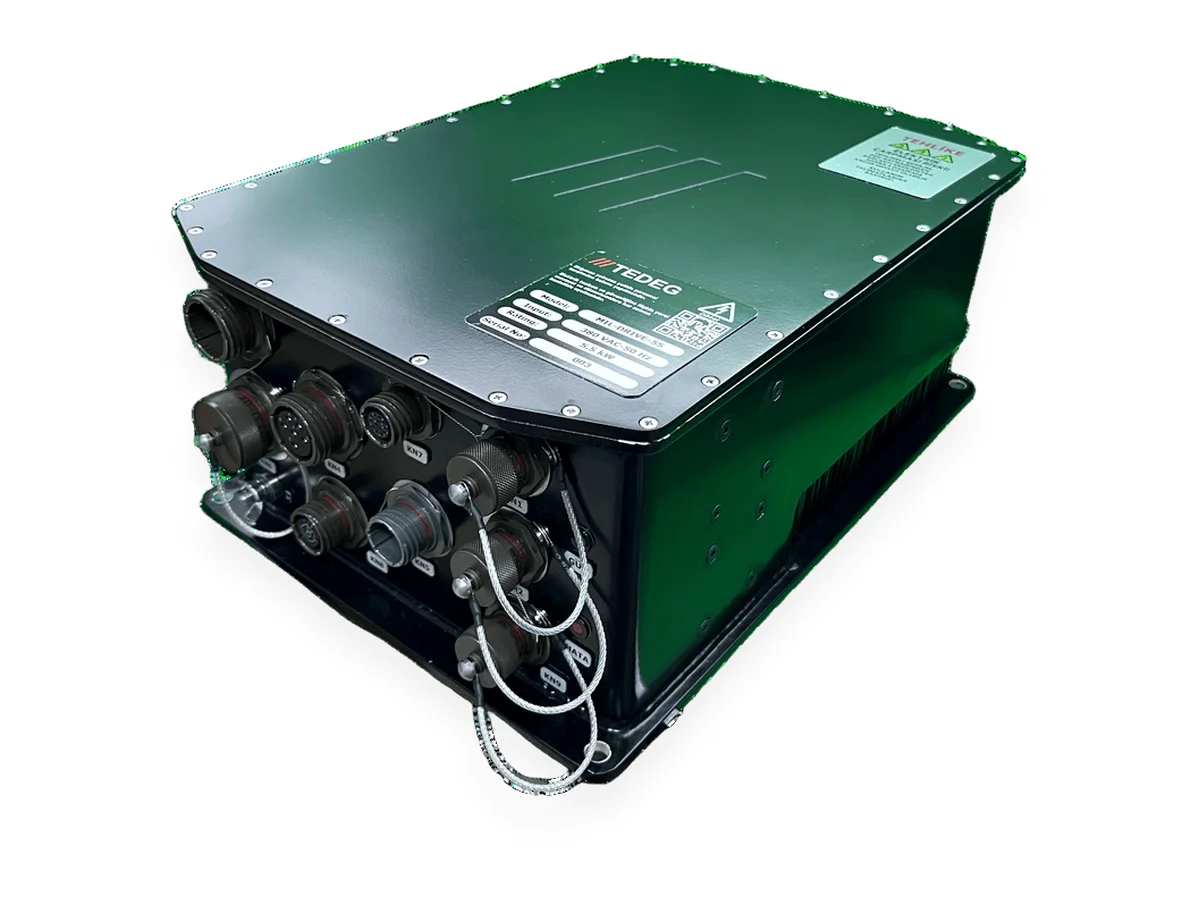
Air Defence · 2025
Mobile Air Defence Platform — Pedestal Motor Control & Radar Frequency Feed
A motor drive and a frequency converter sourced from separate foreign suppliers were replaced by a matched TEDEG pair, designed together so that neither interferes with the other.
Read case study