
Land Platforms
Armoured Vehicle Family — One Smoke Launcher Architecture, 4 to 16 Launchers
Instead of a separate imported smoke system for every vehicle variant, one domestic system whose launcher count and coverage are chosen per variant and which joins the vehicle data bus over J1939.
- Platform
- Wheeled armoured vehicle family — turreted and turretless variants
- Customer
- Leading Turkish Armoured Vehicle Manufacturer
- Sector
- Land · armoured vehicles
- Year
- 2025
Customer & Context
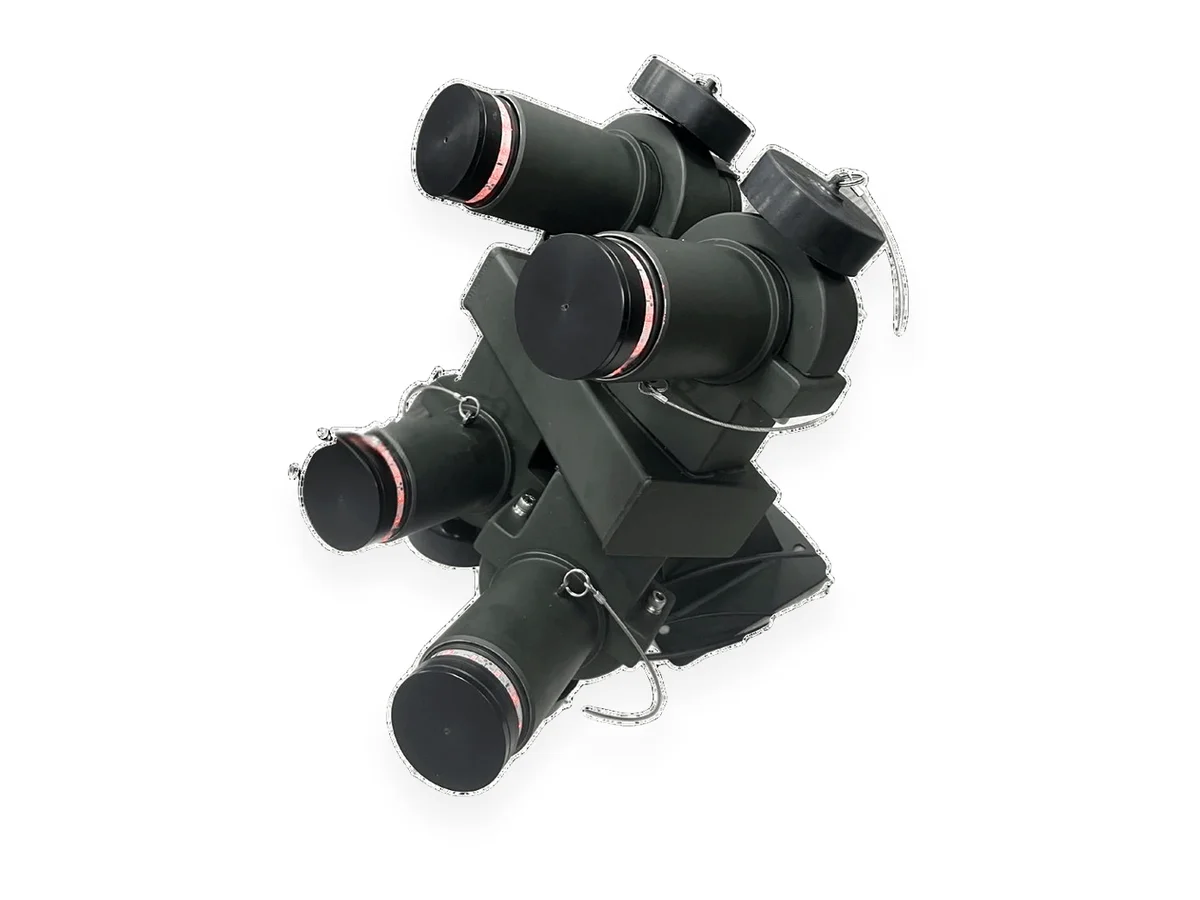
A leading Turkish armoured vehicle manufacturer wanted a common smoke grenade launcher system across every variant of its wheeled armoured vehicle family. The family runs from a light turretless variant to a fully protected variant with a weapon turret, and each needs a different smoke screen: a directional screen over the front sector is enough for the light variants, while the turreted variants call for protection all the way around the vehicle.
Until then, each configuration used its own imported system. As it renewed the family's electronic architecture, the manufacturer required the smoke launcher, like every other subsystem, to join the vehicle CAN data bus and to suit the conditions of the 28 VDC military vehicle power network. It drew up a technical requirements document for a domestic system with selectable launcher count and coverage, running on a single control architecture, and handed it to TEDEG Defence.
Challenge
As the vehicle family grew, the existing set-up added work on the production line and in the field. While the requirements document was being prepared, the manufacturer's engineering, quality and logistics teams pointed to these issues:
- A separate system per variant: each vehicle configuration needed its own launcher layout, its own control unit and its own cable harness. Several part families sat in stores, and maintenance crews followed a different procedure for each system.
- Control cut off from the vehicle electronics: the imported control unit did not connect to the vehicle CAN bus. Smoke launcher status could not be seen from the mission systems, and the unit needed its own wiring inside the vehicle.
- EMI compatibility: firing circuits sharing a hull with turret electronics and communications equipment were expected to meet MIL-STD-461G, and the imported system left open questions when that had to be verified against the platform's new electronic architecture.
- Supply conditions: the current drawn at the moment of firing and transients on the vehicle supply meant the system had to be designed around a military vehicle power network.
- Supply-chain dependence: lead times for spares and new orders followed the foreign supplier's schedule, and production planning had to absorb that uncertainty.
The manufacturer was looking for one system that covered every variant and fitted the vehicle's own electronic architecture.
TEDEG Solution
Working from the requirements document, TEDEG Defence configured the TDG-76-SGL 76 mm Smoke Grenade Launcher System for the vehicle family. The aim was not to design a separate system for each variant, but to scale the same launcher and the same control architecture to what each variant needs.
A Launcher Layout That Scales with the Variant
The system is fitted with a minimum of 4 and a maximum of 16 launchers per platform, and the smoke screen is configured for 90°, 120°, 180° or 360° coverage. Light variants received a 4-launcher directional screen, while turreted variants received full 360° coverage with 16 launchers; for the variants in between, the number and position of launchers were set to suit the vehicle geometry. The launcher type and the 76 mm calibre stayed the same across the whole family.
One Remote Control Unit and J1939 Integration
Every variant uses the same remote control unit. Its front panel carries separate fire buttons for the left group, the right group and all ammunition, an arm/safe mode select switch with a status LED, and an indicator showing whether ammunition is loaded. The operator can fire launchers individually, in groups or all at once, and switch between manual and automatic modes. The system communicates with the vehicle’s other electronic systems on the same data bus over CANBUS (J1939), so the control unit no longer needs a communication line of its own.
Vehicle Power, EMI and Field Durability
The system runs on a 28 VDC nominal (16–32 VDC) supply. MIL-STD-1275E was the reference for the characteristics of the 28 VDC military vehicle power bus, MIL-STD-461G for electromagnetic compatibility and MIL-STD-810G for environmental resistance. The zinc-nickel coating, the −40 °C … +70 °C operating range and the 95% humidity rating were decisive for a vehicle family that will serve in very different climates; MTBF is at least 250,000 hours. Delivery included the cleaning and maintenance kit: a wire brush, a hex key set, an ammunition test simulator, snap ring pliers and a cleaning brush.
Outcome
The smoke launcher subsystem is now a single product across every variant of the vehicle family. The only difference between variants is the number and position of the launchers.
- One launcher type and one control unit cover every configuration, from the turretless to the turreted variant.
- The smoke launcher works on the same J1939 data bus as the turret electronics and other mission systems, and its status can be monitored from the vehicle electronics.
- With the maintenance kit and ammunition test simulator, launcher cleaning and routine checks can be done in the field.
- With design and production in Türkiye, spares and new orders no longer depend on a foreign supplier's schedule.
Technical Scope
Values are taken from each product's own technical data; full specifications are on the product page.
- Calibre
- 76 mm
- Effective range
- 100–200 m (depends on ammunition type)
- Length
- 235.5 mm
- Weight
- 2.3 kg ± 0.5 kg
- Power supply
- 28 VDC nominal (16–32 VDC)
- Communication
- CANBUS (J1939)
StandardsMIL-STD-1275EMIL-STD-461GMIL-STD-810GView product: 76 mm Smoke Grenade Launcher System TDG-76-SGL
More case studies
Lighting Systems · 2024
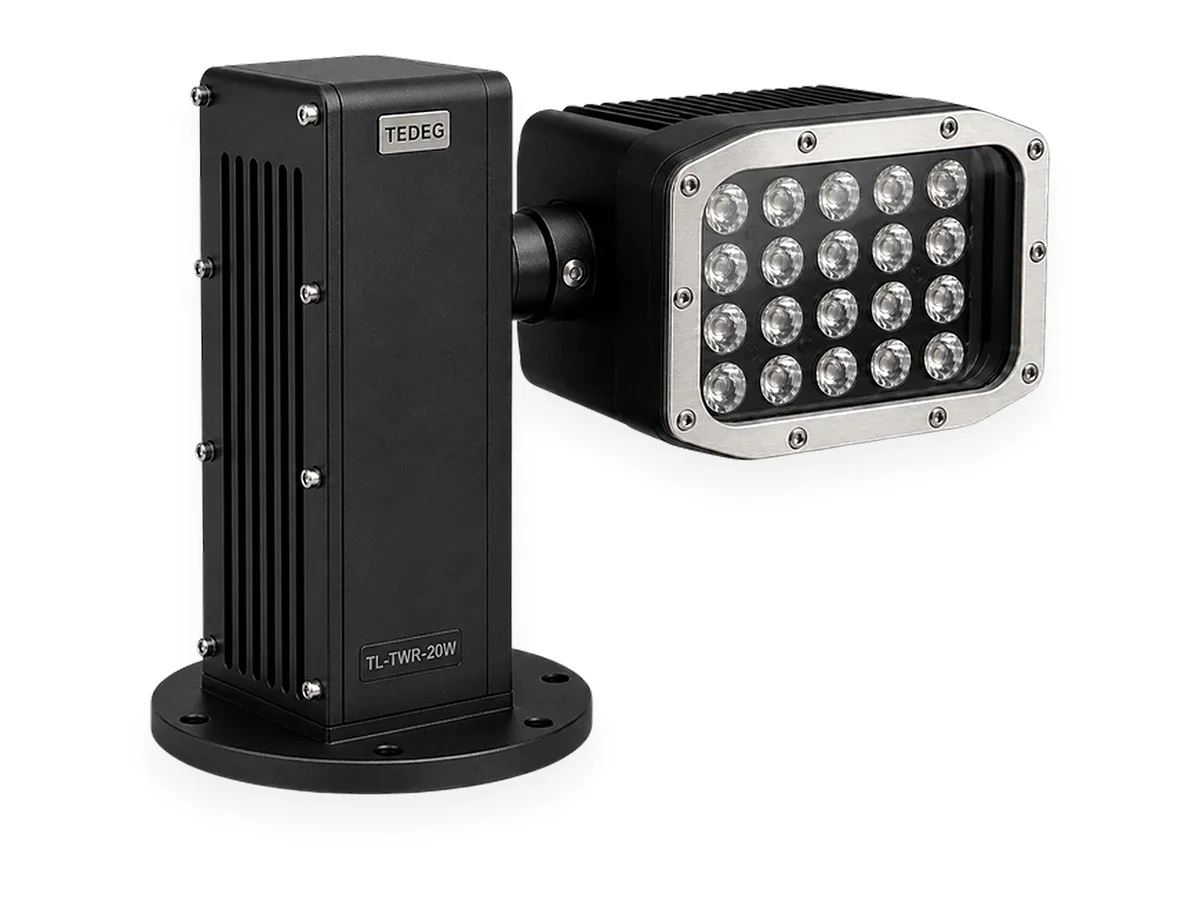
Supplier transitionMilitary Spotlight System — A Domestic LED Solution to Recurring Field Failures
A competitor's spotlight that kept failing in the field was replaced by a domestic design with a sealed enclosure, a reworked motion system and LED electronics.
Read case study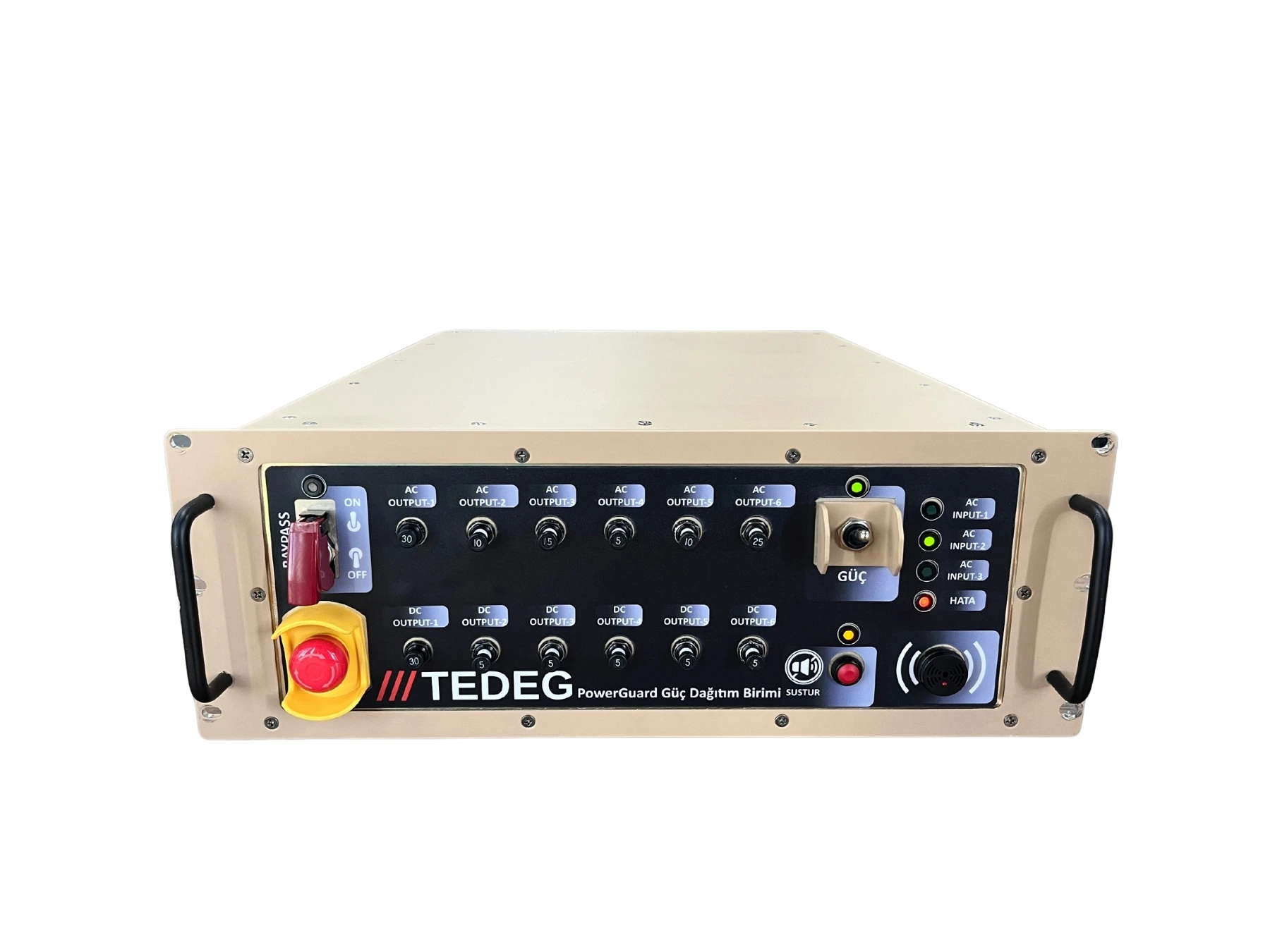
Land Platforms · 2024
Tactical Truck Power Architecture Modernisation
An ageing PDU that could no longer keep pace with growing mission loads was replaced by a remotely monitored power distribution architecture built on the PDU-RT5002 and designed to MIL-STD requirements.
Read case study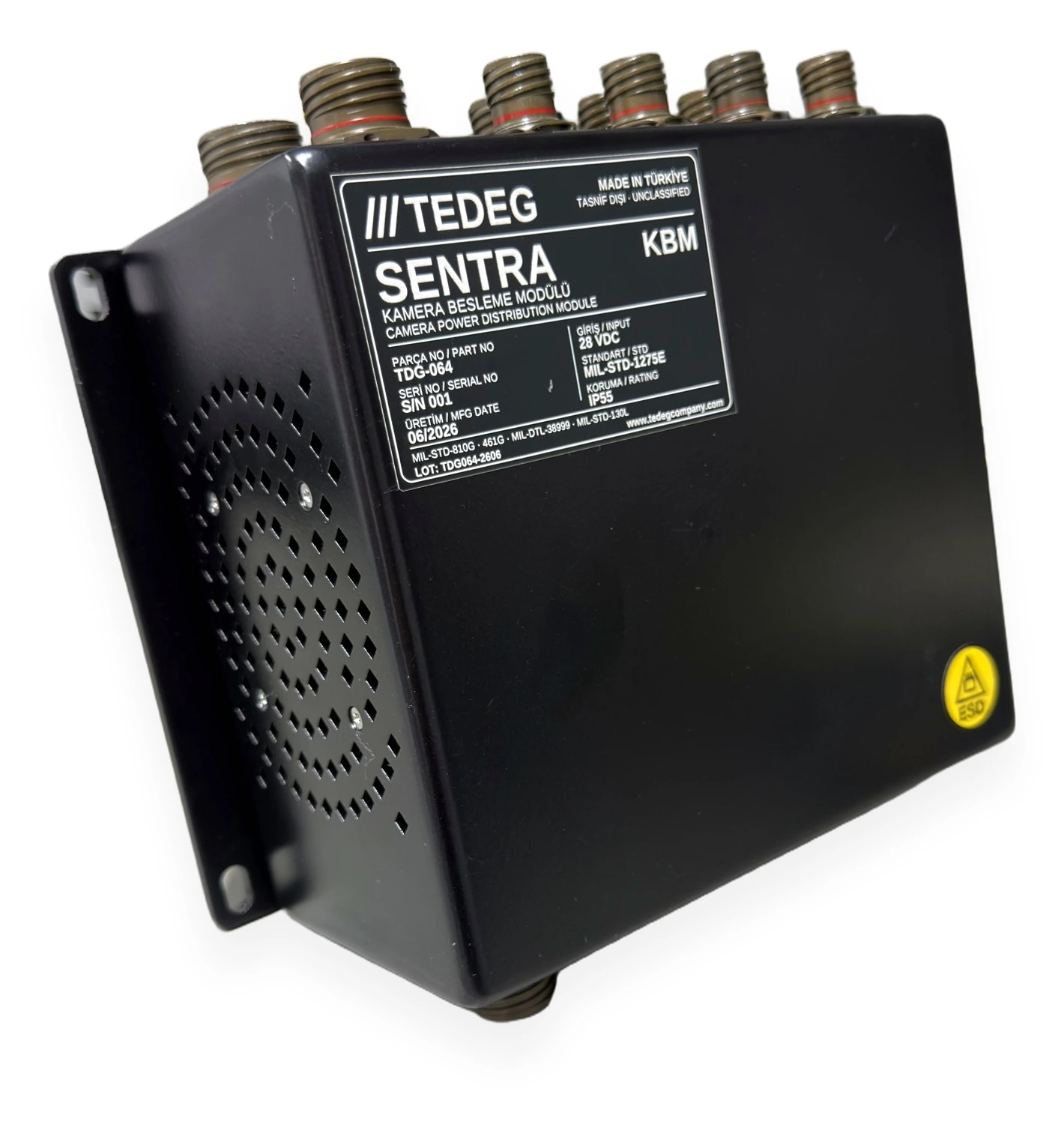
Tactical Wheeled Vehicles · 2026
Tactical Vehicle 360° Camera Suite — From 11 Separate Power Supplies to One Power Module
For a situational awareness suite that fed its cameras, mission computer, operator display and seat module from separate supplies, the SENTRA KBM camera power distribution module, built around the customer’s Technical Requirements Document and ICD.
Read case study